Making the complex simple to understand is the goal of science, any discipline really. That goal often requires compromises where one portion of the overall concept is attempted to be explained by analogy to a commonly understood concept.
Physics uses many basic analogies, Carnot Engines, Equilibrium and adiabatic processes, as foundations even though none may ever exist. They are convenient models of perfection for comparison.
In atmospheric physics, the dry adiabatic lapse rate, where temperature changes with pressure with no gain or loss to the system, is an example of an equilibrium state with prefect energy transfer, a Carnot engine. Perfection does not exist in nature, it can only be approached.
The dry adiabatic lapse rate in Earth’s atmosphere is the combination of the surface temperature, the composition of the gases in the atmosphere, the molecular weight of the gases, the thermal properties of the gases, the gravitational constant and radiant energy interaction with the changing density and composition of gases compressed by gravity. A rather complicated process we on the surface take for granted.
If you are in favor of electrical analogies, the adiabatic lapse rate is an inductive load with a steady state current. Small changes in current are dampen by properties of the inductor and rapid change produces huge changes in the potential energy or electromotive force realized across the inductive load.
The electromotive force is provided not by a single source, but several, a conductive battery, a latent battery, a gravitational battery and a radiant battery are the more significant power sources.
The radiant battery is both solar and black body, with cells poorly designed for the task, but adequate in steady sate conditions. In steady state, the potential can be determined at different points in the atmospheric circuitry and the total accurately calculated from one connection to the next. i.e. if we know the voltage and current into a black box and the current and voltage out of that black box, we can determine to a point what circuitry is in the box. With more than one condition, we can better describe the inner circuitry.
The currents are in parallel from the electromotive sources at the surface, Fc, Fl, Fr, and F?, for conductive, latent, radiant and the question mark is ever present uncertainty. Each of the batteries providing these currents or fluxes, have cells, Fra, Frb, Frc …Frn, for example. The subscript letters can be individual wavelengths, associated energies, or combinations of wavelengths and energies that impact portions of the atmosphere.
This is the simplicity of the Kimoto equation, dF/dT=4(aFc+bFl+cFr+…F?)/T, which is derived from Stefan’s equation, Fi/Fo=alpha(Ti)^4/alpha(To)^4, or the change in energy flux of a body is proportional to the change in temperature of the body at initial temperature T. All the coefficients, a,b,..n, represent changes to the flux through the atmospheric inductor or impedance.
Proper use of this simple equation requires, proper consideration of the flux values and ever present uncertainty.
Showing posts with label Climate Puzzles. Show all posts
Showing posts with label Climate Puzzles. Show all posts
Monday, October 24, 2011

Saturday, October 22, 2011
Carbon Dioxide- A Not so Well Mixed Gas
In an atmosphere without significant water, carbon dioxide would be a very well mixed gas. Earth’s atmosphere has water in all phases and at different concentrations. This greatly complicates solutions for the changes in relative conductive and radiant properties of the atmosphere.
Carbon dioxide rains out in areas with high humidity and precipitation. The rate of diffusion varies with temperature and pressure from well mixed gas ratio to regions where CO2 is depleted via rain out. Using global averages provides good results, but for regional evaluation, the changes and rates of change in CO2 must be considered.
The Antarctic with its low precipitation rate and very cold climate offers a baseline for CO2 change in the overall atmosphere. It is in the Antarctic where the impact of CO2 on conductive flux is most evident and the impact on radiant flux more over estimated. The blend of underestimated conductive change and over-estimated radiant change are uniquely Antarctic.
While theories are plentiful, the reality is hard to determine. Sublimation cannot be completely ruled out on a microscopic scale, due to conditions available between the Antarctic Tropopause and the surface temperatures and pressures.
The exact psychometric relationships will require a great deal of further study. However, as tropospheric temperatures can approach -95C and the temperature and pressures of the Antarctic can be less than -60C at 1020mb, microscopic sublimation is possible provided a deposition substrate of a few atoms can be found. Microscopic carbonic snow, an interesting theory for idle moments.
Carbon dioxide concentration lags between Antarctic and Mona Loa would be much more easily analyzed.'
With a reliable estimate of the changes in carbon dioxide change, the Poisson Equation can be adjusted to the specified thermal properties of the atmosphere regionally, adding greatly to the utility of the Kimoto equation.
Carbon dioxide rains out in areas with high humidity and precipitation. The rate of diffusion varies with temperature and pressure from well mixed gas ratio to regions where CO2 is depleted via rain out. Using global averages provides good results, but for regional evaluation, the changes and rates of change in CO2 must be considered.
The Antarctic with its low precipitation rate and very cold climate offers a baseline for CO2 change in the overall atmosphere. It is in the Antarctic where the impact of CO2 on conductive flux is most evident and the impact on radiant flux more over estimated. The blend of underestimated conductive change and over-estimated radiant change are uniquely Antarctic.
While theories are plentiful, the reality is hard to determine. Sublimation cannot be completely ruled out on a microscopic scale, due to conditions available between the Antarctic Tropopause and the surface temperatures and pressures.
The exact psychometric relationships will require a great deal of further study. However, as tropospheric temperatures can approach -95C and the temperature and pressures of the Antarctic can be less than -60C at 1020mb, microscopic sublimation is possible provided a deposition substrate of a few atoms can be found. Microscopic carbonic snow, an interesting theory for idle moments.
Carbon dioxide concentration lags between Antarctic and Mona Loa would be much more easily analyzed.'
With a reliable estimate of the changes in carbon dioxide change, the Poisson Equation can be adjusted to the specified thermal properties of the atmosphere regionally, adding greatly to the utility of the Kimoto equation.
Thursday, October 20, 2011
Another Shot at Explaining the Atmospheric Effect
I found a dedication quote in response to this question:
Dallas: "Do you actually believe that down welling long wave radiation is nearly twice solar?
"Yes, I do, because that’s what the measurements show and that’s what’s required to close the energy balance. See SURFRAD data, for example ( http://www.srrb.noaa.gov/surfrad/aod/aodpick.html )."
That's what's required? A perfect display of biased perception. The reason I am stating what should be obvious to inquisitive minds.
Carbon dioxide in the atmosphere both warms and cools. This is nothing new. The fear has been it will warm more than cool. At times it will. The relationship is complex.
While I would prefer to move on to other interests, I am asked why and how I may know this. The truth is the Kimoto equation is a very valuable tool for quickly testing relationships between radiant, conductive and latent thermal fluxes in the atmosphere. Simply, it works. How well, I am still working on that.
With the equation dF/dT=4(0.33Fc+1.09Fl+0.825Fr)/T, where Fc is the conductive, Fl is the latent and Fr is the radiant thermal fluxes from the surface at 288K, it is easy to use the standard values available from NASA to do “what ifs” to your heart’s content. That and a basic understanding of thermodynamics, is all it takes to see what is happening.
The basic thermodynamics should be obvious. If surface warming is due to Fr being restricted, the other two fluxes will increase as temperature increases. Water vapor increase is well known, but the increase in conduction seems to have been over looked. It will increase. That is a cooling effect.
Perhaps, the confusion is in the values, 0.33, 1.09 and 0.825? These are the values determined from the steady state condition of the Earth at 288K and 390Wm-2 associated with the 288K by the relationship of a black body’s radiant energy via Stefan’s Law. If the steady state values, 24Wm-2 for conductive, 79Wm-2 Latent and 390-24-79=287 radiant are equal to 0.33Fc, 1.09Fl and 0.825Fr are correct, be my guest and check my work, then you can determine roughly what and how much each value will change. It is easier to see if you consider what would change.
Fr, is the total of all surface radiation after allowing for conductive and latent cooling. Fr, includes both the energy absorbed by the atmosphere with greenhouse gases, and the energy eventually lost directly to space through the atmospheric window, and the matching up welling energy for the down welling atmospheric effect, or greenhouse effect. The radiant energy absorbed by the atmosphere is approximately 80 Wm-2 that can be determined by looking at the NASA Earth Energy Budget drawing where they have clearly shown how incoming solar energy is matched by outgoing combined conductive, latent and radiant flux. The remainder, 287-80=207 is the approximate greenhouse effect. Depending on which source drawing you use, NASA or the Keihl & Trenberth drawings, the 207 varies to approximately 220 Wm-2. Small change, but the values are approximate.
The coefficients are "Effective” values in that they, effect the atmospheric absorption. The 207 to 220 is a balancing force that would vary only if the effects of the three thermal fluxes increase the surface temperature. Then the 207-220 would increase to balance the atmospheric effect.
If you look at the top of the atmosphere, you will see that the solar absorbed by the atmosphere and clouds plus the solar absorbed by the surface is roughly 240Wm-2, The total absorbed by the atmosphere OLR from the surface and incoming solar equals roughly 240Wm-2 and the total leaving from the atmosphere is equal to roughly 240Wm-2. That is the energy balance. The 207 to 220 is the value of the greenhouse effect and is internal to the system.
This value is different from the classic top of the atmosphere value of 390-240=160Wm-2 sometimes noted as 155Wm-2 depending on the initial values used. That flux value corresponds to the 33C warmer the Earth is considered to be because of the combined atmospheric effects, conductive, latent and radiant energy transferred to the atmosphere from the surface to become the potential energy holding the atmospheric gases above the surface in opposition to the gravity attempting to pull them back to the surface. It is higher because the efficiency of the work done and the opacity of the atmosphere varies with pressure.
Everything balances, which is the desired result if you are attempting an Energy Balance of the Earth. The surface, the atmosphere, the top of the atmosphere and the potential energy of the atmosphere, the atmospheric effect, all of these are considered with these values. There are of course small differences due to rounding and uncertainty, but everything is in reasonable balance.
If there is more warming of the atmosphere, the greenhouse effect is getting warmer, the coefficients of surface fluxes, Fc, Fl and Fr increase. That would add to the potential energy of the atmosphere and have to be balanced by an increase of the 207-220 Wm-2.
The hard part for some to grasp, is that increased atmospheric absorption reduces the potential energy difference between the surface to the atmosphere, reducing heat transfer to the atmosphere, with some exceptions, causing interesting feedbacks. These are the rather complex feedbacks to the warming surface. Clouds both absorb more from the surface and reflect more solar from above. CO2 above the clouds retain more heat which warms the cloud tops first, which tends to increase convection at the upper troposphere. More CO2 improves the conductivity which allows more efficient heat transfer from the surface to the lower troposphere. The impacts of these feedbacks vary from region to region.
The tropics are virtually saturated for all three heat fluxes. More radiant warming above the clouds increases convection which increases latent cooling, winds increase and precipitation tends to cool the surface, offsetting warming. The southern pole is temperature limited due to angle of inclination, increased conduction balances increased radiant forcing resulting in little surface temperature change. It is in the Northern polar and subtropical region where radiant forcing impacts the surface temperature the most.
Since increased CO2, impacts a relatively small portion of the radiant spectrum at the surface, the radiant energy flux in the atmospheric window to space increases, which does increase surface warming somewhat, but is limited by near saturation of the CO2 portion of the surface radiant window. Higher in the troposphere, the atmospheric window helps cool the cloud tops warmed by CO2 forcing.
It is a complex system with many more feedbacks than commonly discussed in the literature. The conductive impact and the downward opacity to increased infrared forcing are virtually ignored and crucial for understanding the atmospheric effects. Minimum Local Emissivity Variations are just being evaluated to improve the accuracy of satellite telemetry and surface down welling radiation monitoring plagued with inaccuracy.
Sometimes simple equations are much more valuable for analyzing a complex problem than millions of hours of computer modeling.
Now, try the equation and look out the window.
What? Need more information?
Then let us start at the beginning.
The Earth’s Virgin atmosphere.
If the Earth had no atmosphere, if it were just floating in space minding its own business, the surface temperature would be about 278 degrees K or about five degrees above zero on average. That is because the sun warms the Earth half the time with 340 Wm-2 of energy. If the Earth had snow on the surface that reflected a portion of this energy it would be colder as less solar energy would be absorbed.
So if 30% of the sunlight were reflected, the average temperature would be about 255K which is 18 degrees C below zero. The Earth though has an abundance of nitrogen and oxygen, gases that have a small but significant thermal coefficient 0f 0.025W/m-2.K at 20 degrees C and about 0.024W/m-2.K at -18 degrees C. So even at the colder temperature, the virgin Earth would have surface heat transferred to the atmosphere by conduction. We would have an atmosphere, even without greenhouse gases. Those interested may wish to read up on the ideal gas laws and visit the Engineering Toolbox dot com.
This poses a bit of a challenge for what the virgin albedo of the Earth would be, would the energy be reflected from the surface, the atmosphere or both? Both, is the obvious answer. Why, because nitrogen and oxygen scatter some electromagnetic radiation, absorb some and certain wavelengths cause chemical changes, like O2, oxygen, being split by ultraviolet light and recombining as O3, ozone. This is a little more complicated, but the Engineering Tool box has the information, which should be common knowledge for scientists involved in atmospheric physics.
In addition, the Earth has plenty of water which at the equator would not only be liquid, but evaporate, adding water vapor to the atmosphere. Even if the water vapor had no interaction with outgoing longwave radiation from the surface, it would still interact with incoming solar. The virgin Earth would have a Tropopause, or an inversion if atmospheric temperature cooled from below by the release of radiant energy from the water vapor and conductive energies dissipating to space and warmed from above by solar interaction with oxygen and ozone.
With part of the albedo or reflection of solar energy being in the virgin atmosphere, the surface temperature would be approximately 2 degrees C different, depending on the ratio of surface to atmospheric absorption. This is what a no greenhouse gas Earth atmosphere would be, not a rock in space with no atmosphere at all, a planet with a simple atmosphere that obeys the principals of physics.
The Surface-Atmosphere Solar Absorption Ratio
Without getting into too much detail, the ratio of the solar energy absorbed by the atmosphere versus the surface defines the atmospheric effect. This balance or ratio varies to control the surface temperature. Change the radiant energy forcing, throws that balance off requiring the Earth and Atmosphere to seek a new equilibrium state. This is “Enhanced” Greenhouse Effect aka Global Warming, aka Climate Change aka Climate disruption. Understanding starts with the natural ratio and how it will be changed.
Readers with some experience in thermodynamics will have noted that the description of the Virgin Atmosphere provides three main frames of reference, the surface, the Tropopause and the Top of the Atmosphere (TOA). Properly balanced from one frame of reference, all frames of reference can be described. That is a simple check to verify the accuracy of your solution, Thermo 101 stuff.
The Solar Ratio and Impact of Conductive Heat Transfer
The basic model of the Virgin Earth Atmosphere is very educational. Conductive heat transfer is responsible for most of the atmospheric effect, latent cooling balances the conductive heat transfer and generates indirectly the clouds that maintain the solar absorption ratio. A beautifully simple and elegant relationship. The Radiant component of heat transfer enhances the conductive/latent relationship, it does not dominate the relationship.
Of the 240Wm-2 of solar absorbed by the Earth system, approximately 175Wm-2 is absorbed by the surface and 65 Wm-2 is absorbed by the atmosphere. This is an important ratio, 0.37 approximately. If you are curious, you would notice that the ratio of conductive to latent surface flux is 24/79 or approximately 0.30. If you are rally curious you would investigate the sensible portion of latent cooling, combine that with the conductive flux which is a sensible heat transfer, and find that( 24+5)/74 = 0.39. The surface response attempts to balance the solar impact. How these two ratios vary with respect to each other would determine if the surface is warming or cooling, GHGs enhances this relationship. The values used are approximations, but accurately calculated, the relationship would hold true.
So how does CO2 enhance the atmospheric effect?
At the surface, CO2 is a more efficient conductor of thermal energy both as a radiant absorber and as a conductive gas. Co2 readily absorbs surface thermal energy and transfers that energy to the nitrogen and oxygen in the atmosphere. It is the inefficient heat transfer of nitrogen and oxygen that causes the atmospheric effect. Thermo 101 again, if nitrogen and oxygen were perfect conductors of thermal energy there would be no energy transferred to the atmosphere. CO2 improves the conductivity, but does not make it perfect. Also, CO2 has a non-linear thermal conductivity, at 20C it is 0.09, nearly four times as conductive as N2 and O2 and at -20C it is 0.12, that is nearly a full order of magnitude greater than N2 and O2. Not an insignificant difference even at trace gas quantities. While this conductive impact is often assumed to be negligible, the Antarctic temperature response appears to believe otherwise.
Why is this the right way?
Starting at on a solid thermodynamic base allows for double checking all values. Then differences, even subtle differences can have meaning. Something missed, something new or some silly mistake that is confusing the issue. The conductive portion of the atmospheric effect is fairly constant with temperature with a stable humidity. Conductive flux is directly related to surface pressure, a solid base value that would be simple to determine globally. The latent energy is more variable, but extensively monitored by satellite and surface stations. With solid data for conductive and latent, radiant flux can be accurately calculated, far more accurately that direct measurement by satellite and ground stations. This provides a method to check methods, which is very important in a dynamic system.
So why are the satellites and surface stations measuring radiant down welling flux so far off?
Because temperature is related to radiant flux and neither are stable in the atmosphere, they are dynamic. Changes in humidity, and conductive efficiency impact already limited accuracy of direct measurement of thermal flux. The infrared pyrometers are designed to read temperatures by the approximation of the black body temperature of the object being tested. Atmospheric gases change temperature, density, composition continuously with the weather, why would their radiant energy flux be easy to measure? It is much easier to measure the average temperature of a layer of the atmosphere than it is to measure its energy flux emitted in all directions.
Where the satellites and ground stations are inaccurate is more informative than where they are accurate. Anomalies are the teachers.
Why am I so excited by the Flux measurement anomalies?
The anomalies appear to be indications of relativistic effects in the atmosphere! That is exciting if true. Effects typically only measurable under strict laboratory conditions may be apparent in the petaWatt per sec surface and atmosphere energy exchanges involving peta^n collisions and absorptions of photons as they travel from the surface to space. Something lost so far to science because of a silly erroneous assumption that data must fit preconceived notions. An interesting possibility.
Applications?
The most obvious is that the potential temperature of air at 600mb is a good indicator of changes in radiant forcing versus atmospheric response, aka feedbacks. With 600mb as a base value, the potential temperatures at varying altitudes would be a simple metric for modeling changes in thermal flux interaction at various atmospheric layers. Simple, IF, the base pressure has a physical relationship to Down Welling Long Wave Radiation.
Since the ratio of surface to atmospheric absorption of incoming solar irradiance is an indication of the atmospheric effect, comparisons of solar reconstructions with surface temperature reconstructions can be more informative. Now that it is known that the spectral bands of solar irradiance change more at ends of the spectrum than uniformly across the spectrum, the impact of the individual spectral changes on the atmosphere and surface, (read Oceans) can better explain the solar to temperature relationship.
Conductivity changes, though small, can be better studied to evaluate the Antarctic versus Arctic discrepancy, which is a valuable clue, not an instrumentation anomaly.
In short, the correct frame of reference can make a huge difference in understanding a complex system.
Dallas: "Do you actually believe that down welling long wave radiation is nearly twice solar?
"Yes, I do, because that’s what the measurements show and that’s what’s required to close the energy balance. See SURFRAD data, for example ( http://www.srrb.noaa.gov/surfrad/aod/aodpick.html )."
That's what's required? A perfect display of biased perception. The reason I am stating what should be obvious to inquisitive minds.
Carbon dioxide in the atmosphere both warms and cools. This is nothing new. The fear has been it will warm more than cool. At times it will. The relationship is complex.
While I would prefer to move on to other interests, I am asked why and how I may know this. The truth is the Kimoto equation is a very valuable tool for quickly testing relationships between radiant, conductive and latent thermal fluxes in the atmosphere. Simply, it works. How well, I am still working on that.
With the equation dF/dT=4(0.33Fc+1.09Fl+0.825Fr)/T, where Fc is the conductive, Fl is the latent and Fr is the radiant thermal fluxes from the surface at 288K, it is easy to use the standard values available from NASA to do “what ifs” to your heart’s content. That and a basic understanding of thermodynamics, is all it takes to see what is happening.
The basic thermodynamics should be obvious. If surface warming is due to Fr being restricted, the other two fluxes will increase as temperature increases. Water vapor increase is well known, but the increase in conduction seems to have been over looked. It will increase. That is a cooling effect.
Perhaps, the confusion is in the values, 0.33, 1.09 and 0.825? These are the values determined from the steady state condition of the Earth at 288K and 390Wm-2 associated with the 288K by the relationship of a black body’s radiant energy via Stefan’s Law. If the steady state values, 24Wm-2 for conductive, 79Wm-2 Latent and 390-24-79=287 radiant are equal to 0.33Fc, 1.09Fl and 0.825Fr are correct, be my guest and check my work, then you can determine roughly what and how much each value will change. It is easier to see if you consider what would change.
Fr, is the total of all surface radiation after allowing for conductive and latent cooling. Fr, includes both the energy absorbed by the atmosphere with greenhouse gases, and the energy eventually lost directly to space through the atmospheric window, and the matching up welling energy for the down welling atmospheric effect, or greenhouse effect. The radiant energy absorbed by the atmosphere is approximately 80 Wm-2 that can be determined by looking at the NASA Earth Energy Budget drawing where they have clearly shown how incoming solar energy is matched by outgoing combined conductive, latent and radiant flux. The remainder, 287-80=207 is the approximate greenhouse effect. Depending on which source drawing you use, NASA or the Keihl & Trenberth drawings, the 207 varies to approximately 220 Wm-2. Small change, but the values are approximate.
The coefficients are "Effective” values in that they, effect the atmospheric absorption. The 207 to 220 is a balancing force that would vary only if the effects of the three thermal fluxes increase the surface temperature. Then the 207-220 would increase to balance the atmospheric effect.
If you look at the top of the atmosphere, you will see that the solar absorbed by the atmosphere and clouds plus the solar absorbed by the surface is roughly 240Wm-2, The total absorbed by the atmosphere OLR from the surface and incoming solar equals roughly 240Wm-2 and the total leaving from the atmosphere is equal to roughly 240Wm-2. That is the energy balance. The 207 to 220 is the value of the greenhouse effect and is internal to the system.
This value is different from the classic top of the atmosphere value of 390-240=160Wm-2 sometimes noted as 155Wm-2 depending on the initial values used. That flux value corresponds to the 33C warmer the Earth is considered to be because of the combined atmospheric effects, conductive, latent and radiant energy transferred to the atmosphere from the surface to become the potential energy holding the atmospheric gases above the surface in opposition to the gravity attempting to pull them back to the surface. It is higher because the efficiency of the work done and the opacity of the atmosphere varies with pressure.
Everything balances, which is the desired result if you are attempting an Energy Balance of the Earth. The surface, the atmosphere, the top of the atmosphere and the potential energy of the atmosphere, the atmospheric effect, all of these are considered with these values. There are of course small differences due to rounding and uncertainty, but everything is in reasonable balance.
If there is more warming of the atmosphere, the greenhouse effect is getting warmer, the coefficients of surface fluxes, Fc, Fl and Fr increase. That would add to the potential energy of the atmosphere and have to be balanced by an increase of the 207-220 Wm-2.
The hard part for some to grasp, is that increased atmospheric absorption reduces the potential energy difference between the surface to the atmosphere, reducing heat transfer to the atmosphere, with some exceptions, causing interesting feedbacks. These are the rather complex feedbacks to the warming surface. Clouds both absorb more from the surface and reflect more solar from above. CO2 above the clouds retain more heat which warms the cloud tops first, which tends to increase convection at the upper troposphere. More CO2 improves the conductivity which allows more efficient heat transfer from the surface to the lower troposphere. The impacts of these feedbacks vary from region to region.
The tropics are virtually saturated for all three heat fluxes. More radiant warming above the clouds increases convection which increases latent cooling, winds increase and precipitation tends to cool the surface, offsetting warming. The southern pole is temperature limited due to angle of inclination, increased conduction balances increased radiant forcing resulting in little surface temperature change. It is in the Northern polar and subtropical region where radiant forcing impacts the surface temperature the most.
Since increased CO2, impacts a relatively small portion of the radiant spectrum at the surface, the radiant energy flux in the atmospheric window to space increases, which does increase surface warming somewhat, but is limited by near saturation of the CO2 portion of the surface radiant window. Higher in the troposphere, the atmospheric window helps cool the cloud tops warmed by CO2 forcing.
It is a complex system with many more feedbacks than commonly discussed in the literature. The conductive impact and the downward opacity to increased infrared forcing are virtually ignored and crucial for understanding the atmospheric effects. Minimum Local Emissivity Variations are just being evaluated to improve the accuracy of satellite telemetry and surface down welling radiation monitoring plagued with inaccuracy.
Sometimes simple equations are much more valuable for analyzing a complex problem than millions of hours of computer modeling.
Now, try the equation and look out the window.
What? Need more information?
Then let us start at the beginning.
The Earth’s Virgin atmosphere.
If the Earth had no atmosphere, if it were just floating in space minding its own business, the surface temperature would be about 278 degrees K or about five degrees above zero on average. That is because the sun warms the Earth half the time with 340 Wm-2 of energy. If the Earth had snow on the surface that reflected a portion of this energy it would be colder as less solar energy would be absorbed.
So if 30% of the sunlight were reflected, the average temperature would be about 255K which is 18 degrees C below zero. The Earth though has an abundance of nitrogen and oxygen, gases that have a small but significant thermal coefficient 0f 0.025W/m-2.K at 20 degrees C and about 0.024W/m-2.K at -18 degrees C. So even at the colder temperature, the virgin Earth would have surface heat transferred to the atmosphere by conduction. We would have an atmosphere, even without greenhouse gases. Those interested may wish to read up on the ideal gas laws and visit the Engineering Toolbox dot com.
This poses a bit of a challenge for what the virgin albedo of the Earth would be, would the energy be reflected from the surface, the atmosphere or both? Both, is the obvious answer. Why, because nitrogen and oxygen scatter some electromagnetic radiation, absorb some and certain wavelengths cause chemical changes, like O2, oxygen, being split by ultraviolet light and recombining as O3, ozone. This is a little more complicated, but the Engineering Tool box has the information, which should be common knowledge for scientists involved in atmospheric physics.
In addition, the Earth has plenty of water which at the equator would not only be liquid, but evaporate, adding water vapor to the atmosphere. Even if the water vapor had no interaction with outgoing longwave radiation from the surface, it would still interact with incoming solar. The virgin Earth would have a Tropopause, or an inversion if atmospheric temperature cooled from below by the release of radiant energy from the water vapor and conductive energies dissipating to space and warmed from above by solar interaction with oxygen and ozone.
With part of the albedo or reflection of solar energy being in the virgin atmosphere, the surface temperature would be approximately 2 degrees C different, depending on the ratio of surface to atmospheric absorption. This is what a no greenhouse gas Earth atmosphere would be, not a rock in space with no atmosphere at all, a planet with a simple atmosphere that obeys the principals of physics.
The Surface-Atmosphere Solar Absorption Ratio
Without getting into too much detail, the ratio of the solar energy absorbed by the atmosphere versus the surface defines the atmospheric effect. This balance or ratio varies to control the surface temperature. Change the radiant energy forcing, throws that balance off requiring the Earth and Atmosphere to seek a new equilibrium state. This is “Enhanced” Greenhouse Effect aka Global Warming, aka Climate Change aka Climate disruption. Understanding starts with the natural ratio and how it will be changed.
Readers with some experience in thermodynamics will have noted that the description of the Virgin Atmosphere provides three main frames of reference, the surface, the Tropopause and the Top of the Atmosphere (TOA). Properly balanced from one frame of reference, all frames of reference can be described. That is a simple check to verify the accuracy of your solution, Thermo 101 stuff.
The Solar Ratio and Impact of Conductive Heat Transfer
The basic model of the Virgin Earth Atmosphere is very educational. Conductive heat transfer is responsible for most of the atmospheric effect, latent cooling balances the conductive heat transfer and generates indirectly the clouds that maintain the solar absorption ratio. A beautifully simple and elegant relationship. The Radiant component of heat transfer enhances the conductive/latent relationship, it does not dominate the relationship.
Of the 240Wm-2 of solar absorbed by the Earth system, approximately 175Wm-2 is absorbed by the surface and 65 Wm-2 is absorbed by the atmosphere. This is an important ratio, 0.37 approximately. If you are curious, you would notice that the ratio of conductive to latent surface flux is 24/79 or approximately 0.30. If you are rally curious you would investigate the sensible portion of latent cooling, combine that with the conductive flux which is a sensible heat transfer, and find that( 24+5)/74 = 0.39. The surface response attempts to balance the solar impact. How these two ratios vary with respect to each other would determine if the surface is warming or cooling, GHGs enhances this relationship. The values used are approximations, but accurately calculated, the relationship would hold true.
So how does CO2 enhance the atmospheric effect?
At the surface, CO2 is a more efficient conductor of thermal energy both as a radiant absorber and as a conductive gas. Co2 readily absorbs surface thermal energy and transfers that energy to the nitrogen and oxygen in the atmosphere. It is the inefficient heat transfer of nitrogen and oxygen that causes the atmospheric effect. Thermo 101 again, if nitrogen and oxygen were perfect conductors of thermal energy there would be no energy transferred to the atmosphere. CO2 improves the conductivity, but does not make it perfect. Also, CO2 has a non-linear thermal conductivity, at 20C it is 0.09, nearly four times as conductive as N2 and O2 and at -20C it is 0.12, that is nearly a full order of magnitude greater than N2 and O2. Not an insignificant difference even at trace gas quantities. While this conductive impact is often assumed to be negligible, the Antarctic temperature response appears to believe otherwise.
Why is this the right way?
Starting at on a solid thermodynamic base allows for double checking all values. Then differences, even subtle differences can have meaning. Something missed, something new or some silly mistake that is confusing the issue. The conductive portion of the atmospheric effect is fairly constant with temperature with a stable humidity. Conductive flux is directly related to surface pressure, a solid base value that would be simple to determine globally. The latent energy is more variable, but extensively monitored by satellite and surface stations. With solid data for conductive and latent, radiant flux can be accurately calculated, far more accurately that direct measurement by satellite and ground stations. This provides a method to check methods, which is very important in a dynamic system.
So why are the satellites and surface stations measuring radiant down welling flux so far off?
Because temperature is related to radiant flux and neither are stable in the atmosphere, they are dynamic. Changes in humidity, and conductive efficiency impact already limited accuracy of direct measurement of thermal flux. The infrared pyrometers are designed to read temperatures by the approximation of the black body temperature of the object being tested. Atmospheric gases change temperature, density, composition continuously with the weather, why would their radiant energy flux be easy to measure? It is much easier to measure the average temperature of a layer of the atmosphere than it is to measure its energy flux emitted in all directions.
Where the satellites and ground stations are inaccurate is more informative than where they are accurate. Anomalies are the teachers.
Why am I so excited by the Flux measurement anomalies?
The anomalies appear to be indications of relativistic effects in the atmosphere! That is exciting if true. Effects typically only measurable under strict laboratory conditions may be apparent in the petaWatt per sec surface and atmosphere energy exchanges involving peta^n collisions and absorptions of photons as they travel from the surface to space. Something lost so far to science because of a silly erroneous assumption that data must fit preconceived notions. An interesting possibility.
Applications?
The most obvious is that the potential temperature of air at 600mb is a good indicator of changes in radiant forcing versus atmospheric response, aka feedbacks. With 600mb as a base value, the potential temperatures at varying altitudes would be a simple metric for modeling changes in thermal flux interaction at various atmospheric layers. Simple, IF, the base pressure has a physical relationship to Down Welling Long Wave Radiation.
Since the ratio of surface to atmospheric absorption of incoming solar irradiance is an indication of the atmospheric effect, comparisons of solar reconstructions with surface temperature reconstructions can be more informative. Now that it is known that the spectral bands of solar irradiance change more at ends of the spectrum than uniformly across the spectrum, the impact of the individual spectral changes on the atmosphere and surface, (read Oceans) can better explain the solar to temperature relationship.
Conductivity changes, though small, can be better studied to evaluate the Antarctic versus Arctic discrepancy, which is a valuable clue, not an instrumentation anomaly.
In short, the correct frame of reference can make a huge difference in understanding a complex system.
Monday, October 17, 2011
Could Atmospheric Conductivity Help Regulate Antarctic Temperature?
The “Effective” emissivity of the atmosphere does not have to be large to be significant. The relationship to what is a small value of the thermal conductivity of the atmosphere is what is important. Note: In the table below borrowed from Thermal conductivity of CO2, http://www.engineeringtoolbox.com/carbon-dioxide-d_1000.html that the thermal conductivity of CO2 increases to its maximum near -20 C then decreases. Odd that? Now where in the world would that matter?
While I am sure that the thermal conductivity of the atmosphere is a constant topic of conversation among climate scientists, I have never heard it mentioned except when I asked about its impact.
So when I get around to it, I will attempt to fine tune the Kimoto equation, for now, I am comfortable with my preliminary results.
Temperature
- T -
(oC) Density
- ρ -
(kg/m3) Specific Heat Capacity
- cp -
(103 J/kg K) Thermal Conductivity
- k -
(W/m K) Kinematic Viscosity
- ν -
(10-6 m2/s) Prandtl Number
- Pr -
-50 1156 1.84 0.086 0.119 2.96
-40 1118 1.88 0.101 0.118 2.46
-30 1077 1.97 0.112 0.117 2.22
-20 1032 2.05 0.115 0.115 2.12
-10 983 2.18 0.110 0.113 2.20
0 927 2.47 0.105 0.108 2.38
10 860 3.14 0.097 0.101 2.80
20 773 5.0 0.087 0.091 4.10
30 598 36.4 0.070 0.080 28.7
While I am sure that the thermal conductivity of the atmosphere is a constant topic of conversation among climate scientists, I have never heard it mentioned except when I asked about its impact.
So when I get around to it, I will attempt to fine tune the Kimoto equation, for now, I am comfortable with my preliminary results.
Temperature
- T -
(oC) Density
- ρ -
(kg/m3) Specific Heat Capacity
- cp -
(103 J/kg K) Thermal Conductivity
- k -
(W/m K) Kinematic Viscosity
- ν -
(10-6 m2/s) Prandtl Number
- Pr -
-50 1156 1.84 0.086 0.119 2.96
-40 1118 1.88 0.101 0.118 2.46
-30 1077 1.97 0.112 0.117 2.22
-20 1032 2.05 0.115 0.115 2.12
-10 983 2.18 0.110 0.113 2.20
0 927 2.47 0.105 0.108 2.38
10 860 3.14 0.097 0.101 2.80
20 773 5.0 0.087 0.091 4.10
30 598 36.4 0.070 0.080 28.7
Sunday, October 16, 2011
What is a Pyrometer Measuring When You Aim it at the Sky?
Temperature based on the infrared spectrum of the device. It i not directly measuring DWLR due to the "Greenhouse" effect, it is measuring temperature which is energy.
Why would it measure about 320Wm-2 or 275K which is 1 degree C? Because there is potential energy in the atmosphere. The weight of the atmophere that is held up against the force of gravity by out going energy, mainly conductive flux assisted by radiant flux leaving the surface to space that is creating the potential energy.
At night does the tropopause fall hundreds of meters? No, it slowly sinks, so slowly there is little change in altitude. The energy flow through the atmosphere changes by nearly two hundred Wm-2 between day and night, more from season to season. Why doesn't the altitude of the tropopause constantly move up and down with the change? Because the tropopause regulates the flow of energy by changing temperature. The Tropopause can change by more than 30C faster than its altitude can change. This is because conductive flux from the surface maintains the lapse rate along with radiant energy interacting with water vapor.
In the day, solar enrgy is absorbed both at the surface and in the atmosphere. The average ratio is 70 atmosphere/170 surface. This average ratio, 0.41 times the surface flux is 160Wm-2. Which happens to be approximately atmospheric effect at the top of the troposphere. That is why the atmopheric effect is roughly in equilibrium. Clouds, Greenhouse gases, dust can change that equilibrium ratio. Latent flux change attempts to balance changes in that equilibrium.
The change in solar cycles change the ratio. High energy short wave, UV changes more than low energy near infrared. It is a push versus pull effect on the lapse rate. The surface convection pushing, the upper troposphere convection pulling. That amplifies the solar change slightly.
The Pyrometer or infrared thermometer is measuring the net down welling energy of all this dynamic energy transfer. A large portion of which is the response to the conductive flux, the potential energy of the atmophere. You could measure at the surface and subtract the temperature at the end of the lapse rate. Why bother? You have the temperature at the surface and the temperature at the top end of the lapse rate, calculate the DWLR. It is about 288-(-28C)or 288K-246K = 42K on average.
The Earth's atmosphere is in a remarkable balance of competing energy flux effects. It is easy to think you are measuring one, when you are in fact measuring several.
What is the significance of the 42K? It would be the approximate change in surface temperature due to the "Greenhouse" gas portion of the atmospheric effect. Remember, latent flux cools the surface.
If that is the case? 216/42=5.16 Wm-2/K is the climate sensitivity at the top of the tropopause and 216/33=6.54Wm-2/K the sensitivity at the surface. There is an inverse relationship between energy at the surface and energy at the top of the tropopause. A doubling of CO2, if it equals 3.7Wm-2 of forcing, would produce 3.7/6.54=0.8 degrees at the surface. At the top of the troposphere, 5.16/3.7=1.4 degrees at the top of the troposphere. Where the change in forcing is felt is very important to know. If you consider the conductive and latent flux response, the ratio changes slightly.
Why would it measure about 320Wm-2 or 275K which is 1 degree C? Because there is potential energy in the atmosphere. The weight of the atmophere that is held up against the force of gravity by out going energy, mainly conductive flux assisted by radiant flux leaving the surface to space that is creating the potential energy.
At night does the tropopause fall hundreds of meters? No, it slowly sinks, so slowly there is little change in altitude. The energy flow through the atmosphere changes by nearly two hundred Wm-2 between day and night, more from season to season. Why doesn't the altitude of the tropopause constantly move up and down with the change? Because the tropopause regulates the flow of energy by changing temperature. The Tropopause can change by more than 30C faster than its altitude can change. This is because conductive flux from the surface maintains the lapse rate along with radiant energy interacting with water vapor.
In the day, solar enrgy is absorbed both at the surface and in the atmosphere. The average ratio is 70 atmosphere/170 surface. This average ratio, 0.41 times the surface flux is 160Wm-2. Which happens to be approximately atmospheric effect at the top of the troposphere. That is why the atmopheric effect is roughly in equilibrium. Clouds, Greenhouse gases, dust can change that equilibrium ratio. Latent flux change attempts to balance changes in that equilibrium.
The change in solar cycles change the ratio. High energy short wave, UV changes more than low energy near infrared. It is a push versus pull effect on the lapse rate. The surface convection pushing, the upper troposphere convection pulling. That amplifies the solar change slightly.
The Pyrometer or infrared thermometer is measuring the net down welling energy of all this dynamic energy transfer. A large portion of which is the response to the conductive flux, the potential energy of the atmophere. You could measure at the surface and subtract the temperature at the end of the lapse rate. Why bother? You have the temperature at the surface and the temperature at the top end of the lapse rate, calculate the DWLR. It is about 288-(-28C)or 288K-246K = 42K on average.
The Earth's atmosphere is in a remarkable balance of competing energy flux effects. It is easy to think you are measuring one, when you are in fact measuring several.
What is the significance of the 42K? It would be the approximate change in surface temperature due to the "Greenhouse" gas portion of the atmospheric effect. Remember, latent flux cools the surface.
If that is the case? 216/42=5.16 Wm-2/K is the climate sensitivity at the top of the tropopause and 216/33=6.54Wm-2/K the sensitivity at the surface. There is an inverse relationship between energy at the surface and energy at the top of the tropopause. A doubling of CO2, if it equals 3.7Wm-2 of forcing, would produce 3.7/6.54=0.8 degrees at the surface. At the top of the troposphere, 5.16/3.7=1.4 degrees at the top of the troposphere. Where the change in forcing is felt is very important to know. If you consider the conductive and latent flux response, the ratio changes slightly.
Friday, October 14, 2011
What is The 4C Thermal Boundary?
Update: The http://www.technologyreview.com/blog/arxiv/27260/ Cern study in Switzerland, realizes that the speed of light is a real barrier. That's a good thing. That would mean that the preception of the speed of photons in a media changes, the relative speed is what is important not the actually speed. That makes life a lot simpler. That makes the calculation of the variable for randiant flux in a mixed gas environment make sense, without having to redefine solid physics. The change in the rate of change is all that is required, not the change of the speed of light. Kinda blows my dark energy theory back, but improves the probability of the Kimoto equation solution.

Again with the high quality graphics, the Temperatures of Earth, (yes, I know there is a degree or so off here or there.)
Note: This is a work sheet I am leaving public. I know most of this has been done before, I am just using a different frame of reference to attempt to better define the variables.
RHC, Relativistic Heat Conduction, is not required to solve any particular thermodynamic problem, but it does simplify solution of complex problems cover millions of years of heat transfer.
d{dF}t/d{dT)t or the change of the change in flux per the change of change in temperature, both with respect to time. It is like all energy flow wants to accelerate, but may be limited by its media of transport. Light appears to have a mass because it cannot accelerate beyond the speed of light because space is not a perfect media.
Note: Light having a mass is a bone of contention with some. The way I look at it, as the energy of a photon increases, its mass is converted into energy, when the energy decreases, the mass increases as energy is converted to mass. E=MC^2 and all that. So my hypothesis is that a photon is an assembly of sub atomic particles, each with a specific quantum of energy and the equivalent of shells for orbits. The combination of possible orbital occupations would be the quantum energy of the photon. Interaction with electrons in matter produces the Phonon effect. The Phonon is the missing element in the RHC equation for the atmosphere. It really should be simple.
Would this play hell with Coulomb's Law? I don't think so. It would tend to more firmly relate fields. Not a bad thing. It should not be too hard to figure out what the basic quatum is?
http://youtube/tEL3Amxf8eI
So a photon may have 1x10^35 quantum states from relativistic masses of 2.21x10-42kg to 2.21x10⁻⁷kg. That's just rough estimate of course. The mass of an electron is 9.10938x10^-31kg. Since the relative mass of a photon is obviously not going to be equal to that of an electron, angular momentum, gravity and charge would have to be allowed for to determine the effective rest mass of the photon, which is likely on the order of 2.21x10^-42kg. The overlap of potential relative masses would indicate possible interaction in a mixed gas environment, but there is work still to be done.
Unfortunately, it appears that the appearent mass of a photon has to approach zero, from its all ready near infintesimally small mass, for this to work. That would mean the speed of light is a relative constant, it would approach an infinity. A little scary when you look at it as a whole, but it makes sense. Whether this totally agrees with the concept of VLS, I don't know yet.
Most understand the simple heat transfer barriers, insulation, gas to liquid contact, optics and radiant energy. RHC just defines all heat transfer in terms of time scales (changes in rates of change may be better). It is a simplification, probably not an ultimate solution, but a step in that direction.
I will be working on this from time to time to define simple RHC boundaries. One of the more interesting is the deep ocean 4C barrier. This is density barrier, above 4C sea water density varies with energy flow. Below the 4C barrier, temperature is relatively constant as heat flow is slow, tens of millinia and mirco Watts per meter squared. The effect is the appearance of near perfect conduction of heat, thermal equilibrium on a much longer time scale, that is a much tigher, denser, probability cloud, i,e, if it is easier to locate a packet of energy, its rate of change is less.
What is The 4C Thermal Boundary?
Selecting a frame of reference is more than just a choice of a point in space, it is a choice of space and time. The 4C boundary in the deep ocean is the point of maximum density of our saline ocean. From this boundary upward is the ocean atmopshere mixing layer. Heat is transfer is much greater speed than below the 4C layer. Below the 4C layer is the ocean crust mixing layer. Its heat transfer time scale is on the order of tens of millinia.
This is analogous to the tropopause, we the rate of heat transfer can be much greater than the rate of transfer of energy from the surface mixing layer to the tropopause.
Most studies of thermodynamic full cover thse issues with coefficients of heat transfer across a thermal barrier. Part of the description of the coefficient of heat transfer is the time restraints, but in normal applications, the time constraints can be simplified. In studying the Earth system, these time constrains are only negligable between one boundary per estimate. The relative impacts of the time constraints between two or more thermal boundariers has to be consider for correct estimates.
4C boundary time constant tens of millinia
upper ocean time constant roughly a millinium
This layer is from the 4C density boundary to the surface. There are several layers in this layer. The 100m layer, defined by shorter short wave radiant energy, green to ultraviolet, and the 10 meter layer defined by the longer short wave energy, yellow moving to near infrared, and the skin layers, millimeters to micro meters.
surface air mixing layer time constant roughly months
This is the most interesting boundary to me. Radiant heat from the surface of the oceans is limited by the coefficient of heat transfer from water to air. Changes in wind change the rate of flow. Changes in density change the flow. Changes in the composition of the gases change the flow. Once radiant energy is transferred, the photons enter a supercharge version of nature's pinball machine from Hell. Greenhouse gases can readily absorb photions but the much higher rate of collisional heat transfer to emission by relaxation is phenominal. Conductive heat transfer is more coherent in the direction of temperature drop while emissions are totally random. The absorption the collision de-excitation can enhance conductivity like crazy. The wavelength of the photon from one form of de-excitation can change in nanoseconds. Each of these relaxations that change wavelength can be less efficient than the last or more efficient than the next. This is thermal chaos! Going from near zero to light speed and back billions of times in fractions of seconds.
This is the main reason for my considering relativistic heat conduction and the possibility of variable light speed. While the speed of light may not vary, it would definitly appear to vary. It is like the doppler effect on steroids. Yeah, I think it is kind of exciting :)
The probability density approach is the only way to come close to solving this layer. Once that is estimated, the probability density changes with density of the media, ratio of the mixed gases and the rate of temperature decrease with density. This is where the Kimoto equation becomes a major tool to simplify the calculations. Using surface temperature, potential temperature and "effective" emissivity, a reasonable approximation may be possible. Approximation though, is all it will ever be. There is no equilibrium, just probability density.
Tropopause time constant roughly microsecs
In the Tropopause, you have up welling infrared with downwelling infrared with incoming solar at wide angles and scattered/reflected solar from below. A lot of different fluxes from all directions. The spectral window is very clear for some wavelengths and opaque for others. This is the one spot in the atmosphere that a sandard radiative model could get totally lost. More ice, water vapor or water would play hell in getting a good number. All it takes is a few molecules combined to change the radiant spectrum of the small amounts of water. Measurement of the changes would be complicated becaue of the available angles of emission and absorption not inline with the instrumentation. Getting it close is quite a feat. This is were RHC can really come in handy. The complicate relationships of heat flux can be simplified to temperature, pressure, potential temperature, which is a function of temperature and pressure, to get an estimate of the "effective" emissivity*. That may sound complicated, but the change in temperature with altitude is a direct indication of the net flux. Change in the rate of change of temperature is an indication of the magnitude and sign of the net flux. So the temperature relationship between the mid-troposphere temperature and the lower stratosphere can give you and indication of the flux relationships in the tropopause.
Now that the weird energy changes and actual change in the speed of light are ruled out, the relative motion of the of the photons is the impedance to radiant flux, which changes with density. Near the tropopause the side windows are more open, which expalins the dramatic changes possible in the tropopause. So it will be much easier to explain why the change in rate of change has such an impact. Resistance to flow through the stratosphere changes slowly with respect to the side windows, allowing radiant flux relief, if you will, for larger changes in flux from the surface.
What does this mean for the mid-tropo/strat Watt-meter? That larger areas of the stratopshere will be needed to get the full signal of the change in flux from the surface.
* At the surface, emissivity of the surface times transmittance of atmosphere times the change in transmittance with respect to density. Roughly at this point in the calculations.
The confusing part is the "Effective" emissivity. In a straight line, electromagnetic radiation would follow all the classic rules. The mixture of wavelengths, energies and angles appears to be simplified as a single "effective" unit, with this special case of RHC. How accurately, I am still working on that. It looks pretty close and would be closer with two accurate estimates at two different denisities. The more points you get right, the more you can get right.
In any case, the change in the rate of change is very important.
TOA time constant with space roughly nano seconds
As at the tropopause, but much simpler. With less banging around, the photons are more coherent. There is still some, "resistance" to flow so there will be a change in the rate of change of interaction entering relatively constant emissivity of space. Space still has a "resistance" so there is still entropy. So there is roughly an order of magnitude change in the rate of collisions between the stratosphere and space.
This is the concept of Relativistic Heat Conduction, as I see it, the change in the rate of change for all forms of energy is related to entropy, so all forms of energy flux share common transmission properties.

Again with the high quality graphics, the Temperatures of Earth, (yes, I know there is a degree or so off here or there.)
Note: This is a work sheet I am leaving public. I know most of this has been done before, I am just using a different frame of reference to attempt to better define the variables.
RHC, Relativistic Heat Conduction, is not required to solve any particular thermodynamic problem, but it does simplify solution of complex problems cover millions of years of heat transfer.
d{dF}t/d{dT)t or the change of the change in flux per the change of change in temperature, both with respect to time. It is like all energy flow wants to accelerate, but may be limited by its media of transport. Light appears to have a mass because it cannot accelerate beyond the speed of light because space is not a perfect media.
Note: Light having a mass is a bone of contention with some. The way I look at it, as the energy of a photon increases, its mass is converted into energy, when the energy decreases, the mass increases as energy is converted to mass. E=MC^2 and all that. So my hypothesis is that a photon is an assembly of sub atomic particles, each with a specific quantum of energy and the equivalent of shells for orbits. The combination of possible orbital occupations would be the quantum energy of the photon. Interaction with electrons in matter produces the Phonon effect. The Phonon is the missing element in the RHC equation for the atmosphere. It really should be simple.
Would this play hell with Coulomb's Law? I don't think so. It would tend to more firmly relate fields. Not a bad thing. It should not be too hard to figure out what the basic quatum is?
http://youtube/tEL3Amxf8eI
So a photon may have 1x10^35 quantum states from relativistic masses of 2.21x10-42kg to 2.21x10⁻⁷kg. That's just rough estimate of course. The mass of an electron is 9.10938x10^-31kg. Since the relative mass of a photon is obviously not going to be equal to that of an electron, angular momentum, gravity and charge would have to be allowed for to determine the effective rest mass of the photon, which is likely on the order of 2.21x10^-42kg. The overlap of potential relative masses would indicate possible interaction in a mixed gas environment, but there is work still to be done.
Most understand the simple heat transfer barriers, insulation, gas to liquid contact, optics and radiant energy. RHC just defines all heat transfer in terms of time scales (changes in rates of change may be better). It is a simplification, probably not an ultimate solution, but a step in that direction.
I will be working on this from time to time to define simple RHC boundaries. One of the more interesting is the deep ocean 4C barrier. This is density barrier, above 4C sea water density varies with energy flow. Below the 4C barrier, temperature is relatively constant as heat flow is slow, tens of millinia and mirco Watts per meter squared. The effect is the appearance of near perfect conduction of heat, thermal equilibrium on a much longer time scale, that is a much tigher, denser, probability cloud, i,e, if it is easier to locate a packet of energy, its rate of change is less.
What is The 4C Thermal Boundary?
Selecting a frame of reference is more than just a choice of a point in space, it is a choice of space and time. The 4C boundary in the deep ocean is the point of maximum density of our saline ocean. From this boundary upward is the ocean atmopshere mixing layer. Heat is transfer is much greater speed than below the 4C layer. Below the 4C layer is the ocean crust mixing layer. Its heat transfer time scale is on the order of tens of millinia.
This is analogous to the tropopause, we the rate of heat transfer can be much greater than the rate of transfer of energy from the surface mixing layer to the tropopause.
Most studies of thermodynamic full cover thse issues with coefficients of heat transfer across a thermal barrier. Part of the description of the coefficient of heat transfer is the time restraints, but in normal applications, the time constraints can be simplified. In studying the Earth system, these time constrains are only negligable between one boundary per estimate. The relative impacts of the time constraints between two or more thermal boundariers has to be consider for correct estimates.
4C boundary time constant tens of millinia
upper ocean time constant roughly a millinium
This layer is from the 4C density boundary to the surface. There are several layers in this layer. The 100m layer, defined by shorter short wave radiant energy, green to ultraviolet, and the 10 meter layer defined by the longer short wave energy, yellow moving to near infrared, and the skin layers, millimeters to micro meters.
surface air mixing layer time constant roughly months
This is the most interesting boundary to me. Radiant heat from the surface of the oceans is limited by the coefficient of heat transfer from water to air. Changes in wind change the rate of flow. Changes in density change the flow. Changes in the composition of the gases change the flow. Once radiant energy is transferred, the photons enter a supercharge version of nature's pinball machine from Hell. Greenhouse gases can readily absorb photions but the much higher rate of collisional heat transfer to emission by relaxation is phenominal. Conductive heat transfer is more coherent in the direction of temperature drop while emissions are totally random. The absorption the collision de-excitation can enhance conductivity like crazy. The wavelength of the photon from one form of de-excitation can change in nanoseconds. Each of these relaxations that change wavelength can be less efficient than the last or more efficient than the next. This is thermal chaos! Going from near zero to light speed and back billions of times in fractions of seconds.
This is the main reason for my considering relativistic heat conduction and the possibility of variable light speed. While the speed of light may not vary, it would definitly appear to vary. It is like the doppler effect on steroids. Yeah, I think it is kind of exciting :)
The probability density approach is the only way to come close to solving this layer. Once that is estimated, the probability density changes with density of the media, ratio of the mixed gases and the rate of temperature decrease with density. This is where the Kimoto equation becomes a major tool to simplify the calculations. Using surface temperature, potential temperature and "effective" emissivity, a reasonable approximation may be possible. Approximation though, is all it will ever be. There is no equilibrium, just probability density.
Tropopause time constant roughly microsecs
In the Tropopause, you have up welling infrared with downwelling infrared with incoming solar at wide angles and scattered/reflected solar from below. A lot of different fluxes from all directions. The spectral window is very clear for some wavelengths and opaque for others. This is the one spot in the atmosphere that a sandard radiative model could get totally lost. More ice, water vapor or water would play hell in getting a good number. All it takes is a few molecules combined to change the radiant spectrum of the small amounts of water. Measurement of the changes would be complicated becaue of the available angles of emission and absorption not inline with the instrumentation. Getting it close is quite a feat. This is were RHC can really come in handy. The complicate relationships of heat flux can be simplified to temperature, pressure, potential temperature, which is a function of temperature and pressure, to get an estimate of the "effective" emissivity*. That may sound complicated, but the change in temperature with altitude is a direct indication of the net flux. Change in the rate of change of temperature is an indication of the magnitude and sign of the net flux. So the temperature relationship between the mid-troposphere temperature and the lower stratosphere can give you and indication of the flux relationships in the tropopause.
Now that the weird energy changes and actual change in the speed of light are ruled out, the relative motion of the of the photons is the impedance to radiant flux, which changes with density. Near the tropopause the side windows are more open, which expalins the dramatic changes possible in the tropopause. So it will be much easier to explain why the change in rate of change has such an impact. Resistance to flow through the stratosphere changes slowly with respect to the side windows, allowing radiant flux relief, if you will, for larger changes in flux from the surface.
What does this mean for the mid-tropo/strat Watt-meter? That larger areas of the stratopshere will be needed to get the full signal of the change in flux from the surface.
* At the surface, emissivity of the surface times transmittance of atmosphere times the change in transmittance with respect to density. Roughly at this point in the calculations.
The confusing part is the "Effective" emissivity. In a straight line, electromagnetic radiation would follow all the classic rules. The mixture of wavelengths, energies and angles appears to be simplified as a single "effective" unit, with this special case of RHC. How accurately, I am still working on that. It looks pretty close and would be closer with two accurate estimates at two different denisities. The more points you get right, the more you can get right.
In any case, the change in the rate of change is very important.
TOA time constant with space roughly nano seconds
As at the tropopause, but much simpler. With less banging around, the photons are more coherent. There is still some, "resistance" to flow so there will be a change in the rate of change of interaction entering relatively constant emissivity of space. Space still has a "resistance" so there is still entropy. So there is roughly an order of magnitude change in the rate of collisions between the stratosphere and space.
This is the concept of Relativistic Heat Conduction, as I see it, the change in the rate of change for all forms of energy is related to entropy, so all forms of energy flux share common transmission properties.
Wednesday, October 12, 2011
A Little Help Please. Global Average Surface Pressure Change
One of the most overlooked variables that relates to climate change is the surface conductivity of the atmosphere. It is over look because for all intents and purposes, it appears to be negligible. I think it probably is, but the equation seems to think other wise.
CO2 and CH4 improves the conductivity of air. Small improvement, but we are only looking at small changes, average air temperature changes conductivity. Average surface pressure changes conductivity. How much combined change is required to be significant?
In a warming world, the increased temperature decreases conductivity increasing warming. The increased warming increases latent convection increasing cooling. A reasonable counter balance of effects that regulate temperature. With CO2 and CH4 improving conductivity, surface warming would be less amplified by increased surface temperature, dampening one part of the temperature regulator. That should lead to a more stable temperature range, however, natural cooling cycles, solar plus the internal natural variability, could tend to increase the rate of cooling as the surface cools. Not a very good change in the feedback controls.
So CO2 could lead to a warmer stable climate or a wicked shift to a much colder climate, possibly a new glacial period. The Glacial period appears unlikely as does the stable climate, that leaves more wicked climate variability.
A reconstruction of the average sea level pressure of the past few decades may provide some insight into the future. I cannot locate such a product on the internet. Anyone know if such a product exists and possibly where?
CO2 and CH4 improves the conductivity of air. Small improvement, but we are only looking at small changes, average air temperature changes conductivity. Average surface pressure changes conductivity. How much combined change is required to be significant?
In a warming world, the increased temperature decreases conductivity increasing warming. The increased warming increases latent convection increasing cooling. A reasonable counter balance of effects that regulate temperature. With CO2 and CH4 improving conductivity, surface warming would be less amplified by increased surface temperature, dampening one part of the temperature regulator. That should lead to a more stable temperature range, however, natural cooling cycles, solar plus the internal natural variability, could tend to increase the rate of cooling as the surface cools. Not a very good change in the feedback controls.
So CO2 could lead to a warmer stable climate or a wicked shift to a much colder climate, possibly a new glacial period. The Glacial period appears unlikely as does the stable climate, that leaves more wicked climate variability.
A reconstruction of the average sea level pressure of the past few decades may provide some insight into the future. I cannot locate such a product on the internet. Anyone know if such a product exists and possibly where?
Determing How Wrong I May Be
While I am fine tuning my spread sheet to better estimate the values of the coefficients, I have been getting correspondence from someone trying to help me disprove myself. In case you want to join the fray, here is my latest response;
True, For the Earth and atmosphere as it now exists
Surface 390Wm-2 @ 288K TOA 238Wm-2 @ 254.5K
Near the tropopause 225K @ 145.329 Wm-2 That decrease in temperature and the flux
associated with that temperature is in effect the Atmospheric Effect.
If you view the change in temperature with the change in altitude, that is in effect the
change in net flux in the atmosphere
For a no atmosphere Earth with albedo = to zero, Ein = Eout, 340Wm-2 indicates a
temperature of 278.3 K.
Earth however does have a wealth of nitrogen and oxygen, while they have minimal
significantly intense spectral lines in the SW and LW spectrum, they do have a coefficient
of heat conduction. With a no greenhouse gas atmosphere, the 278.3K warms the gases
near the surface, causing those gases to expand against gravity. The energy required
to expand those gases would be the no GHG atmospheric effect. Which would create a low, but
existing tropopause.
The combination of surface and atmospheric albedos would supposedly create a planet with 240Wm-2 in
and 240Wm-2 out, the basic model of the no greenhouse gases Earth to calculate the magnitude to the
Greenhouse effect. For the top of the tropopause, that would be a valid model. However, since the
Earth would have a conductive induced tropopause with latent heat transferred from the surface to the
top of the tropopause, the surface temperature would not be 254.5K @ 238Wm-2, that is the conditions at
the tropopause, or TOA for a no GHG Earth.
With cloud albedo estimated at 10% and surface albedo at 20%, 90% of the incoming solar 340Wm-2
would be felt at the would penetrate the cloud cover, 306Wm-2 and 80%, .8 times 306Wm-2 would be
absorbed by the surface. 306Wm-2 * 0.8 = 244.5 Wm-2 which corresponds with at surface temperature
of 256.25K. Small but not insignificant difference from 254.5, as it would be, 1.75/33 = 5.3% of
the warming.
If, cloud albedo is 15%, which I believe quite reasonable, then 15% reflected by clouds would be
340Wm-2 * .85 = 289Wm-2 at the surface of which 85% would be absorb with a surface albedo of 15%
giving 245.65 Absorbed at the surface which would have an equivalent temperature of 256.5K.
Small but still not insignificant relative to 254.5K. The location of the albedo factors matter,
as it is 6% of the total calculate warming.
What my use of the equation is doing is showing an 8% over estimation of warming due to the variably
of the assumption of initial albedo. Which, BTW, happens to be approximately the margin climate
models are currently over estimating current warming.
I would like to fine tune the equation to see what assumption of initial albedo would be correct.
If the equation is correct, there are indications of interesting feedback relationships, which are
currently being published by NASA. http://pubs.giss.nasa.gov/abs/la09300d.html
The data I have glean from the use of the equation so far indicates tropopause and lower stratosphere
ice particle feedback from deep convection that has been here to date underestimated. Dr. Susan Solomon,
has a relatively new paper where the impact of stratospheric water vapor was recently discovered has a
cooling effect. I believe that using the spectrum of ice, instead of water vapor would fine tune
that estimate as it only takes a few molecules of water vapor joined together, to radiate in the ice spectrum.
Again a small but not insignificant impact.
If you now consider that a 5% error in temperature results in a 20% error in flux value, you will see why I am a little interested in this pseudoscience. :)
It may be nothing of course, however, the results are interesting thus far.
Thanks for your patience Lynx-Fox
Yes, there is not a lot off between estimates, but when evaluating a 1% change a 5% potential error is significant.
True, For the Earth and atmosphere as it now exists
Surface 390Wm-2 @ 288K TOA 238Wm-2 @ 254.5K
Near the tropopause 225K @ 145.329 Wm-2 That decrease in temperature and the flux
associated with that temperature is in effect the Atmospheric Effect.
If you view the change in temperature with the change in altitude, that is in effect the
change in net flux in the atmosphere
For a no atmosphere Earth with albedo = to zero, Ein = Eout, 340Wm-2 indicates a
temperature of 278.3 K.
Earth however does have a wealth of nitrogen and oxygen, while they have minimal
significantly intense spectral lines in the SW and LW spectrum, they do have a coefficient
of heat conduction. With a no greenhouse gas atmosphere, the 278.3K warms the gases
near the surface, causing those gases to expand against gravity. The energy required
to expand those gases would be the no GHG atmospheric effect. Which would create a low, but
existing tropopause.
The combination of surface and atmospheric albedos would supposedly create a planet with 240Wm-2 in
and 240Wm-2 out, the basic model of the no greenhouse gases Earth to calculate the magnitude to the
Greenhouse effect. For the top of the tropopause, that would be a valid model. However, since the
Earth would have a conductive induced tropopause with latent heat transferred from the surface to the
top of the tropopause, the surface temperature would not be 254.5K @ 238Wm-2, that is the conditions at
the tropopause, or TOA for a no GHG Earth.
With cloud albedo estimated at 10% and surface albedo at 20%, 90% of the incoming solar 340Wm-2
would be felt at the would penetrate the cloud cover, 306Wm-2 and 80%, .8 times 306Wm-2 would be
absorbed by the surface. 306Wm-2 * 0.8 = 244.5 Wm-2 which corresponds with at surface temperature
of 256.25K. Small but not insignificant difference from 254.5, as it would be, 1.75/33 = 5.3% of
the warming.
If, cloud albedo is 15%, which I believe quite reasonable, then 15% reflected by clouds would be
340Wm-2 * .85 = 289Wm-2 at the surface of which 85% would be absorb with a surface albedo of 15%
giving 245.65 Absorbed at the surface which would have an equivalent temperature of 256.5K.
Small but still not insignificant relative to 254.5K. The location of the albedo factors matter,
as it is 6% of the total calculate warming.
What my use of the equation is doing is showing an 8% over estimation of warming due to the variably
of the assumption of initial albedo. Which, BTW, happens to be approximately the margin climate
models are currently over estimating current warming.
I would like to fine tune the equation to see what assumption of initial albedo would be correct.
If the equation is correct, there are indications of interesting feedback relationships, which are
currently being published by NASA. http://pubs.giss.nasa.gov/abs/la09300d.html
The data I have glean from the use of the equation so far indicates tropopause and lower stratosphere
ice particle feedback from deep convection that has been here to date underestimated. Dr. Susan Solomon,
has a relatively new paper where the impact of stratospheric water vapor was recently discovered has a
cooling effect. I believe that using the spectrum of ice, instead of water vapor would fine tune
that estimate as it only takes a few molecules of water vapor joined together, to radiate in the ice spectrum.
Again a small but not insignificant impact.
If you now consider that a 5% error in temperature results in a 20% error in flux value, you will see why I am a little interested in this pseudoscience. :)
It may be nothing of course, however, the results are interesting thus far.
Thanks for your patience Lynx-Fox
Yes, there is not a lot off between estimates, but when evaluating a 1% change a 5% potential error is significant.
Tuesday, October 11, 2011
Science as a Contact Sport
What happened to the good old days of science? Well they are back! Full contact in your face science!
Consensus science is powder puff football. Dumbing down so no scientist is left behind. Real science is Australian rules football! Get your nose bloody, take your licks and try to give back better.
Today's scientist mistake the subtlety of the centuries old confrontations. When Angstrom told Arrhenius he was wrong, "Sorry, old boy. You appear to have miscalculated." In today's terms that is equivalent to, "You twit! What planet are you from! Heh, Auburn grad!"
You think a ponderer of his destiny as a member of the master race would take that lying down? No! If he had got the goods on Angstrom he would have been right dead in is face with, "Perhaps you should review your experiment again." Instead, Arrhenius sulked for a decade before grudgingly conceding, "Yes, warming would not be as much." The media was all over Svante "Arrhenius admits error, but does not provide his results!" It was years later before he cried uncle with, "1.6 (2.3) with water vapor."
That's the problem with these master race wimps. Arrhenius should have grown a pair and lashed back at Knut, "I may be off, but so are you!" A classic scientific feign to restore some honor. Then science would have advanced.
That is how it is supposed to work, in your face science! Like Dessler and Spencer. Get dirty and kick some data!
Consensus science is powder puff football. Dumbing down so no scientist is left behind. Real science is Australian rules football! Get your nose bloody, take your licks and try to give back better.
Today's scientist mistake the subtlety of the centuries old confrontations. When Angstrom told Arrhenius he was wrong, "Sorry, old boy. You appear to have miscalculated." In today's terms that is equivalent to, "You twit! What planet are you from! Heh, Auburn grad!"
You think a ponderer of his destiny as a member of the master race would take that lying down? No! If he had got the goods on Angstrom he would have been right dead in is face with, "Perhaps you should review your experiment again." Instead, Arrhenius sulked for a decade before grudgingly conceding, "Yes, warming would not be as much." The media was all over Svante "Arrhenius admits error, but does not provide his results!" It was years later before he cried uncle with, "1.6 (2.3) with water vapor."
That's the problem with these master race wimps. Arrhenius should have grown a pair and lashed back at Knut, "I may be off, but so are you!" A classic scientific feign to restore some honor. Then science would have advanced.
That is how it is supposed to work, in your face science! Like Dessler and Spencer. Get dirty and kick some data!
A Point I Missed Explaining Very Well- The Tropopause
Assuming that the TOA is at the surface for a no greenhouse Earth is incorrect. Due to the Conductive flux, the tropopause would be located approximately 3800 meters above the surface. Close, but not at the surface. Since the Earth still has water, it still would have latent cooling. This effect transfers heat from the surface to the infant tropopause. That is the initial condition of the atmosphere as calculate assuming a 255K temperature and 240Wm-2 TOA total energy flux.
Adding the radiative effect of greenhouse gases elevates the Tropopause with the inclusion of the moist adiabatic lapse rate.
If your choice of frame of reference is correct it will work in all other frames. Poor choice of frame of reference results in pondering perpetual motion, dark energies, pseudo scientific phenomena, which is entertaining, but not very scientific.
Adding the radiative effect of greenhouse gases elevates the Tropopause with the inclusion of the moist adiabatic lapse rate.
If your choice of frame of reference is correct it will work in all other frames. Poor choice of frame of reference results in pondering perpetual motion, dark energies, pseudo scientific phenomena, which is entertaining, but not very scientific.
Saturday, October 8, 2011
While Energy is Fungible, the Work is Not
Something so simple is so hard to explain.
Explaining the Kimoto equation unfortunately requires completely changing the way one looks at the atmospheric effect. In general, outgoing radiation balanced by down welling radiation of equal amounts have no net impact. The atmosphere is different. While the energy fluxes are just flows, they represent energy at a point in space and time. So while a surface flux may be matched, it has more impact at the surface. It creates more collisions in the denser environment. This is an increase in conductivity. So while two flows may pass, they are maintaining conductive conditions. Energy must be conserved, but the location of that energy is important.
In the atmosphere, there are changes in the type of energy flowing. There is latent heat from water warmed a the surface and carried aloft which does not lose its latent energy until it change phase. Conductive energy which is the number of collisions between molecules and radiant every which does not require a collision to release energy.
All three interact in the atmosphere until they revert to radiant energy and escape to space.
Each is better at transferring potential energy of a given type at a give efficiency. How easy it is to transfer heat from one boundary layer to another is extremely important. For example water is very efficient transferring energy via conduction to air that air is transferring energy to water. In an air to water heat exchanger, a conductive metal is used for the water and air boundary. Smooth tubes can be used on the water side without much loss of efficiency. On the air side, undulations are used to cause more turbulence in the air to increase the rate of collisions of the air molecules. On our oceans, heat flow from the surface increases with wave action and wind speed, more molecules contact the water's surface so more heat can be transferred. Water to air transfer of conductive heat is 1000 times more efficient that air to water, because the energy contain in every water molecule is much higher and the contact with other water molecules is much more efficient for transferring energy with in the water.
Air being orders of magnitude lower in density, takes longer to transfer energy between air molecules. Pure gases have different coefficients of heat transfer. Argon and Xenon are noble gases selected for their insulation qualities. Water vapor and carbon dioxide are not because they are better conductors. They are far from idea, but better
For example gases at atmospheric pressure separated by metal have heat transfer coefficients of 5 to 35 W/m^2K under pressure that changes to 100 to 500W/m^2K.
Under normal atmospheric conditions, water vapor and CO2 enhance the heat transfer because they can absorb energy both by conduction and through radiation. Under pressure they can transfer more and at a higher temperature they can transfer more than under lower temperature and pressure. The addition of more carbon dioxide increases the radiate energy absorbed, the number of collisions which increases the rate of conduction and increase the rate of evaporation. If there is a window for radiant heat transfer, some of this energy is transferred further from the water's surface which tends to decrease the rate of heat transfer because radiate heat transfer is not as efficient as conductive.
In the atmosphere, the adaptions of the Kimoto equation tells me, that while energy is fungible, the impact of the flows are very different, 24Wm-2 up of conductive flux is balance by 24Wm-2 down of radiative flux down from one point in the atmosphere, is not the same as 24Wm-2 up 100 meters and matched by a counter flux of 24Wm-2 at the TOA.
Explaining the Kimoto equation unfortunately requires completely changing the way one looks at the atmospheric effect. In general, outgoing radiation balanced by down welling radiation of equal amounts have no net impact. The atmosphere is different. While the energy fluxes are just flows, they represent energy at a point in space and time. So while a surface flux may be matched, it has more impact at the surface. It creates more collisions in the denser environment. This is an increase in conductivity. So while two flows may pass, they are maintaining conductive conditions. Energy must be conserved, but the location of that energy is important.
In the atmosphere, there are changes in the type of energy flowing. There is latent heat from water warmed a the surface and carried aloft which does not lose its latent energy until it change phase. Conductive energy which is the number of collisions between molecules and radiant every which does not require a collision to release energy.
All three interact in the atmosphere until they revert to radiant energy and escape to space.
Each is better at transferring potential energy of a given type at a give efficiency. How easy it is to transfer heat from one boundary layer to another is extremely important. For example water is very efficient transferring energy via conduction to air that air is transferring energy to water. In an air to water heat exchanger, a conductive metal is used for the water and air boundary. Smooth tubes can be used on the water side without much loss of efficiency. On the air side, undulations are used to cause more turbulence in the air to increase the rate of collisions of the air molecules. On our oceans, heat flow from the surface increases with wave action and wind speed, more molecules contact the water's surface so more heat can be transferred. Water to air transfer of conductive heat is 1000 times more efficient that air to water, because the energy contain in every water molecule is much higher and the contact with other water molecules is much more efficient for transferring energy with in the water.
Air being orders of magnitude lower in density, takes longer to transfer energy between air molecules. Pure gases have different coefficients of heat transfer. Argon and Xenon are noble gases selected for their insulation qualities. Water vapor and carbon dioxide are not because they are better conductors. They are far from idea, but better
For example gases at atmospheric pressure separated by metal have heat transfer coefficients of 5 to 35 W/m^2K under pressure that changes to 100 to 500W/m^2K.
Under normal atmospheric conditions, water vapor and CO2 enhance the heat transfer because they can absorb energy both by conduction and through radiation. Under pressure they can transfer more and at a higher temperature they can transfer more than under lower temperature and pressure. The addition of more carbon dioxide increases the radiate energy absorbed, the number of collisions which increases the rate of conduction and increase the rate of evaporation. If there is a window for radiant heat transfer, some of this energy is transferred further from the water's surface which tends to decrease the rate of heat transfer because radiate heat transfer is not as efficient as conductive.
In the atmosphere, the adaptions of the Kimoto equation tells me, that while energy is fungible, the impact of the flows are very different, 24Wm-2 up of conductive flux is balance by 24Wm-2 down of radiative flux down from one point in the atmosphere, is not the same as 24Wm-2 up 100 meters and matched by a counter flux of 24Wm-2 at the TOA.
Thursday, October 6, 2011
Snake Oil Salesman or Simple Logic?
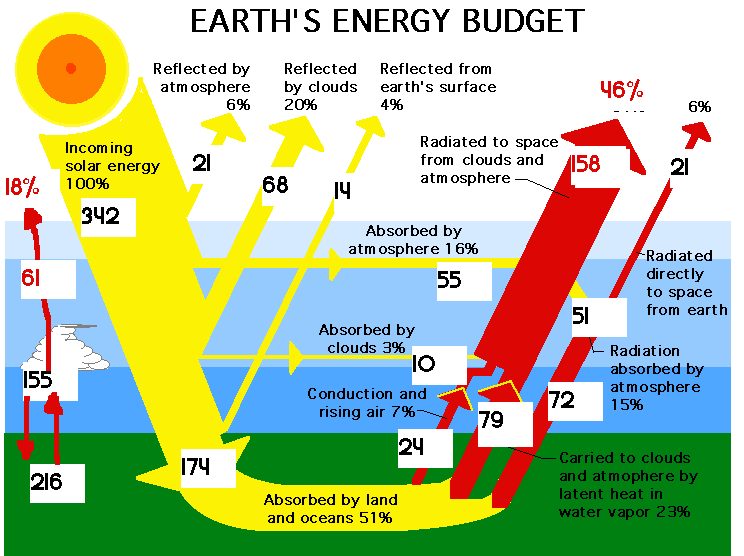
dF/dT=4(aFc+bFl+eFr), F=heat flux, T=Temperature, c=conduction, l=latent, r=radiative and a,b and e are constants of proportionality.
That is one amazingly powerful equation. All three heat fluxes have different properties but adhere to the same laws of physics. So all heat fluxes share the same basic relationship with temperature. Only their rates of flow vary with the method and media of propagation. They share the inverse square law. A general relativity of flux.
The first time I say this formula, which I have since modified with the coefficients, was on the Blackboard blog. It is the result of a paper in an obscure and controversial journal, Energy and Environment
If the journal had not been E&E and the debate on the internet, that formula would greatly simplify solutions to common mixed heat flux problems in the atmosphere.
The debate seems to center around the "implicit" Planck response of the atmosphere, but really should be centered around the coefficients, a, b and especially e, which I will call the Effective emissivity of radiative flux at the surface of the Earth.
That emissivity is generally e={dF/dT}/4 if a one degree change in temperature is due to a 3.3Wm-2 change in flux, the e=3.3/4=0.825 a unit less value, as 3.3 is the actual flow to temperature and 4 is the ideal flow to temperature. Extremely simple coefficient. For conduction, a, would be the ratio of actual flow to ideal flow, b, actual flow to ideal flow. Incredibly simple and elegant mathematics.
The e value is implicit it the climate science literature, it ranges from 0.61 to 1, ideal, with often 0.926, the value estimated by Stefan-Boltzman for a real black body since an ideal black body does not exist.
Update: The value for e is still an issue. Why? I have no clue, it is a benchmark value that can be determined in many ways, if you compare the approximate greenhouse temperature 33 to the approximate greenhouse energy flux 155, 155/33=4.7 Wm-2/K 4/4.7= 0.851 This is the initial value I determined for e which allows for the effective emissivity of the atmosphere. The surface though is still not a true black body, water has a very high emissivity of 0.99, but the average emissivity of all of Earth's surface is 0.967, which multiplied by the 0.851=.825. If anyone has a better estimate let me know.
The elegance can be seen in the Earth's atmosphere. Heat flux at the surface is divided into three forms, each with different characteristics of flow. Radiant heat for the surface does not uniformly interact with the atmosphere, only a portion e, interacts at differing spectral lines and intensities.
So a 100W/m-2 flux upward, with e=0.825 would produce a radiative interaction impact 82.5 W/m-2 in the atmosphere, down welling longwave radiation for some. An effective temperature for many others. This is the Greenhouse Effect, due to radiative flux. Conduction, convection and latent heat fluxes all contribute with differing impact as defined by their coefficients. This is so simple it should not require a proof. It is obvious in our physical world.
Using data from the NASA energy budget drawing, the atmosphere absorbs, 24 conductive, 78 latent and 51 radiative Wm-2 from the surface for a total of 153, the greenhouse effect. The atmosphere also absorbs 68 W/m-2 from the sun, the combined atmospheric effect is 153+68=221. All of these are absorbed values, eFr, not Fr needing adjustment. Since the solar is absorbed at different altitudes, its effect propagates according to the same simple inverse squared relationship. How hard do you really what to make nature?
http://ourhydrogeneconomy.blogspot.com/2011/10/call-for-mathematicians-greenhouse.html
Wednesday, October 5, 2011
A call for Mathematicians - The Greenhouse Effect, not so Simplified
This is extremely frustrating. Since there are errors in the math for the K&T drawing, I cannot explain the solution until I solve several other problems. So I am going to have to take much more time than I think is reasonable.
While Energy is Fungible, the Work is Not
Something so simple is so hard to explain.
Explaining the Kimoto equation unfortunately requires completely changing the way one looks at the atmospheric effect. In general, outgoing radiation balanced by down welling radiation of equal amounts have no net impact. The atmosphere is different. While the energy fluxes are just flows, they represent energy at a point in space and time. So while a surface flux may be matched, it has more impact at the surface. It creates more collisions in the denser environment. This is an increase in conductivity. So while two flows may pass, they are maintaining conductive conditions. Energy must be conserved, but the location of that energy is important.
In the atmosphere, there are changes in the type of energy flowing. There is latent heat from water warmed a the surface and carried aloft which does not lose its latent energy until it change phase. Conductive energy which is the number of collisions between molecules and radiant every which does not require a collision to release energy.
All three interact in the atmosphere until they revert to radiant energy and escape to space.
Each is better at transferring potential energy of a given type at a give efficiency. How easy it is to transfer heat from one boundary layer to another is extremely important. For example water is very efficient transferring energy via conduction to air that air is transferring energy to water. In an air to water heat exchanger, a conductive metal is used for the water and air boundary. Smooth tubes can be used on the water side without much loss of efficiency. On the air side, undulations are used to cause more turbulence in the air to increase the rate of collisions of the air molecules. On our oceans, heat flow from the surface increases with wave action and wind speed, more molecules contact the water's surface so more heat can be transferred. Water to air transfer of conductive heat is 1000 times more efficient that air to water, because the energy contain in every water molecule is much higher and the contact with other water molecules is much more efficient for transferring energy with in the water.
Air being orders of magnitude lower in density, takes longer to transfer energy between air molecules. Pure gases have different coefficients of heat transfer. Argon and Xenon are noble gases selected for their insulation qualities. Water vapor and carbon dioxide are not because they are better conductors. They are far from idea, but better
For example gases at atmospheric pressure separated by metal have heat transfer coefficients of 5 to 35 W/m^2K under pressure that changes to 100 to 500W/m^2K.
Under normal atmospheric conditions, water vapor and CO2 enhance the heat transfer because they can absorb energy both by conduction and through radiation. Under pressure they can transfer more and at a higher temperature they can transfer more than under lower temperature and pressure. The addition of more carbon dioxide increases the radiate energy absorbed, the number of collisions which increases the rate of conduction and increase the rate of evaporation. If there is a window for radiant heat transfer, some of this energy is transferred further from the water's surface which tends to decrease the rate of heat transfer because radiate heat transfer is not as efficient as conductive.
In the atmosphere, the adaptions of the Kimoto equation tells me, that while energy is fungible, the impact of the flows are very different, 24Wm-2 up of conductive flux is balance by 24Wm-2 down of radiative flux down from one point in the atmosphere, is not the same as 24Wm-2 up 100 meters and matched by a counter flux of 24Wm-2 at the TOA.
Below I was a brief derivation of the initial greenhouse effect. It is difficult to follow, because the assumptions, while valid are a bit unusual in the computer age. Now it is no longer brief.
For a temperature radiative flux relationship, dF/dT=4F/T This basic equation is part of the problem. while it is perfect for a radiative only solution it gets involve proving it can be used for a mixed heat flux solution. When I set the equation up for the Earth I get.
dF/dT= 4*(aFc + bFl +cFr)/T, a=conductive heat flow coefficient, b=latent heat flow coefficient and c=radiative heat flow coefficient aka emissivity. With the separate coefficients, this is totally valid, however with the proper valid assumptions I can make a and b disappear. And not by magic, by logic.
If dT/dt=0, i.e. it is in equilibrium with space and surface temperature does not change, then
Equilibrium can be assumed for a steady state, equilibrium may never truly exist, it is a numerical concept. It is very important that this equilibrium be understood. I am going to apply a radical impulse.
If the Earth was floating in space all by itself at a temperature of 288K and with no atmosphere, T=390W.m-2, aFc=0, dFl=0 and C=1 Fr=390 Do I have to explain how I got that? I hope not, with no atmosphere there would only be radiant heat loss.
Now you need a little imagination,
If we suddenly add an atmosphere, T=4*(aFc+bFl+0.825Fr), 0.825 is an impulse change in emissivity from 1 to 0.825, and following happens, aFc=24, bFl=76 and cFr=290 as it leaves the surface of the Earth. By selecting the approximate final value, I eliminate the need to solve three simultaneous equations.
Note: This value of 0.825 for the coefficient of Fr was carefully selected based on the current estimate of climate sensitivity. While there are many that may disagree it is valid, it simplifies the solution. If it is wrong, that will be obvious once we get to the final solution. I will try to clean up the methods I used to arrive at that value, but not until this stage has been simplified enough for others to understand.
By selecting the final values of aFc and bFl I am in effect assuming a solution for a and c. This is a little bit of mathematical trickery not common place any more. Since I am assuming that the responses of aFc and bFl are low and slow with respect to eFr, Fc and Fl would stabilize prior to Fr. Since the impulse is applied only to Fr via the change in emissivity and the stable values of Fc and Fl assumed correct, there would be insignificant harmonic interference with Fr's approach to the new equilibrium state. This is a very effective simplification.
Okay, a little more imagination, once the surface and the atmosphere reach a steady state, equilibrium, for the briefest moment in time, we get aFc=24, bFl=76 and c becomes 0.825 which changes cFr to 0.825*290=239.5, so for that moment all hell breaks loose. The Earth would attempt to maintain the 390Wm-2 total flux, it would overshoot, and gradually seek equilibrium. Before it finds equilibrium, the atmospheric resistance to flux with the impulse change in emissivity would over shot a peak value. Knowing the final value at the TOA, 237 and the final temperature and flux at the surface, we can determine the initial green house response by artificial selecting a high but very close to reality, impulse flux from the surface. This must be trickier that I thought because no one understands this trick. Then,
T=4(aFc+bFc+cFr)+4GHe, that should be fairly simple to follow, do I need to expand that? Since I will be solving for the impulse value of GHe, I have to modify the equation. Should not be that hard to follow.
4GHe=T-4(aFc+bFc+cFr)
GHe=(T-4(aFc+bFc+cFr))/4
So the initial Greenhouse effect(GHe) is,
GHe=(288-4*(24+76+239.5)/4 = (288-4*339.5)/4 = -267.5
I selected 239.5 for convenience. I could have picked 400 or infinity, but the closer it is to reality the more information we can obtain.
That is the end of the first moment in time, a sudden impulse to a BB in equilibrium at the average temperature of Earth. Still no sun, that will be at the end.
GHe=-267.5 which has to be matched by Outgoing Longwave Radiation (OLR) in the second moment in time for the surface to regain equilibrium. The assumption of equilibrium at the surface is critical. The approximate equilibrium value at the TOA will be assumed for this stage.
390-267=122.5, the initial surface response to the GHe.
Had I selected a higher value for Fr, both the initial -267.5 and the resulting value 122.5 would have been different, but proportionally different. That is the trick by selecting 239.5 up to 390 I avoid the confusion of the sign change. The sign of GHe is very important, the value after subtracting from 390 not so important because we know that it will return to 390. It is the proportion and sign of GHe that matter. In the next step you can see why I chose a value close to the equilibrium value of Fr.
As the surface of the Earth obtains equilibrium with the atmosphere,
Surface (24+76+239.5+122.5)=462 is the initial peak radiation which will decay as equilibrium is approached. -267.5 is the initial value of the greenhouse effect which will decay as equilibrium is approached. These are impulse conditions. At the TOA, the flux has dropped to near zero and will stabilize to a value of 237Wm-2.
As you can see the peak 462 is a manageable number. It is a totally fictitious number, but it is proportional to the -271 GHe impulse which is also fictitious. As long as they are proportional, greater that the final value and the signs are correct, these values will work. But, since I selected 239.5 for the value, which is steady state, there is some meaning in -271 and 462.
At this point we release Temperature so that it actually change. The surface will reduce its emitted radiation by 462-390=72Wm-2 The radiation at the top of the atmosphere will decay to 239.5Wm-2. This is the start of the third layer solution. By selecting 239.5, I get 462 peak at the surface minus 271 in the atmosphere. 462+(-271)=191 at the TOA. The TOA has to increase to 239.5 and 462 has to decrease to 390. GHe cannot increase if 462 is decreasing and 191 is increasing. So both have to decay, or reduce in magnitude, to a stable value while TOA is increasing. This must be part of my trick that is very hard to f0llow.
At the surface, 462 decreases as 122.5 decays to 72 yielding 50.5, the amount of radiation absorbed by the atmosphere. The GHe -267.5 proportionally with the 122.5 decays to -267.5 + 50.5 = -217 The 50.5 is a verification of the method, but not if you were using the Trenberth values. 51 is the determined by NASA, 50.5 tends to confirm their calculations.
This final step may be difficult, but not so bad if you have followed me so far.
There is still no sun in the sky, this is the third moment in the existence of the atmosphere. With no solar input at all, the problem is super simplified. This equilibrium condition would exist on for the briefest period of time.
The TOA value of 237 is assumed to be the momentary equilibrium value. Trenberth added the 72 to 267.5 to get 339 and then decayed that to 321, 339-321=18, the amount he mistakenly has for atmospheric absorption.
In order to solve for the solar input, I have to use the same methods, only the it is not really needed. Since the equilibrium values are very close to the real world values, adding the sun only requires minor accounting to resolve the atmospheric balance. Think of should I let the surface flux decrease to 390 minus any small value, then slowly increase the solar values to maintain the 390. Instead of adding an impulse, the slow matching input maintains the surface balance and the TOA balance, then it is just minor accounting to solve the atmospheric balance. Since the upeard flux does not change, the down welling will not change since it is created by resistance to outgoing flow. The values selected for Fc and Fl are based on the steady state with solar, so only the upper troposphere needs to be tweaked.
Setting up this solution was most of the battle. It took me a while to confirm that 0.825 was a valid estimate, I had to determine a reasonable estimate of the DWR from comparing both K&T drawings to the NASA, I had to basically solve the problem before I could solve the problem. So this is not the best or only way, it is only A way.
Now I have confirmed the Trenberth error several ways, but it is difficult to unseat the champion. Unfortunately, there are probably not many people that can appreciate the simple elegance of this mathematical trickery. Unfortunately, this method will probably not be accepted even though all the assumptions are valid, because they push the limits pretty severely. Until this first step is understood and at least somewhat accepted I cannot advance to calculating climate sensitivity with greater accuracy using the simple formula dF/dT=4F/T with the proper coefficients.
I think I will call this proof by discovery of error. If you look closely at the K&T you should confirm the DWR and atmospheric absorption errors which amplify each other in opposite directions. In the old K&T, 26 was the atmospheric absorption of net OLR and the new it is 18 in the old, both require a little snooping to decipher, but they are there. 51, or 50.5 calculated here, appear to be the appropriate values. The correct DWR value is fairly obvious also in the NASA with a little looking. If that is not enough, Angstrom's turn of the 20th century estimate was closer than the K&T drawing. Check Eli Rabbet's blog.
I would like to thank Fred Moolton for helping me figure out what was so hard to understand.
While Energy is Fungible, the Work is Not
Something so simple is so hard to explain.
Explaining the Kimoto equation unfortunately requires completely changing the way one looks at the atmospheric effect. In general, outgoing radiation balanced by down welling radiation of equal amounts have no net impact. The atmosphere is different. While the energy fluxes are just flows, they represent energy at a point in space and time. So while a surface flux may be matched, it has more impact at the surface. It creates more collisions in the denser environment. This is an increase in conductivity. So while two flows may pass, they are maintaining conductive conditions. Energy must be conserved, but the location of that energy is important.
In the atmosphere, there are changes in the type of energy flowing. There is latent heat from water warmed a the surface and carried aloft which does not lose its latent energy until it change phase. Conductive energy which is the number of collisions between molecules and radiant every which does not require a collision to release energy.
All three interact in the atmosphere until they revert to radiant energy and escape to space.
Each is better at transferring potential energy of a given type at a give efficiency. How easy it is to transfer heat from one boundary layer to another is extremely important. For example water is very efficient transferring energy via conduction to air that air is transferring energy to water. In an air to water heat exchanger, a conductive metal is used for the water and air boundary. Smooth tubes can be used on the water side without much loss of efficiency. On the air side, undulations are used to cause more turbulence in the air to increase the rate of collisions of the air molecules. On our oceans, heat flow from the surface increases with wave action and wind speed, more molecules contact the water's surface so more heat can be transferred. Water to air transfer of conductive heat is 1000 times more efficient that air to water, because the energy contain in every water molecule is much higher and the contact with other water molecules is much more efficient for transferring energy with in the water.
Air being orders of magnitude lower in density, takes longer to transfer energy between air molecules. Pure gases have different coefficients of heat transfer. Argon and Xenon are noble gases selected for their insulation qualities. Water vapor and carbon dioxide are not because they are better conductors. They are far from idea, but better
For example gases at atmospheric pressure separated by metal have heat transfer coefficients of 5 to 35 W/m^2K under pressure that changes to 100 to 500W/m^2K.
Under normal atmospheric conditions, water vapor and CO2 enhance the heat transfer because they can absorb energy both by conduction and through radiation. Under pressure they can transfer more and at a higher temperature they can transfer more than under lower temperature and pressure. The addition of more carbon dioxide increases the radiate energy absorbed, the number of collisions which increases the rate of conduction and increase the rate of evaporation. If there is a window for radiant heat transfer, some of this energy is transferred further from the water's surface which tends to decrease the rate of heat transfer because radiate heat transfer is not as efficient as conductive.
In the atmosphere, the adaptions of the Kimoto equation tells me, that while energy is fungible, the impact of the flows are very different, 24Wm-2 up of conductive flux is balance by 24Wm-2 down of radiative flux down from one point in the atmosphere, is not the same as 24Wm-2 up 100 meters and matched by a counter flux of 24Wm-2 at the TOA.
Below I was a brief derivation of the initial greenhouse effect. It is difficult to follow, because the assumptions, while valid are a bit unusual in the computer age. Now it is no longer brief.
For a temperature radiative flux relationship, dF/dT=4F/T This basic equation is part of the problem. while it is perfect for a radiative only solution it gets involve proving it can be used for a mixed heat flux solution. When I set the equation up for the Earth I get.
dF/dT= 4*(aFc + bFl +cFr)/T, a=conductive heat flow coefficient, b=latent heat flow coefficient and c=radiative heat flow coefficient aka emissivity. With the separate coefficients, this is totally valid, however with the proper valid assumptions I can make a and b disappear. And not by magic, by logic.
If dT/dt=0, i.e. it is in equilibrium with space and surface temperature does not change, then
Equilibrium can be assumed for a steady state, equilibrium may never truly exist, it is a numerical concept. It is very important that this equilibrium be understood. I am going to apply a radical impulse.
If the Earth was floating in space all by itself at a temperature of 288K and with no atmosphere, T=390W.m-2, aFc=0, dFl=0 and C=1 Fr=390 Do I have to explain how I got that? I hope not, with no atmosphere there would only be radiant heat loss.
Now you need a little imagination,
If we suddenly add an atmosphere, T=4*(aFc+bFl+0.825Fr), 0.825 is an impulse change in emissivity from 1 to 0.825, and following happens, aFc=24, bFl=76 and cFr=290 as it leaves the surface of the Earth. By selecting the approximate final value, I eliminate the need to solve three simultaneous equations.
Note: This value of 0.825 for the coefficient of Fr was carefully selected based on the current estimate of climate sensitivity. While there are many that may disagree it is valid, it simplifies the solution. If it is wrong, that will be obvious once we get to the final solution. I will try to clean up the methods I used to arrive at that value, but not until this stage has been simplified enough for others to understand.
By selecting the final values of aFc and bFl I am in effect assuming a solution for a and c. This is a little bit of mathematical trickery not common place any more. Since I am assuming that the responses of aFc and bFl are low and slow with respect to eFr, Fc and Fl would stabilize prior to Fr. Since the impulse is applied only to Fr via the change in emissivity and the stable values of Fc and Fl assumed correct, there would be insignificant harmonic interference with Fr's approach to the new equilibrium state. This is a very effective simplification.
Okay, a little more imagination, once the surface and the atmosphere reach a steady state, equilibrium, for the briefest moment in time, we get aFc=24, bFl=76 and c becomes 0.825 which changes cFr to 0.825*290=239.5, so for that moment all hell breaks loose. The Earth would attempt to maintain the 390Wm-2 total flux, it would overshoot, and gradually seek equilibrium. Before it finds equilibrium, the atmospheric resistance to flux with the impulse change in emissivity would over shot a peak value. Knowing the final value at the TOA, 237 and the final temperature and flux at the surface, we can determine the initial green house response by artificial selecting a high but very close to reality, impulse flux from the surface. This must be trickier that I thought because no one understands this trick. Then,
T=4(aFc+bFc+cFr)+4GHe, that should be fairly simple to follow, do I need to expand that? Since I will be solving for the impulse value of GHe, I have to modify the equation. Should not be that hard to follow.
4GHe=T-4(aFc+bFc+cFr)
GHe=(T-4(aFc+bFc+cFr))/4
So the initial Greenhouse effect(GHe) is,
GHe=(288-4*(24+76+239.5)/4 = (288-4*339.5)/4 = -267.5
I selected 239.5 for convenience. I could have picked 400 or infinity, but the closer it is to reality the more information we can obtain.
That is the end of the first moment in time, a sudden impulse to a BB in equilibrium at the average temperature of Earth. Still no sun, that will be at the end.
GHe=-267.5 which has to be matched by Outgoing Longwave Radiation (OLR) in the second moment in time for the surface to regain equilibrium. The assumption of equilibrium at the surface is critical. The approximate equilibrium value at the TOA will be assumed for this stage.
390-267=122.5, the initial surface response to the GHe.
Had I selected a higher value for Fr, both the initial -267.5 and the resulting value 122.5 would have been different, but proportionally different. That is the trick by selecting 239.5 up to 390 I avoid the confusion of the sign change. The sign of GHe is very important, the value after subtracting from 390 not so important because we know that it will return to 390. It is the proportion and sign of GHe that matter. In the next step you can see why I chose a value close to the equilibrium value of Fr.
As the surface of the Earth obtains equilibrium with the atmosphere,
Surface (24+76+239.5+122.5)=462 is the initial peak radiation which will decay as equilibrium is approached. -267.5 is the initial value of the greenhouse effect which will decay as equilibrium is approached. These are impulse conditions. At the TOA, the flux has dropped to near zero and will stabilize to a value of 237Wm-2.
As you can see the peak 462 is a manageable number. It is a totally fictitious number, but it is proportional to the -271 GHe impulse which is also fictitious. As long as they are proportional, greater that the final value and the signs are correct, these values will work. But, since I selected 239.5 for the value, which is steady state, there is some meaning in -271 and 462.
At this point we release Temperature so that it actually change. The surface will reduce its emitted radiation by 462-390=72Wm-2 The radiation at the top of the atmosphere will decay to 239.5Wm-2. This is the start of the third layer solution. By selecting 239.5, I get 462 peak at the surface minus 271 in the atmosphere. 462+(-271)=191 at the TOA. The TOA has to increase to 239.5 and 462 has to decrease to 390. GHe cannot increase if 462 is decreasing and 191 is increasing. So both have to decay, or reduce in magnitude, to a stable value while TOA is increasing. This must be part of my trick that is very hard to f0llow.
At the surface, 462 decreases as 122.5 decays to 72 yielding 50.5, the amount of radiation absorbed by the atmosphere. The GHe -267.5 proportionally with the 122.5 decays to -267.5 + 50.5 = -217 The 50.5 is a verification of the method, but not if you were using the Trenberth values. 51 is the determined by NASA, 50.5 tends to confirm their calculations.
This final step may be difficult, but not so bad if you have followed me so far.
There is still no sun in the sky, this is the third moment in the existence of the atmosphere. With no solar input at all, the problem is super simplified. This equilibrium condition would exist on for the briefest period of time.
The TOA value of 237 is assumed to be the momentary equilibrium value. Trenberth added the 72 to 267.5 to get 339 and then decayed that to 321, 339-321=18, the amount he mistakenly has for atmospheric absorption.
In order to solve for the solar input, I have to use the same methods, only the it is not really needed. Since the equilibrium values are very close to the real world values, adding the sun only requires minor accounting to resolve the atmospheric balance. Think of should I let the surface flux decrease to 390 minus any small value, then slowly increase the solar values to maintain the 390. Instead of adding an impulse, the slow matching input maintains the surface balance and the TOA balance, then it is just minor accounting to solve the atmospheric balance. Since the upeard flux does not change, the down welling will not change since it is created by resistance to outgoing flow. The values selected for Fc and Fl are based on the steady state with solar, so only the upper troposphere needs to be tweaked.
Setting up this solution was most of the battle. It took me a while to confirm that 0.825 was a valid estimate, I had to determine a reasonable estimate of the DWR from comparing both K&T drawings to the NASA, I had to basically solve the problem before I could solve the problem. So this is not the best or only way, it is only A way.
Now I have confirmed the Trenberth error several ways, but it is difficult to unseat the champion. Unfortunately, there are probably not many people that can appreciate the simple elegance of this mathematical trickery. Unfortunately, this method will probably not be accepted even though all the assumptions are valid, because they push the limits pretty severely. Until this first step is understood and at least somewhat accepted I cannot advance to calculating climate sensitivity with greater accuracy using the simple formula dF/dT=4F/T with the proper coefficients.
I think I will call this proof by discovery of error. If you look closely at the K&T you should confirm the DWR and atmospheric absorption errors which amplify each other in opposite directions. In the old K&T, 26 was the atmospheric absorption of net OLR and the new it is 18 in the old, both require a little snooping to decipher, but they are there. 51, or 50.5 calculated here, appear to be the appropriate values. The correct DWR value is fairly obvious also in the NASA with a little looking. If that is not enough, Angstrom's turn of the 20th century estimate was closer than the K&T drawing. Check Eli Rabbet's blog.
I would like to thank Fred Moolton for helping me figure out what was so hard to understand.
Trenberth, Monckton and Lucia - Are They missing the Heat?
In my last post Back to Baking Bacon Bread, the pork fat must have stimulated my brain or killed a few extra brain cells, not sure which. Anyway, in my pork fat euphoria, it appears I have located a missing 22Wm-2 of heat. Because of the sensitivity of errors, it is not all that easy to find out how much heat is missing versus some just misplaced.
However, since it looks like the flux generated by the greenhouse effect is 133 and not 155, there is probably a slight error in estimating the effective emissivity of the Earth's atmosphere, the planet itself or both. That is not only likely, but probable. The question would be how much would it effect the overall estimation of the change in forcing due to a doubling of CO2? Hummm?
I am not sure how to go directly to the answer. I can start by using the 133 instead of 155 just to see what that may do.
Back to my new favorite formula, dF/dT=4F/T and the ratio Tge/(288-255)=Fge/(390-235), the 390, Fs(urface)-235, Ftoa equals 155, but that does not include the effective emissivity of the atmosphere. Effective emissivity would be 133/155=0.85, which is much lower than typically assumed. So modifying the ratio, 0.85*(Fge)/0.85(Fs-Ftoa), to allow for this emissivity value we have T/33=0.85Fge/133. Since we are solving for an unknown temperature change due to 2xCO2 we have, dTge=dFge*Tge/4Fge=0.85*(3.7*33)/(4*133)=0.195, so for a 3.7Wm-2 change in forcing, 0.72 degree K change. That is a considerably smaller amount than the 1 estimated, a lot smaller that the 1.2 often estimated and one hellava lot less than the 1.5 estimate by some. So I think it is worth looking into a bit.
The nuts of the matter is that warming is likely over estimated by up to 15%, 85% of 3C is 2.55 Degrees, which purely by chance I am sure, agrees nicely with most of the recent estimates of sensitivity and is just about how much the models are over estimating the impact of global warming.
Could it be the MISSING HEAT?
However, since it looks like the flux generated by the greenhouse effect is 133 and not 155, there is probably a slight error in estimating the effective emissivity of the Earth's atmosphere, the planet itself or both. That is not only likely, but probable. The question would be how much would it effect the overall estimation of the change in forcing due to a doubling of CO2? Hummm?
I am not sure how to go directly to the answer. I can start by using the 133 instead of 155 just to see what that may do.
Back to my new favorite formula, dF/dT=4F/T and the ratio Tge/(288-255)=Fge/(390-235), the 390, Fs(urface)-235, Ftoa equals 155, but that does not include the effective emissivity of the atmosphere. Effective emissivity would be 133/155=0.85, which is much lower than typically assumed. So modifying the ratio, 0.85*(Fge)/0.85(Fs-Ftoa), to allow for this emissivity value we have T/33=0.85Fge/133. Since we are solving for an unknown temperature change due to 2xCO2 we have, dTge=dFge*Tge/4Fge=0.85*(3.7*33)/(4*133)=0.195, so for a 3.7Wm-2 change in forcing, 0.72 degree K change. That is a considerably smaller amount than the 1 estimated, a lot smaller that the 1.2 often estimated and one hellava lot less than the 1.5 estimate by some. So I think it is worth looking into a bit.
The nuts of the matter is that warming is likely over estimated by up to 15%, 85% of 3C is 2.55 Degrees, which purely by chance I am sure, agrees nicely with most of the recent estimates of sensitivity and is just about how much the models are over estimating the impact of global warming.
Could it be the MISSING HEAT?
Tuesday, October 4, 2011
Back to Baking Bacon Bread

It is crusty roll fit for my crusty role.
Update: In case Fred show up, To use ratio and proportion correctly in this problem the 33C greenhouse effect would need to be equal to Surface radiation minus TOA radiation divide by four. 155/4=38.7 so either relationship in the equation is wrong, 33 is wrong or 155 is wrong, my money is on the 155.
Just in case you are wondering, the emissivity estimate of 0.926 only accounts for part of the difference, 143.5wm-2, there is still nearly 10 Wm-2 missing.
In the Monckton-Lucia online debate I am a non-combatant, I really don't care. I was curious if there was any justification for the linear approximation of flux versus temperature. Not only is there justification, there are several ways of using that approximation, with some pitfalls for the unwary. I will leave those issues to others. The one equation used was dF/dT=4F/T, so if I am going to use simple ratio and proportion to calculate a change in one relative to the other, it is a piece of cake. But is it valid with a mix of heat fluxes, latent thermal(sensible I prefer) and radiant?
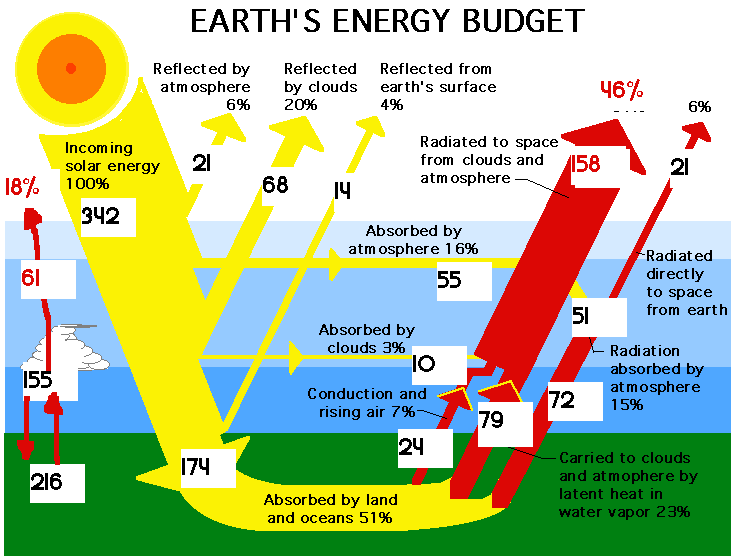
I marked up this NASA energy budget drawing to determine the fluxes at the surface and atmosphere. There are a few differences between this drawing and the Kiehl and Trenberth energy budget drawings, mainly subtle differences.
If energy is fungible and the Earth's surface tends toward energy equilibrium, the sum of the energy fluxes at the surface will sum to the black body energy flux at 288K, the average surface temperature. Since the Earth has a greenhouse gas atmosphere, the temperature at the surface is greater than at the Top Of the Atmosphere (TOA). The difference in the heat flux at the surface is greater than the heat flux at the TOA by approximate 155W/m-2 on average. Adding twice the amount of CO2 to the atmosphere with increase the resistance to Outgoing Long wave Radiation (OLR)flow rate, or flux, changing the flux by 3.7Wm-2, which I am assuming is correct. As Co2 is a well mixed gas, the resistance will be greatest at the surface and decrease with altitude. Due to competition with water vapor in the lower atmosphere, the impact of CO2 will be more conductive and convective than radiative near the surface due to rapid transfer of absorbed energy by conduction (collisional transfer).
At the surface, all three basic types of heat flow, conduction(sensible), convection(a combination of sensible and latent) and radiative are present. To avoid confusion, conduction is used on the NASA cartoon while thermals is used on the K&T cartoons. Of the three types of heat flow, only radiative is directly changed by the addition of CO2. Of the radiative flux, only some spectral lines are effected by CO2, those spectral lines will cause the unaffected spectral lines to adjust to maintain equilibrium. Since energy is fungible, meaning it can change from one form to another as long as it is conserved, the conductive and latent fluxes with adjust to the change in radiative flux, limited by the thermodynamic relationships that influence them.
Based on the above the relationship Fout=Fc(onductive)+Fl(antent)+Fr(adiative) is true at the surface. Since only a portion of Fr(radiative) is effected, Fr can be separated into Fra(atmosphere) and Frs (space,) where Frs is the portion of the radiative spectrum not effected by the change in CO2.
For the modified drawing that yields, 390=24+79+(218+72). Fr=72+218=288 is a total of the heat loss from the surface interacting with the atmosphere only 21Wm-2 passes directly from the surface to space. The 390=24+79+21+267 would be the result of splitting Fr in Frs and Fra.
In order to use a ratio and proportion we have to define the range impacted by the change. The resistance to radiative flux in steady state creates a temperature imbalance between the surface (Ts) and the Top of the Amosphere (Toa) of Ts-Ttoa = Ts-255K or 33 degrees K, felt at the surface for an average temperature of 288K, the temperature and flux at the TOA will remain the same as it is in equilibrium with solar energy into the TOA. Then Tge=Ts-Ttoa. This range is equivalent to the change in radiative flux based on the black body temperature of the surface, 390-242=148 though 155W/m-2 is typically used after allowing for emissivity, which is the flux absorbed and re-emitted by the atmosphere, Fge.
So for a change in flux, (dFge/Fge) is proportional to d(Tge)/Tge, this can be written as dFge/dTge=4Fge/Tge => dTge=Tge*(dFge/4). For a discussion on this see, Uncertainty Monster Visits MIT. (This is a blog, so I am referencing a blog :)
Tge=33K, Fge=155W/m-2, dFge=2xCO2=3.7 and dTge is unknown
dTge=Tge*dFge/4=(33K*3.7)/(155Wm-2*4)=0.196K/Wm-2, based on the values typically assumed on the NASA drawing. For a 5 Wm-2 increase would produce 5Wm-2*0.196K/wm-2=0.98K, which is slightly lower than many estimates.
For the K&T old drawing, Fge=24+78+26=128Wm-2, Tge=33K and dFge=3.7 => 33*3.7/(155*4)=0.197 K/Wm-2
But this not the end of the story, Fr, the radiation from the surface, has the Frs portion that has a free pass to space and Fl and Fc have other thermodynamic issues to deal with. This will reduce the impact of Fge on Tge. In order to account for that impact we need to use Fnet = Fc+Fl+Fge+Fs
Fnet is complicated between the two drawings. In the NASA drawing, more radiation is shown leaving the surface and entering the atmosphere and less shown having a free path to space.
For NASA, Fnet = 51+21=72 and K&T 26 is calculated by converting the OLR to net and Fs is shown as 40 producing a Fnet of 66. So we have;
Nasa Fnet=24+79+51+21= 175 K&T Fnet=24+78+26+40= 168 Assuming Tge=33 and Fge=155 for both,
Nasa (33*3.7)/(4*175)=0.174Kwm-2 K&T (33*3.7)/(4*168)=0.18KWm-2
For a 5Wm-2 increase 5*0.174=0.87K
Both Fge and Fnet calculations should be considered as the increase in atmospheric temperature by Fge will feed back and the impact of that feedback will be reduced somewhat by the radiation window considered in Fnet. The truer value should be in between those two. Of the two drawings, the NASA is more realistic since water in liquid and solid formed in the atmosphere will emit in the atmospheric window to some degree.
Finally, by assuming that the net radiation is Fout-Fc-Fl=288 we can calculate,
(33*3.7)/(4*288)=0.106K/Wm-2 or we could use the total OLR based solely on the 228K radiation value of 390Wm-2 and obtain (33*3.7)/(4*390)=0.078K/Wm-2 In both cases there is a large amount of energy not actively participating either to warm the atmosphere or cool the surface. This produces an unrealistically low value for the Planck response. The atmospheric or greenhouse effect would respond only to an attempt to change the rate of flux through the atmosphere. The difference in temperature of the surface is due the effective temperature differences between the surface and the atmosphere which is in equilibrium if we assume the surface energy is seeking equilibrium, atmospheric energy is seeking equilibrium and the TOA is seeking equilibrium.
The assumption of equilibrium in no way implies true equilibrium. The impact of addition forcing on various layers of the atmosphere will have differing effects. An integration of the impact of different layers would have on their neighbors would be required for complete understanding. This method only provides a reasonable estimate of the Planck response to a change in emissivity. The varying limits of conductive, convective and latent responses would have to be considered separately.
While this has been interesting, a simple ratio and proportion of the surface is not all that valuable. It would better if used as part of an analysis of surface regions with similar feedback responses, like a tropical zone (slightly lower Planck response), northern hemisphere zone (higher Planck response with more water vapor feedback) and southern hemisphere zone (in between, but closer to the NH Planck response with less water vapor feedback). Each would have very different responses to a change in forcing. An atmospheric balance of each zone should also be considered as heat energy would migrate from one zone into another.
That's the end of me trying to act serious. Now its speculation time!
For these drawings, an atmospheric ratio is interesting. For the K$T old drawing, We have solar absorbed by clouds Fs=67, Fc(the thermals)=24, Fl=78 and Fr=26 for an Fnet=195. We do not have a Tge or Fge and temperatures in the atmosphere are well below the black body temperature at the TOA. We can calculate a change in forcing, 3.7/195=0.0036 and we have an estimate of the Planck response of 0.18K/Wm-2. Dividing the Planck response by the ratio of the change in forcing we get 50K. 288K-50K=238K, which is very close to the TOA effective temperature. If we use that as an estimate for Tge in the atmosphere, 50*3.7/(4*195)=0.23 or 5W/m-2*0.23=1.18K With an estimate of Tge for the atmosphere of 38K we would have the same Planck response as the surface. Subtracting that from the 288K surface temperature we would get an effective temperature of the atmosphere of -23 degrees C. This is roughly the potential temperature of a parcel of air at 250K and 600mb or an altitude of 4.5 km. Interesting?
UPDATE: The discrepancy between Tge and Fge is likely due to the effective emissivity plus a few assumptions. Fge should be approximately 133Wm-2 instead of the 155Wm-2 assumed, of course 288K at the surface is also assumed as well as 3.7Wm-2 being the change in forcing due to a doubling of CO2, so there is a whole lot of 'summin' goin' on. However, 22Wm-2 is a fair amount of missing heat for a high class radiation budget.
Now time to eat baked bacon bread.
Monday, October 3, 2011
Supplimental Issues for What's not Good
I have revised this to make the situation clearer, Back To Baking Bacon Bread, which was pretty tasty. I will leave the rest below because there are some ideas I may want to revisit.
The issue of what is the more appropriate initial value should be used for assumed linear extrapolation of surface temperature needs to be clarified.
From my perspective the greenhouse ratio would be 33K/(288-255)K. This produces a value of one equivalent with the initial value of the greenhouse or atmospheric effect. Optionally, 33K/(288-33) or 33/255 is proposed. This implies and initial ratio of 0.129 and changes to that ratio may provide a better approximation.
Comparing the two, a ten percent change in temperature would be 36.3/(288-255) or 10% increase. In the other case,36.3/255=0.142, then 0.142/0.129=10%, my method just reduces a step.
The question can this be used for determining a climate sensitivity to the change in CO2, it could not be. It would be an estimate for the change in climate due to a sensitivity of forcing at the surface only. In the atmosphere, the procedure would be used as a change in sensitivity for the atmosphere only.
A second question would be when using the ratio for combined fluxes if the ratio should include adjustments for the nonlinear relationships. For a small change the linear assumption should be fine, but at what point would the approximation produce significant error?
By assigning temperatures to the flux change in Era based on S-B, a 10% change in Era would result in 10.6% change in temperature. So there is error due to non-linearity, whether that error is acceptable for the situation would depend on the purpose of the estimation. Huh?
Update: Possibly, that error may be due to issues on the K&T cartoon other than the 235 at the TOA. 24+78+40+26=168 Where on average that should equal 390, the flux of a black body at 288K, at the surface.

I will get back to this, but it looks like K&T double dipped. The way I have drawn in the NASA budget should be closer to reality. The proportional method I was using may allow me to tweak it, though I still have some issues with dF/dT=4F/T at the surface. We will see.
Just a Note: The NASA cartoon is a little better because it shows radiant heat rising into the atmosphere, then splitting into absorbed and directly radiated to space. Water in the atmosphere is responsible for some percentage of the radiation in the direct window. So we have three basic heat fluxes with different rates of flow varying with conditions. The total flux from the surface will be approximately 390Wm-2, the minimum average downwelling will be 155Wm-2 and the maximum should be a percentage of the flux interacting with the atmosphere decreasing toward 155Wm-2.
The wind is blowing, so while I wait before going fishing, the little greenhouse effect thing on the left of the drawing is and initial estimate. The 216 and 72 radiative fluxes just happen to equal 288, not a mistake, just chance. That does change our initial heat fluxes to Er=288, El=79 and Et=24. Now a 3.7W/m^2 increase in Er gives us (288+3.7)/(390+3.7)=0.7409 from an initial 288/390 = 0.7385. A decrease equals (288-3.7)/(390-3.7)=0.736. The difference of the two from initial is the approximate ratio of the change in forcing which is both for flux and temperature as they happen to be equal. For radiative change, dF/dT=4F/T, is a good approximation. That does not necessarily hold for the latent, sensible or non-interactive radiative fluxes at the surface, but should be in the ballpark for such a small change. For an increase, 0.7409-0.7385=0.0024..., time 288 yields 0.707 For a decrease, 0.736-0.7385=-0.0025 times 288 yields -0.7214. Using dT(T)=dF/4F, I believe that results in a Planck parameter of approximately 0.18 :)
The issue of what is the more appropriate initial value should be used for assumed linear extrapolation of surface temperature needs to be clarified.
From my perspective the greenhouse ratio would be 33K/(288-255)K. This produces a value of one equivalent with the initial value of the greenhouse or atmospheric effect. Optionally, 33K/(288-33) or 33/255 is proposed. This implies and initial ratio of 0.129 and changes to that ratio may provide a better approximation.
Comparing the two, a ten percent change in temperature would be 36.3/(288-255) or 10% increase. In the other case,36.3/255=0.142, then 0.142/0.129=10%, my method just reduces a step.
The question can this be used for determining a climate sensitivity to the change in CO2, it could not be. It would be an estimate for the change in climate due to a sensitivity of forcing at the surface only. In the atmosphere, the procedure would be used as a change in sensitivity for the atmosphere only.
A second question would be when using the ratio for combined fluxes if the ratio should include adjustments for the nonlinear relationships. For a small change the linear assumption should be fine, but at what point would the approximation produce significant error?
By assigning temperatures to the flux change in Era based on S-B, a 10% change in Era would result in 10.6% change in temperature. So there is error due to non-linearity, whether that error is acceptable for the situation would depend on the purpose of the estimation. Huh?
Update: Possibly, that error may be due to issues on the K&T cartoon other than the 235 at the TOA. 24+78+40+26=168 Where on average that should equal 390, the flux of a black body at 288K, at the surface.

I will get back to this, but it looks like K&T double dipped. The way I have drawn in the NASA budget should be closer to reality. The proportional method I was using may allow me to tweak it, though I still have some issues with dF/dT=4F/T at the surface. We will see.
Just a Note: The NASA cartoon is a little better because it shows radiant heat rising into the atmosphere, then splitting into absorbed and directly radiated to space. Water in the atmosphere is responsible for some percentage of the radiation in the direct window. So we have three basic heat fluxes with different rates of flow varying with conditions. The total flux from the surface will be approximately 390Wm-2, the minimum average downwelling will be 155Wm-2 and the maximum should be a percentage of the flux interacting with the atmosphere decreasing toward 155Wm-2.
The wind is blowing, so while I wait before going fishing, the little greenhouse effect thing on the left of the drawing is and initial estimate. The 216 and 72 radiative fluxes just happen to equal 288, not a mistake, just chance. That does change our initial heat fluxes to Er=288, El=79 and Et=24. Now a 3.7W/m^2 increase in Er gives us (288+3.7)/(390+3.7)=0.7409 from an initial 288/390 = 0.7385. A decrease equals (288-3.7)/(390-3.7)=0.736. The difference of the two from initial is the approximate ratio of the change in forcing which is both for flux and temperature as they happen to be equal. For radiative change, dF/dT=4F/T, is a good approximation. That does not necessarily hold for the latent, sensible or non-interactive radiative fluxes at the surface, but should be in the ballpark for such a small change. For an increase, 0.7409-0.7385=0.0024..., time 288 yields 0.707 For a decrease, 0.736-0.7385=-0.0025 times 288 yields -0.7214. Using dT(T)=dF/4F, I believe that results in a Planck parameter of approximately 0.18 :)
Sunday, October 2, 2011
So What's not to Like?
More Notes: http://ourhydrogeneconomy.blogspot.com/2011/10/back-to-baking-bacon-bread.html has come more clarification, but this situation is progressing - stay tuned.
Note: I have started a supplemental post to discuss the potential error range of the approximation.

Update: Well, Trenberth's cartoon for one thing.

I was thinking my method sucked, but I am getting the idea most of the issue is in the cartoon. In any case, the NASA budget and the K&T budget have some inconsistencies.
First, seeing that whopping 324 Wm-2 coming out of that huge greenhouse cloud, I can't take it anymore. The Earth is warmer by about 33 degrees thanks to the greenhouse effect and that is because it re-radiates 155 W/m-2. The sky is still warmed by the sun, so the 169 in red is its contribution.
In trying to figure out what Christopher Monckton was on about, I started looking at the cartoon again. To me there is a pretty obvious relationship at the surface with three heat flows or fluxes, Thermal, Latent and Radiative,All three depend on the Earth for their energy, heat flowing from a source at 288K and each have different factors that effect their rates of flow. At the surface the total outward heat flow is 390Wm-2 based on the black body temperature. At the top of the atmosphere, the flow rate is 235 Wm-2, or equivalent to about 255K degrees (actually, 240Wm-2 is the more typical value used for 255K). The difference is due to the atmospheric effect or greenhouse effect.
So for my explanation I assume that layers of the atmosphere and the surface want to be in energy equilibrium, Ein=Eout. That is the way it is at the top of the atmosphere, that should be the way it is in the atmosphere and that is the way it should be at the surface, though it will never be in true equilibrium. Over some length of time, the approximation of equilibrium would be valid. This is a pretty common assumption and no one seems to be bent out of shape over that.
Since we are mainly concerned with a change in the radiative flux due to more CO2, CO2 change mainly impacts the outgoing radiation, I am looking for what impact CO2 change would have on surface radiative flux. An addition 3.7Wm-2 of flux would be a 14% change in the portion of the radiative flux impacted by the atmosphere. Since the total flux at the surface is 168, that would be a 0.022% change in the total flux. As the radiative impact of the atmosphere is 33 degree (288K-255K), that would cause a 0.73 degree change in surface temperature. The estimated value of a change of 3.7 Wm-2 is 1.2 - 1.5 Wm-2. If I take the difference between the total flux at the surface for a black body at 288K = 390Wm-2 and subtract the TOA flux of 235 there is 155 Wm-2 difference. 3.7Wm-2 divided by 155 would be 0.024% change or 0.78 degrees change. So there are two quick estimates of climate sensitivity based on the flux averages listed on the K&T cartoon, both are in the ballpark, but neither are correct.
Also if I divided 3.7 by 390Wm-2, the surface flux, I get 0.0095, multiply that by 288K and I get 2.73 and at the TOA 3.7/235Wm-2 = 0.0157, multiply that by 255K, I get 4.0K. Why? Because the atmosphere only adds approximately 33 degrees to the surface temperature. A simple ratio will only work for extrapolating the actual range impacted for small changes. I can use the S-B equation for the change in surface radiation from 390 to 393.7 Wm-2 and get a 0.68 change in surface temperature. That is still not 1.2 - 1.5 degrees, but using the more standard method of calculating temperature of a black body, there is some agreement with the ratio extrapolation. S-B does require an estimate of emissivity, since the Earth is not a true black body.
Assumption for the use of ratio and proportion to estimate change in surface flux: In purely radiative heat flow, if one portion of the spectrum is restricted, the unrestricted portion will uniformly increase to regain equilibrium. As energy is fungible, in a mixed heat flux environment, if one portion of any flux is restricted, the unrestricted fluxes will uniformly increase to regain equilibrium within the limits of their physical heat flow characteristics.
The way I chose to handle the problem was with a simple ratio of the change in radiative flux at the surface. The fluxes are, Et(thermals or sensible heat), El (latent heat), Era (radiant energy interacting with the atmosphere)and Ers(radiant energy lost directly to space). Using the above assumption, the Eout = Et+El+Era+Ers, a change in Era would cause a change in the remaining heat flux to maintain equilibrium. I had to calculate the Era by subtracting the 324 down welling from the 350 upwelling after the Ers, or radiation directly to space was subtracted. That gives us 24+78+26+40=168 Wm-2 leaving the surface. CO2 will only impact the Era. Feedbacks from that will have some impact on the rest, but they are not directly impacted. Using a ratio of the change in Era by 3.7Wm-2 to total upward energy fluxes, I came up with 29.7/171.7=0.179 or 17.9 percent change. I could have calculated a reduction, 22.3/164.3=0.135, but it is just an estimate, so why bother?
In the atmosphere we have Esun (the solar energy absorbed by the atmosphere)+Et+El+Era warming the atmosphere. Using the same ratio, I get 29.7/(67+24+78+29.7)=29.7/198.7=0.149 or 15%. For a reduction I could have calculated 22.3/191.3=0.116 or 12%. In both cases, the temperature that would be changed is 33C so the range of temperature change due to the atmospheric imbalance would be 3.96 to 4.96 from an initial value of 4.4 degrees due to radiative absorption in the atmosphere or -.48 to 0.56 degrees. At the surface, 4.4 to 5.9 with 5.2 the initial value for a range of -0.8 to 0.7 degrees.
If I were to derive a better method, Ein=Eout at the TOA, so from the top down, the integration would be from TOA to surface which is a temperature range of approximately 33 degrees. There is no need to start with 288K. If I did want to start with the 288K S-B gives me an estimate of 0.68K with an assumption of emissivity equaling one.
In the interpolation for the atmosphere, the total energy in initially is 195Wm-2. Using the same assumption of equilibrium, the effective temperature of the atmosphere is 242.2 degrees K. With increased absorbed Era, that temperature would increase by 0.56 to 242.76K. The surface would increase by 0.7 to 288.7K. The temperature differential between the surface and the atmosphere would increase from 288-242.2=45.8 degrees to 288.7-242.76=45.96K. That is 0.16K increase relative to 45.8K differential or a virtually negligible, 0.35% increase. That indicates minimal increase in the thermal and latent fluxes. Assuming that the reduced surface flux Era would proportionally divide between the other less effect fluxes, the increase would be 3.7/168=0.022 or 2.2 percent. Since temperature difference and its effect on pressure, is an important factor in the latent and thermal, the flux adjustment to regain equilibrium would of the shift to Ers, the radiation direct to space, as minimal change to radiation window is indicated, the path of least resistance. There is no indication of significant water vapor, differential temperature or radiative feedback to the small change in Era flux.
Since the K&T drawing provides 324W/m-2 value for down welling radiation, the effective temperature of the atmosphere would be 279.5 degrees. On the drawing above I split the down welling into 169W/m^2 due to Esun, Et and El, the majority of this energy is day time accumulated, and 155W/m^2 the outgoing long wave radiation greenhouse effect down welling radiation. The change in the diurnal resistance to heat loss is better illustrate with this modification.
As previously noted, the TOA flux indicated is 235Wm-2 equivalent to 253.8K instead of the more common estimate of 255K. This can cause a margin of error of 3.6 percent. Since the tropics are effective saturated for changes in radiative flux in the spectrum of CO2, most of the change in radiative balance would impact the higher latitudes. Then the approximate 0.8 increase in global temperature would be realized as greater increase in the mid to upper latitudes of approximately 1.6 degrees, predominately in the Northern Hemisphere where the land mass ratio would amplify impact. This imbalance increases potential feed back of water vapor to a significant value.
Update: On the question of is a linear approximation of any use? For a 10% change in forcing of Era, the error is approximately 6 percent due to the approximation. Cumulative errors would be pretty large. For small changes it could be useful, though a little more sophisticated method would be better. The inter-dependency of the three fluxes is interesting.
Musing: El, the latent flux is also dependent on available water vapor. With the large temperature difference between the poles, the north pole summers are near the freezing point of water while the south pole is well below freezing. Latent feedback at the south pole will be less than the north for a small change in Era. In this musing, it appears that a simple model would include three distinct regions, the Northern Extent, the Modified Tropics and the Southern Extent. With the modified tropics defined as the region where 50% of the incident sunlight is absorbed, the the thermal characteristics of the Northern Extent, more impacted by water vapor and albedo feedback could be contrasted with the Southern extent where radiative feedback would be less pronounce in individual fluxes.
As always this is a work in progress, feel free to comment.
Note: I have started a supplemental post to discuss the potential error range of the approximation.

Update: Well, Trenberth's cartoon for one thing.

I was thinking my method sucked, but I am getting the idea most of the issue is in the cartoon. In any case, the NASA budget and the K&T budget have some inconsistencies.
First, seeing that whopping 324 Wm-2 coming out of that huge greenhouse cloud, I can't take it anymore. The Earth is warmer by about 33 degrees thanks to the greenhouse effect and that is because it re-radiates 155 W/m-2. The sky is still warmed by the sun, so the 169 in red is its contribution.
In trying to figure out what Christopher Monckton was on about, I started looking at the cartoon again. To me there is a pretty obvious relationship at the surface with three heat flows or fluxes, Thermal, Latent and Radiative,All three depend on the Earth for their energy, heat flowing from a source at 288K and each have different factors that effect their rates of flow. At the surface the total outward heat flow is 390Wm-2 based on the black body temperature. At the top of the atmosphere, the flow rate is 235 Wm-2, or equivalent to about 255K degrees (actually, 240Wm-2 is the more typical value used for 255K). The difference is due to the atmospheric effect or greenhouse effect.
So for my explanation I assume that layers of the atmosphere and the surface want to be in energy equilibrium, Ein=Eout. That is the way it is at the top of the atmosphere, that should be the way it is in the atmosphere and that is the way it should be at the surface, though it will never be in true equilibrium. Over some length of time, the approximation of equilibrium would be valid. This is a pretty common assumption and no one seems to be bent out of shape over that.
Since we are mainly concerned with a change in the radiative flux due to more CO2, CO2 change mainly impacts the outgoing radiation, I am looking for what impact CO2 change would have on surface radiative flux. An addition 3.7Wm-2 of flux would be a 14% change in the portion of the radiative flux impacted by the atmosphere. Since the total flux at the surface is 168, that would be a 0.022% change in the total flux. As the radiative impact of the atmosphere is 33 degree (288K-255K), that would cause a 0.73 degree change in surface temperature. The estimated value of a change of 3.7 Wm-2 is 1.2 - 1.5 Wm-2. If I take the difference between the total flux at the surface for a black body at 288K = 390Wm-2 and subtract the TOA flux of 235 there is 155 Wm-2 difference. 3.7Wm-2 divided by 155 would be 0.024% change or 0.78 degrees change. So there are two quick estimates of climate sensitivity based on the flux averages listed on the K&T cartoon, both are in the ballpark, but neither are correct.
Also if I divided 3.7 by 390Wm-2, the surface flux, I get 0.0095, multiply that by 288K and I get 2.73 and at the TOA 3.7/235Wm-2 = 0.0157, multiply that by 255K, I get 4.0K. Why? Because the atmosphere only adds approximately 33 degrees to the surface temperature. A simple ratio will only work for extrapolating the actual range impacted for small changes. I can use the S-B equation for the change in surface radiation from 390 to 393.7 Wm-2 and get a 0.68 change in surface temperature. That is still not 1.2 - 1.5 degrees, but using the more standard method of calculating temperature of a black body, there is some agreement with the ratio extrapolation. S-B does require an estimate of emissivity, since the Earth is not a true black body.
Assumption for the use of ratio and proportion to estimate change in surface flux: In purely radiative heat flow, if one portion of the spectrum is restricted, the unrestricted portion will uniformly increase to regain equilibrium. As energy is fungible, in a mixed heat flux environment, if one portion of any flux is restricted, the unrestricted fluxes will uniformly increase to regain equilibrium within the limits of their physical heat flow characteristics.
The way I chose to handle the problem was with a simple ratio of the change in radiative flux at the surface. The fluxes are, Et(thermals or sensible heat), El (latent heat), Era (radiant energy interacting with the atmosphere)and Ers(radiant energy lost directly to space). Using the above assumption, the Eout = Et+El+Era+Ers, a change in Era would cause a change in the remaining heat flux to maintain equilibrium. I had to calculate the Era by subtracting the 324 down welling from the 350 upwelling after the Ers, or radiation directly to space was subtracted. That gives us 24+78+26+40=168 Wm-2 leaving the surface. CO2 will only impact the Era. Feedbacks from that will have some impact on the rest, but they are not directly impacted. Using a ratio of the change in Era by 3.7Wm-2 to total upward energy fluxes, I came up with 29.7/171.7=0.179 or 17.9 percent change. I could have calculated a reduction, 22.3/164.3=0.135, but it is just an estimate, so why bother?
In the atmosphere we have Esun (the solar energy absorbed by the atmosphere)+Et+El+Era warming the atmosphere. Using the same ratio, I get 29.7/(67+24+78+29.7)=29.7/198.7=0.149 or 15%. For a reduction I could have calculated 22.3/191.3=0.116 or 12%. In both cases, the temperature that would be changed is 33C so the range of temperature change due to the atmospheric imbalance would be 3.96 to 4.96 from an initial value of 4.4 degrees due to radiative absorption in the atmosphere or -.48 to 0.56 degrees. At the surface, 4.4 to 5.9 with 5.2 the initial value for a range of -0.8 to 0.7 degrees.
If I were to derive a better method, Ein=Eout at the TOA, so from the top down, the integration would be from TOA to surface which is a temperature range of approximately 33 degrees. There is no need to start with 288K. If I did want to start with the 288K S-B gives me an estimate of 0.68K with an assumption of emissivity equaling one.
In the interpolation for the atmosphere, the total energy in initially is 195Wm-2. Using the same assumption of equilibrium, the effective temperature of the atmosphere is 242.2 degrees K. With increased absorbed Era, that temperature would increase by 0.56 to 242.76K. The surface would increase by 0.7 to 288.7K. The temperature differential between the surface and the atmosphere would increase from 288-242.2=45.8 degrees to 288.7-242.76=45.96K. That is 0.16K increase relative to 45.8K differential or a virtually negligible, 0.35% increase. That indicates minimal increase in the thermal and latent fluxes. Assuming that the reduced surface flux Era would proportionally divide between the other less effect fluxes, the increase would be 3.7/168=0.022 or 2.2 percent. Since temperature difference and its effect on pressure, is an important factor in the latent and thermal, the flux adjustment to regain equilibrium would of the shift to Ers, the radiation direct to space, as minimal change to radiation window is indicated, the path of least resistance. There is no indication of significant water vapor, differential temperature or radiative feedback to the small change in Era flux.
Since the K&T drawing provides 324W/m-2 value for down welling radiation, the effective temperature of the atmosphere would be 279.5 degrees. On the drawing above I split the down welling into 169W/m^2 due to Esun, Et and El, the majority of this energy is day time accumulated, and 155W/m^2 the outgoing long wave radiation greenhouse effect down welling radiation. The change in the diurnal resistance to heat loss is better illustrate with this modification.
As previously noted, the TOA flux indicated is 235Wm-2 equivalent to 253.8K instead of the more common estimate of 255K. This can cause a margin of error of 3.6 percent. Since the tropics are effective saturated for changes in radiative flux in the spectrum of CO2, most of the change in radiative balance would impact the higher latitudes. Then the approximate 0.8 increase in global temperature would be realized as greater increase in the mid to upper latitudes of approximately 1.6 degrees, predominately in the Northern Hemisphere where the land mass ratio would amplify impact. This imbalance increases potential feed back of water vapor to a significant value.
Update: On the question of is a linear approximation of any use? For a 10% change in forcing of Era, the error is approximately 6 percent due to the approximation. Cumulative errors would be pretty large. For small changes it could be useful, though a little more sophisticated method would be better. The inter-dependency of the three fluxes is interesting.
Musing: El, the latent flux is also dependent on available water vapor. With the large temperature difference between the poles, the north pole summers are near the freezing point of water while the south pole is well below freezing. Latent feedback at the south pole will be less than the north for a small change in Era. In this musing, it appears that a simple model would include three distinct regions, the Northern Extent, the Modified Tropics and the Southern Extent. With the modified tropics defined as the region where 50% of the incident sunlight is absorbed, the the thermal characteristics of the Northern Extent, more impacted by water vapor and albedo feedback could be contrasted with the Southern extent where radiative feedback would be less pronounce in individual fluxes.
As always this is a work in progress, feel free to comment.
Subscribe to:
Posts (Atom)