Besides the name sucking, the Radon Biological Decay Chain (RBDC), see I changed the name from Biological Half Life because that is confusing, has potential. The comparison of decay energy probability of known Radon, which we can't avoid, to other ionizing radioisotopes should be pretty easy to understand. Converting that to counts per minute is a little tricky.
Since we are comparing energy released over time for an isotope, a Radon atom will have one or two measurable counts in the decay chain, but the future counts have to be considered for biological impact. While Radon-222 has a lag of 22.3 years in the last half of the decay chain, the Pb-210 tends to stay in the body, so there is a high likelihood that the final energy in the decay chain will have a biological impact.
Since we are comparing decay energy, we compare to the probable decay energy of the other isotope, Uranium, Cesium, whatever, and few have the total biological decay chain of Radon. Radon has four alpha decays and five beta decays while most other isotopes will have one possibly two during a human life span. The RBDC ratio considers the decay energy, but the counts should be considered since that is the most common way of determining exposure. In the previous post I use the multiplier five. With one or two Radon counts out of nine probable being countable, 4.5 would be the worst case (9/2) with 9 being the best (9/1)case. Rounding to 5 should be reasonably conservative. The two multiplier just allows for normal biological tolerance and background fluctuations.
The 2 multiplier for comparing counts is most likely to be challenged. I include it because it allows for a multitude of uncertainty without pressing reasonable probability limits. One is the biological half life of the isotope. Another the the likelihood of absorption. To make the comparison more accurate, each could be considered resulting in a more complicated evaluation. The idea of the Radon Biological Decay Chain comparison is to simplify things. For the common isotopes that are likely to be fallout from a nuclear incident, it does the job.
Since Radon is naturally occurring and the leading cause of lung cancer in non-smokers, the RBDC ratio may not be all that comforting. The reality though is that life has risks and it is the magnitude of avoidable risk that is in question. Ten times the tested Radon count for most isotopes possibly causes the same risk of natural Radon exposure, remember, this is conservative. At this level other life choices cause more risk, over eating, alcohol, driving, sex you name it, all have equal or greater risk of shortening your life.
I will continue digging, but everything I have seen so far indicates that radiation risk is overly emphasized. Next I may tackle the risks in other forms of energy.
Showing posts with label nuclear. Show all posts
Showing posts with label nuclear. Show all posts
Wednesday, June 15, 2011

Tuesday, June 7, 2011
Radiation: So Many Experts - So Much Controversy
I spend much more time than I should trying to understand why there is so much disagreement among experts over the subject of radiation. We are bathed in radiation every day of our lives. Some is harmful, some beneficial and some we cannot agree upon. The Three Mile Island incident started my first inquiries into ionizing radiation. The sudden interest in Radon gas prompted another inquiry. Chernobyl brought it to mind again. Now Fukushima has piqued my interest again.
Before Fukushima I just assumed that Plutonium was extremely dangerous. It was the terrorist dream material. It was used to make the big bombs. It was supposed to be the most poisonous of the radioactive elements made by man.
Trying to sort out which experts to believe, I have spent more time studying Plutonium and Radium this time around. It is hard to find an expert opinion that makes sense.
Radium 226 is the most stable of the radium isotopes and is naturally occurring. It is a decay product of Uranium 238, the most common form of Uranium. Radium 226 has a fairly short half life at 1601 years. It decays by releasing an alpha particle into Radon 222 giving off 4871 KeV of energy. Radon 222 has a half life of only 3.8 day and decays by releasing an alpha particle into Polonium 218 with a half life of 3.1 minutes, giving off approximately 5500 KeV of energy, which decays to Lead 214 with a half life of 3.1 minutes giving off an energy of approximately 5000 KeV, which decays by Beta emission to Bismuth 214 which beta decays with a half life of 27 minutes to Polonium 214 with a half life of 20 minutes to Lead 210 with a half life of 160 milliseconds. I'll stop there since Lead 210 has a half life of a full 22 years.
Plutonium 239 decays has a half life of about 24,000 years which decays to Uranium 235 releasing 5245 KeV. Uranium 235 has a half life of 700 million years.
Energy wise, if you consume Radium 226, there is a lot of radiation released within a day or so on the order of 23,000 KeV, after one Radium 226 atom pops. Radium has a pretty significant decay chain with a large biological impact. Still, since it is common in Brazil nuts, it does not seem to be that harmful with tests indicating it is safe in levels up to 1000 times normal background.
Plutonium 239 with about of the quarter of the energy and 15 times less likely to pop than Radium 226 is considered 100 times more dangerous. That does not make sense.
In a reactor, Plutonium 239 produces 207,100 KeV during fission. There should not be a great likelihood of fission in the body, but perhaps this is where the 100 times more dangerous comes from, an unlikely situation. During fallout following a nuclear incident, it is pretty unlikely that large concentrations of Plutonium 239 would end up in an area far from the power plant. That is the case at Fukushima, a few traces were found and only one appears to be confirmed from power plant. The rest appear to be due to atmospheric testing in the fifties and sixties.
The danger from ionizing radiation is the decay frequency and energy per decay. There is some danger from the chemical properties of the heavy metals, but that is unlikely to be the case in food contamination. So Radium 226 should be 4 times more dangerous than Plutonium 239 if ingested.
So this has me really suspicious of some of the anti-nuke experts warning of the dangers of fallout from Fukushima in the US and Canada. That fallout may possibly increase radiation levels by 5 pops per day versus about 25 pops per second from a good thick steak or 15 pops per second from a tofu burger. The source of the ionizing radiation may be different, but it is the energy that counts.
Before Fukushima I just assumed that Plutonium was extremely dangerous. It was the terrorist dream material. It was used to make the big bombs. It was supposed to be the most poisonous of the radioactive elements made by man.
Trying to sort out which experts to believe, I have spent more time studying Plutonium and Radium this time around. It is hard to find an expert opinion that makes sense.
Radium 226 is the most stable of the radium isotopes and is naturally occurring. It is a decay product of Uranium 238, the most common form of Uranium. Radium 226 has a fairly short half life at 1601 years. It decays by releasing an alpha particle into Radon 222 giving off 4871 KeV of energy. Radon 222 has a half life of only 3.8 day and decays by releasing an alpha particle into Polonium 218 with a half life of 3.1 minutes, giving off approximately 5500 KeV of energy, which decays to Lead 214 with a half life of 3.1 minutes giving off an energy of approximately 5000 KeV, which decays by Beta emission to Bismuth 214 which beta decays with a half life of 27 minutes to Polonium 214 with a half life of 20 minutes to Lead 210 with a half life of 160 milliseconds. I'll stop there since Lead 210 has a half life of a full 22 years.
Plutonium 239 decays has a half life of about 24,000 years which decays to Uranium 235 releasing 5245 KeV. Uranium 235 has a half life of 700 million years.
Energy wise, if you consume Radium 226, there is a lot of radiation released within a day or so on the order of 23,000 KeV, after one Radium 226 atom pops. Radium has a pretty significant decay chain with a large biological impact. Still, since it is common in Brazil nuts, it does not seem to be that harmful with tests indicating it is safe in levels up to 1000 times normal background.
Plutonium 239 with about of the quarter of the energy and 15 times less likely to pop than Radium 226 is considered 100 times more dangerous. That does not make sense.
In a reactor, Plutonium 239 produces 207,100 KeV during fission. There should not be a great likelihood of fission in the body, but perhaps this is where the 100 times more dangerous comes from, an unlikely situation. During fallout following a nuclear incident, it is pretty unlikely that large concentrations of Plutonium 239 would end up in an area far from the power plant. That is the case at Fukushima, a few traces were found and only one appears to be confirmed from power plant. The rest appear to be due to atmospheric testing in the fifties and sixties.
The danger from ionizing radiation is the decay frequency and energy per decay. There is some danger from the chemical properties of the heavy metals, but that is unlikely to be the case in food contamination. So Radium 226 should be 4 times more dangerous than Plutonium 239 if ingested.
So this has me really suspicious of some of the anti-nuke experts warning of the dangers of fallout from Fukushima in the US and Canada. That fallout may possibly increase radiation levels by 5 pops per day versus about 25 pops per second from a good thick steak or 15 pops per second from a tofu burger. The source of the ionizing radiation may be different, but it is the energy that counts.
Sunday, June 5, 2011
Natural Radiation in Foods: Where is all the Information?
It would seem with all the health conscious organic food affectionados, there would be more information on foods high in natural ionizing radiation. Really, the organic food guys are trying to avoid part per billions of pesticides, hormones and inorganic fertilizer elements. It would seem that they would have stepped up to the plate to warn the world of all the radiation in certain foods. The best list I have found so far is at this site at Idaho State University.
This list is pretty basic as far as individual foods. With the exception of Brazil Nuts, the list may be useful for types of food stuffs. At least it gives a little bit of insight.
The propagation part of plants seem to be highest in radiation, so the root vegetables and seed portions should be the highest source of radiation in the plant. That is not a definite, but it makes some sense. Leafy vegetables should have radiation levels proportional to their potassium content. Since cesium 137 is chemically similar to potassium, it is likely that vegetables high in potassium would also tend to be higher in cesium if grown in an area with radiation fallout. Since the first atomic bomb tests, wine has traces of cesium 137, which seems to support that thought.
It would seem reasonable that farmers and gardeners that want to reduce the Cesium uptake of their crops would increase the potassium in their soils. The plants would fill their potassium needs more easily with the abundant potassium instead of scrounging around for traces of Cesium. Since the potassium content of the vegetables is lower in Becquerel/kilogram than the limits set by governments, it is unlikely that plants would shift gears to absorb more Cesium than potassium. To me that would indicate that most of the excess radiation contained in food stuffs would be external to the plants. Rinsing vegetables well before serving should then significantly reduce the exposure to radiation fallout.
Meats are a little different. Pork and sheep that are mainly feed in pastures would tend to absorb more fallout. Pork especially since they are rooting feeders. They would ingest more soil with the fallout. Sheep feed close to the ground so they also would tend to be higher as well as free range poultry. So to reduce the amount of radiation farm animals absorb, their feed should be limited to the least amount of radiation possible. Milk producing cattle are pasture feed primarily. Milk is susceptible to higher radioactive iodine levels early in a nuclear event which reduces quickly with the decay of the iodine 131 and rain rinsing the radiation off the grass leaves into the soil. Cattle generally consume less soil when grazing.
Radioactive cesium is the primary isotope of concern after the first month of an incident. With its half life of 30 years versus many millions of years for potassium 40, it only takes a small percentage of cesium replacing potassium to make a large increase in radiation activity. Cesium and potassium have similar biological half lives of 70 to 100 days, so it is quite possible that animals fed high potassium feeds would reduce Cesium levels in the meat and other products.
How effective is blocking with potassium? That is kind of hard to say. The Becquerel reading is decays per second or pops per second. It takes a tiny fraction of Cesium to produce the equivalent counts per second of the huge amount of potassium. A single Cesium 137 atom is about a billion times more likely to pop in its biological half than a potassium atom. On the other hand, only a very small amount of Cesium would need to be replaced to prevent a lot of pops. So reducing the likelihood of absorbing Cesium is much better than trying to get rid of it.
The banana dose, while not perfect, does give a pretty good indication of risk. White potatoes have a natural Becquerel reading of 126 per kilogram. That is close to the 130 Bq/kilogram for bananas, 126 for carrots, 111 for red meat, and 172 for raw lima beans. Brazil Nuts which seem to not be harmful, have an average around 350 Bq/kg with a high of about 465 Bq/kg. Most of the Brazil nut radiation is from Radium 226 which has a half life of 1600 years. Radium 226 is an alpha particle emitter with energy of about 5000 KeV per decay. While alpha particles travel less than Beta particles or gamma rays, the energy is significant. Brazil nuts by the way have radium levels nearly 1000 times higher than most foods. That just gives you an indication of how flexible the radiation level can be in the body without significant damage. So the 500 Bq/kg limit in Japan is quite safe as are the 600 Bq/kg in the EU and the 1000 Bq/kg in the UK for sheep meat, unless the body absorbs more than a normal percentage of the more active isotopes.
The main concern should be good nutrition and healthy lifestyle. Good nutrition with normal electrolyte levels and regularity, helps the body prevent absorption of excess amount of the stronger radiation. Normal body weight would also reduce absorbed radiation. Active lifestyles burn more calories which would reduce the biological half life of radiation in the body. Home remedies and special diets may be of some help, but good health is the best defense.
While I was researching to provide a more comprehensive list a natural radiation levels in foods, I could not help but notice the similarity of radium 226 decay energy and plutonium 239 decay energy. Pu239 is also an alpha particle emitter with just a little higher energy than radium 226. A very small amount of Pu239 was released at Fukushima. Since Ra226 has a half life of 1600 years and Pu239 a half life of 24,000 years, milligram per milligram, naturally occurring radium is more dangerous than plutonium. While both are dangerous, it seems that plutonium fears may be a bit overstated. The Radium Girls were workers employed to paint watch dials with radium for glow in the dark operation. The workers ingested radium from licking their paint brushes to smooth the tips. Research on the dial painters determined a threshold of 0.1 microcurries (3700 Becquerel) of radium which was established as the tolerance level for radium. The Argonne National Laboratory performed further research finding that 1000 times normal radium 226 levels is a suggested threshold for radium induced malignancies. Interesting that threshold is verified by Brazil nuts.
Inhalation of radium or plutonium is much more hazardous than ingestion. Approximately 20% of the radium and one percent of the plutonium ingested with be absorbed in the blood stream. Once in the bloodstream, both radium and plutonium are likely to treated as calcium in the body. This is not to say we should add plutonium to our diets, just that naturally occurring isotopes are so similar to the nasty man made ones, that natural dietary radioisotopes give a better clue of what to expect.
There is no way anything I write will calm many fears, but if some of the health food guru's look at the facts, they may be able to have more influence. Everything I have read so far indicates there is no governmental or nuclear industry conspiracy to force us to accept dangers. If the health food gurus devoted a little more time to natural radioactivity and how it compares to the unnatural radioactivity things would be more understandable for the general public. One thing they should more greatly research is natural iodine in various foods such as sea foods and kelps. Natural iodine does help block radioactive iodine, but daily doses need to be on the order of 120 milligrams to make a difference early in an event. Most that I have seen do responsibly recommend stable iodine tables, but a few are misleading. Another thing they may wish to research is the odd radiation paradox. Relatively low levels of radiation in addition to normal background seem to have produce a vaccine effect helping to reduce cancer risk.
Added resources: http://www.fda.gov/downloads/Food/FoodSafety/FoodContaminantsAdulteration/TotalDietStudy/UCM184305.pdf This is a pretty in depth study that generally confirms the other one.
I found another US study that generally confirms the 1000 Bq/kg limit for most accidental release isotopes except Plutionium 239. That study lists that Pu239 is 100 times more dangerous, but did not include Radium 226. It did list the biological impact of Pu239 at 1.7 e-5 Sv/Bq. Since only an extremely small amount of plutonium has been released and radium 226 is much more abundant, it would be interesting to see a more direct comparison.
This list is pretty basic as far as individual foods. With the exception of Brazil Nuts, the list may be useful for types of food stuffs. At least it gives a little bit of insight.
The propagation part of plants seem to be highest in radiation, so the root vegetables and seed portions should be the highest source of radiation in the plant. That is not a definite, but it makes some sense. Leafy vegetables should have radiation levels proportional to their potassium content. Since cesium 137 is chemically similar to potassium, it is likely that vegetables high in potassium would also tend to be higher in cesium if grown in an area with radiation fallout. Since the first atomic bomb tests, wine has traces of cesium 137, which seems to support that thought.
It would seem reasonable that farmers and gardeners that want to reduce the Cesium uptake of their crops would increase the potassium in their soils. The plants would fill their potassium needs more easily with the abundant potassium instead of scrounging around for traces of Cesium. Since the potassium content of the vegetables is lower in Becquerel/kilogram than the limits set by governments, it is unlikely that plants would shift gears to absorb more Cesium than potassium. To me that would indicate that most of the excess radiation contained in food stuffs would be external to the plants. Rinsing vegetables well before serving should then significantly reduce the exposure to radiation fallout.
Meats are a little different. Pork and sheep that are mainly feed in pastures would tend to absorb more fallout. Pork especially since they are rooting feeders. They would ingest more soil with the fallout. Sheep feed close to the ground so they also would tend to be higher as well as free range poultry. So to reduce the amount of radiation farm animals absorb, their feed should be limited to the least amount of radiation possible. Milk producing cattle are pasture feed primarily. Milk is susceptible to higher radioactive iodine levels early in a nuclear event which reduces quickly with the decay of the iodine 131 and rain rinsing the radiation off the grass leaves into the soil. Cattle generally consume less soil when grazing.
Radioactive cesium is the primary isotope of concern after the first month of an incident. With its half life of 30 years versus many millions of years for potassium 40, it only takes a small percentage of cesium replacing potassium to make a large increase in radiation activity. Cesium and potassium have similar biological half lives of 70 to 100 days, so it is quite possible that animals fed high potassium feeds would reduce Cesium levels in the meat and other products.
How effective is blocking with potassium? That is kind of hard to say. The Becquerel reading is decays per second or pops per second. It takes a tiny fraction of Cesium to produce the equivalent counts per second of the huge amount of potassium. A single Cesium 137 atom is about a billion times more likely to pop in its biological half than a potassium atom. On the other hand, only a very small amount of Cesium would need to be replaced to prevent a lot of pops. So reducing the likelihood of absorbing Cesium is much better than trying to get rid of it.
The banana dose, while not perfect, does give a pretty good indication of risk. White potatoes have a natural Becquerel reading of 126 per kilogram. That is close to the 130 Bq/kilogram for bananas, 126 for carrots, 111 for red meat, and 172 for raw lima beans. Brazil Nuts which seem to not be harmful, have an average around 350 Bq/kg with a high of about 465 Bq/kg. Most of the Brazil nut radiation is from Radium 226 which has a half life of 1600 years. Radium 226 is an alpha particle emitter with energy of about 5000 KeV per decay. While alpha particles travel less than Beta particles or gamma rays, the energy is significant. Brazil nuts by the way have radium levels nearly 1000 times higher than most foods. That just gives you an indication of how flexible the radiation level can be in the body without significant damage. So the 500 Bq/kg limit in Japan is quite safe as are the 600 Bq/kg in the EU and the 1000 Bq/kg in the UK for sheep meat, unless the body absorbs more than a normal percentage of the more active isotopes.
The main concern should be good nutrition and healthy lifestyle. Good nutrition with normal electrolyte levels and regularity, helps the body prevent absorption of excess amount of the stronger radiation. Normal body weight would also reduce absorbed radiation. Active lifestyles burn more calories which would reduce the biological half life of radiation in the body. Home remedies and special diets may be of some help, but good health is the best defense.
While I was researching to provide a more comprehensive list a natural radiation levels in foods, I could not help but notice the similarity of radium 226 decay energy and plutonium 239 decay energy. Pu239 is also an alpha particle emitter with just a little higher energy than radium 226. A very small amount of Pu239 was released at Fukushima. Since Ra226 has a half life of 1600 years and Pu239 a half life of 24,000 years, milligram per milligram, naturally occurring radium is more dangerous than plutonium. While both are dangerous, it seems that plutonium fears may be a bit overstated. The Radium Girls were workers employed to paint watch dials with radium for glow in the dark operation. The workers ingested radium from licking their paint brushes to smooth the tips. Research on the dial painters determined a threshold of 0.1 microcurries (3700 Becquerel) of radium which was established as the tolerance level for radium. The Argonne National Laboratory performed further research finding that 1000 times normal radium 226 levels is a suggested threshold for radium induced malignancies. Interesting that threshold is verified by Brazil nuts.
Inhalation of radium or plutonium is much more hazardous than ingestion. Approximately 20% of the radium and one percent of the plutonium ingested with be absorbed in the blood stream. Once in the bloodstream, both radium and plutonium are likely to treated as calcium in the body. This is not to say we should add plutonium to our diets, just that naturally occurring isotopes are so similar to the nasty man made ones, that natural dietary radioisotopes give a better clue of what to expect.
There is no way anything I write will calm many fears, but if some of the health food guru's look at the facts, they may be able to have more influence. Everything I have read so far indicates there is no governmental or nuclear industry conspiracy to force us to accept dangers. If the health food gurus devoted a little more time to natural radioactivity and how it compares to the unnatural radioactivity things would be more understandable for the general public. One thing they should more greatly research is natural iodine in various foods such as sea foods and kelps. Natural iodine does help block radioactive iodine, but daily doses need to be on the order of 120 milligrams to make a difference early in an event. Most that I have seen do responsibly recommend stable iodine tables, but a few are misleading. Another thing they may wish to research is the odd radiation paradox. Relatively low levels of radiation in addition to normal background seem to have produce a vaccine effect helping to reduce cancer risk.
Added resources: http://www.fda.gov/downloads/Food/FoodSafety/FoodContaminantsAdulteration/TotalDietStudy/UCM184305.pdf This is a pretty in depth study that generally confirms the other one.
I found another US study that generally confirms the 1000 Bq/kg limit for most accidental release isotopes except Plutionium 239. That study lists that Pu239 is 100 times more dangerous, but did not include Radium 226. It did list the biological impact of Pu239 at 1.7 e-5 Sv/Bq. Since only an extremely small amount of plutonium has been released and radium 226 is much more abundant, it would be interesting to see a more direct comparison.
Friday, June 3, 2011
Natural Cures for Radiation?
Whenever there is a nuclear, biological or chemical (NBC) scare people break out the natural or holistic treatments to protect themselves and loved ones. Some of the natural treatments have some scientific basis which may produce statistically significant results, most don't. From a total lay point of view, I want to look at the logic.
With Fukushima, I have only really looked at the most common radioactive isotopes in the fallout. Since I am not there, I look at things rather coldly. I am more concerned with the increased real risk and economic damage. Nuclear energy so far have proven to be pretty safe, but situations like Fukushima have a low probability of happening and the degree of damage has various level of probabilities. Following Fukushima, there have been plenty of inaccurate reports, most appear to be due to poor translations and inaccurate conversion of the confusing units of radiation levels. One was a report that spinach in one area of Japan tested over the limit of 2000 Becquerel per kilogram. The actual limit on foods like spinach is 500 becquerel per kilogram. That sounded odd, so I did some checking and 2000 Bq/kg is not really that far fetched compared to the UK limit of 1000 Bq/kg for meat.
When food contamination or fallout exposure is at or below the limits set by a government they should be safe, i.e. no probable statistically significant health risk. 2000 Bq/kg meets that assumption depending on manner or methods used. It is getting pretty close to the gray area when competing methods begin to diverge.
Statistically significant isn't all that well understood by the public. Any risk from accidental radiation fallout is significant in their opinion despite the fact that being 10% over weight has a greater probability of harm than 2000 Bq/kg of radiation in your hamburger may have.
Combating Radiation Poisoning is one of many websites that have tips to reduce your radiation damage with natural means. Some of the treatments produce desired results, but do they by combating radiation or reducing other risk factors?
The Macrobiotic diet is a big one. The story behind this one starts with a doctor at a hospital one mile away from ground zero of the WWII Nagasaki blast saving all his patients from radiation poisoning. One mile is very close to the blast. But the terrain of Nagasaki protected some areas from the initial blast, so that part is believable. The items in the diet are very unique to the Western world, but probably not all that unusual for the area. The combination of items in the diet are given credit for the survival of the patients. One of the interesting foods was Hokkaido pumpkin, which is a winter squash as best as I can determine.
Winter squashes are good, nutritional foods. They are high in vitamin C and potassium as well as other stuff good for you. Potassium should be a very good nutrient to reduce absorption by the body of various radioactive "salts". Most of the more dangerous radioactive isotopes react with moisture to produce salts which the body thinks are normal salts that it incorporates to maintain electrolyte levels. Cesium 137 forms an ion similar to potassium for example. If your body has a normal potassium level or more that it needs, it is less likely that it will use the Cesium. Another dietary item is sea salt. Sea salt would balance the body's need for sodium as an electrolyte, doing the same thing. So far so good.
Sea salt contains traces of iodine. Stable iodine is used to prevent the absorption of radioactive iodine in the thyroid, so it has to help right? Not so much. Stable iodine is given in very high dosages to protect the thyroid. There is just not enough iodine in sea salt or iodized salt to have much impact.
Without going into all the other food items, the overall diet is healthy but not high enough in calories to promote obesity. Sugar was not a part of the diet which would be normal for a restricted war time diet. The lack of refined sugar and rather high in fiber diet would promote regularity which would help reduce the time radioactive isotopes spent in the body before flushing. That is basically reducing the metabolic half life of the isotopes in the body. So overall the diet is a good preventative method to reduce risk of radiation harm to the body. It is not the particular dietary items, but the diet in general. So a healthy diet with plenty of electrolytes, vitamins, fiber and fluids is a good thing.
Baking soda and sea salt baths are also touted as being good for releasing radioactive energy from the body. I am not particularly a fan of the logic behind this idea. It does have benefits that are real. Cleanliness is next to Godliness is a clique for a reason. It has health benefits, especially when radiation is involved. Cleating, detoxifying or neutralizing the radioactive isotopes may have a minor impact on the radiation, but cleaning is the most important part. About equally important is the relaxation that you could get from a twenty minute bath and laying naked in the sun afterwards. The naked in the sun afterward may be inconvenient and potentially harmful if you are not a normal naked in the sun layer. If you are on a good healthy diet and in good physical shape, the laying naked in the sun may benefit others, always something to consider.
Baking soda gargling with or without exotic salts is excellent within reason. Too much of anything is bad and too much baking soda can cause gastrointestinal issues. Gargling though is cleaning so it has a benefit depending on how dirty your mouth and throat are.
Clays and rare earths are highly touted by some "experts". Radioactive isotopes often form ions because they react in moisture to become salts. Ions easily react to form other compounds some of which are more stable that others. This is the cleating angle assumed to detoxify, but some of the compounds formed may be toxic negating the "detoxifying". Clays and/or rare earths may form less toxic compounds when they react with radioactive ions or they may not. Outside of the body, you can control the reaction to decontaminate different isotopes. Inside the body it is a little more of a crap shoot. All things in moderation, but as with stable iodine, it normally takes much higher quantities to be therapeutic which pushes other health concerns.
Teas and beverages are good because they promote flushing, can improve electrolyte levels and provide vitamins, minerals and simple sugars. I would be skeptical of detoxifying beverages, but anti-oxidants are beneficial. There are various food items high in anti-oxidants, chocolate is one of my favorites, red wines, dark beers, darker beans, about anything with darker natural color has decent anti-oxidant properties. While some elaborate teas may be more beneficial a dark beer with some potassium chloride salt to kill the head is similar. Teas and beverages are going to be beneficial as long as they don't overly act as a diuretic. Maintaining proper hydration and electrolyte levels is more important.
One of the biggest things to remember are the other risk factors. Twenty times normal background radiation may increase cancer risk by a fraction of a percent. 100 times normal background may increase risk between 1 and 5 percent. Being 20 pounds over weight increases your other risks by about 15 percent. Smoking increases your risk about 50 percent. Improper hydration increases your risk proportionally to how dehydrated you are. Being overly stressed increases risk. It is normally better to relax and weigh your options. Have a beer, wine or some tea and think over the situation.
With Fukushima, I have only really looked at the most common radioactive isotopes in the fallout. Since I am not there, I look at things rather coldly. I am more concerned with the increased real risk and economic damage. Nuclear energy so far have proven to be pretty safe, but situations like Fukushima have a low probability of happening and the degree of damage has various level of probabilities. Following Fukushima, there have been plenty of inaccurate reports, most appear to be due to poor translations and inaccurate conversion of the confusing units of radiation levels. One was a report that spinach in one area of Japan tested over the limit of 2000 Becquerel per kilogram. The actual limit on foods like spinach is 500 becquerel per kilogram. That sounded odd, so I did some checking and 2000 Bq/kg is not really that far fetched compared to the UK limit of 1000 Bq/kg for meat.
When food contamination or fallout exposure is at or below the limits set by a government they should be safe, i.e. no probable statistically significant health risk. 2000 Bq/kg meets that assumption depending on manner or methods used. It is getting pretty close to the gray area when competing methods begin to diverge.
Statistically significant isn't all that well understood by the public. Any risk from accidental radiation fallout is significant in their opinion despite the fact that being 10% over weight has a greater probability of harm than 2000 Bq/kg of radiation in your hamburger may have.
Combating Radiation Poisoning is one of many websites that have tips to reduce your radiation damage with natural means. Some of the treatments produce desired results, but do they by combating radiation or reducing other risk factors?
The Macrobiotic diet is a big one. The story behind this one starts with a doctor at a hospital one mile away from ground zero of the WWII Nagasaki blast saving all his patients from radiation poisoning. One mile is very close to the blast. But the terrain of Nagasaki protected some areas from the initial blast, so that part is believable. The items in the diet are very unique to the Western world, but probably not all that unusual for the area. The combination of items in the diet are given credit for the survival of the patients. One of the interesting foods was Hokkaido pumpkin, which is a winter squash as best as I can determine.
Winter squashes are good, nutritional foods. They are high in vitamin C and potassium as well as other stuff good for you. Potassium should be a very good nutrient to reduce absorption by the body of various radioactive "salts". Most of the more dangerous radioactive isotopes react with moisture to produce salts which the body thinks are normal salts that it incorporates to maintain electrolyte levels. Cesium 137 forms an ion similar to potassium for example. If your body has a normal potassium level or more that it needs, it is less likely that it will use the Cesium. Another dietary item is sea salt. Sea salt would balance the body's need for sodium as an electrolyte, doing the same thing. So far so good.
Sea salt contains traces of iodine. Stable iodine is used to prevent the absorption of radioactive iodine in the thyroid, so it has to help right? Not so much. Stable iodine is given in very high dosages to protect the thyroid. There is just not enough iodine in sea salt or iodized salt to have much impact.
Without going into all the other food items, the overall diet is healthy but not high enough in calories to promote obesity. Sugar was not a part of the diet which would be normal for a restricted war time diet. The lack of refined sugar and rather high in fiber diet would promote regularity which would help reduce the time radioactive isotopes spent in the body before flushing. That is basically reducing the metabolic half life of the isotopes in the body. So overall the diet is a good preventative method to reduce risk of radiation harm to the body. It is not the particular dietary items, but the diet in general. So a healthy diet with plenty of electrolytes, vitamins, fiber and fluids is a good thing.
Baking soda and sea salt baths are also touted as being good for releasing radioactive energy from the body. I am not particularly a fan of the logic behind this idea. It does have benefits that are real. Cleanliness is next to Godliness is a clique for a reason. It has health benefits, especially when radiation is involved. Cleating, detoxifying or neutralizing the radioactive isotopes may have a minor impact on the radiation, but cleaning is the most important part. About equally important is the relaxation that you could get from a twenty minute bath and laying naked in the sun afterwards. The naked in the sun afterward may be inconvenient and potentially harmful if you are not a normal naked in the sun layer. If you are on a good healthy diet and in good physical shape, the laying naked in the sun may benefit others, always something to consider.
Baking soda gargling with or without exotic salts is excellent within reason. Too much of anything is bad and too much baking soda can cause gastrointestinal issues. Gargling though is cleaning so it has a benefit depending on how dirty your mouth and throat are.
Clays and rare earths are highly touted by some "experts". Radioactive isotopes often form ions because they react in moisture to become salts. Ions easily react to form other compounds some of which are more stable that others. This is the cleating angle assumed to detoxify, but some of the compounds formed may be toxic negating the "detoxifying". Clays and/or rare earths may form less toxic compounds when they react with radioactive ions or they may not. Outside of the body, you can control the reaction to decontaminate different isotopes. Inside the body it is a little more of a crap shoot. All things in moderation, but as with stable iodine, it normally takes much higher quantities to be therapeutic which pushes other health concerns.
Teas and beverages are good because they promote flushing, can improve electrolyte levels and provide vitamins, minerals and simple sugars. I would be skeptical of detoxifying beverages, but anti-oxidants are beneficial. There are various food items high in anti-oxidants, chocolate is one of my favorites, red wines, dark beers, darker beans, about anything with darker natural color has decent anti-oxidant properties. While some elaborate teas may be more beneficial a dark beer with some potassium chloride salt to kill the head is similar. Teas and beverages are going to be beneficial as long as they don't overly act as a diuretic. Maintaining proper hydration and electrolyte levels is more important.
One of the biggest things to remember are the other risk factors. Twenty times normal background radiation may increase cancer risk by a fraction of a percent. 100 times normal background may increase risk between 1 and 5 percent. Being 20 pounds over weight increases your other risks by about 15 percent. Smoking increases your risk about 50 percent. Improper hydration increases your risk proportionally to how dehydrated you are. Being overly stressed increases risk. It is normally better to relax and weigh your options. Have a beer, wine or some tea and think over the situation.
Thursday, June 2, 2011
Radiation and Health - The Gray Areas
Linear no threshold modeling is a commonly used and commonly criticized method for determining the effect of something on something else. Radiation's impact on health is commonly calculated by the linear no threshold method. There is nothing particularly wrong with using this method as a part of an analysis. It provides a reasonable upper bound for the relationship of radiation to health.
With radiation, the main concern is long term cancer risk. Does exposure to x amount of radiation at y age produce z more cancers. There are more interesting parts of the puzzle.
Medicine has made a lot of advances in the past couple of hundred years. The average life expectancy at birth has increased from say 40 years to nearly 80 years since the late 1800's. Small pox, polio, measles, influenza, malaria and many other maladies have been eliminated or more easily controlled in most regions. In comparison only a few other new maladies have been cropped up but some older maladies have increased.
Cancer was virtually unknown in the 1800's. Between all the other causes of death, cancer took too long to become apparent and medical science was not up to speed in determining the exact cause of death. Autopsies were pretty uncommon due to religious belief and limits on preserving the dead long enough to do autopsies.
I know this is pretty macabre, but people only live so long. Average life expectancy doubled, but a constant doubling is unlikely. 120 years appears to be about the maximum life expectancy. Getting the average to approach the maximum is going to be harder and harder as science advances.
Since 1950, the average live expectancy has increased greatly and the percentage of death due to cancer has as well. Some of the cancer increase is due to man made radiation but realistically, the majority of the cancer increases is due to medical advances decreasing deaths by other causes.
How the other causes of cancer rate increase is dealt with greatly impacts the results of linear no threshold modeling. To be honest, it is only in the past 20 years or so that we have developed the tools to even begin to determine the different causes with human genome mapping (DNA testing).
Recent studies have found that cellular telephone use may possibly be linked to brain cancer. The media picked up part of the studies that indicate people that have used cell phones for 10 years or more have twice the occurrence of a pre-cancerous brain condition. Twice what and when will it be cancer? Dunno. Will technology increase the risk of other types of cancer and diseases? Of course. But if we eliminate the technologies that lead to the increased risk we increase the risk of something else. For example, without cellular phones, the risks due to inadequate warning of sever weather, fire and a variety of other things could more than offset the health gains of not having cell phones that may possibly cause brain cancer. There is no need to eliminate cell phones, just be aware of the possibilities and adjust your use responsibly. Manufacturers will probably add a little extra radiation barrier between the microwave source and the speaker or more people will get ear pieces which have a different potential health impact. It is a learning curve thing.
Too much sun leads to skin cancers which can evolve into other cancers. Stay out of the sun or use more sunscreen. But a certain amount of sun is good for other health reasons and gradual increases in sun exposure seems to reduce the potential of skin cancer, the radiation paradox.
Some where there is an optimum balance that increases life expectancy. I am a proponent of nuclear energy because there is an optimum balance were some increase in risk of radiation hazard offsets other risks. Life is full of trade offs.
This brings me back to linear no threshold modeling. While it is a valid statistical method, it tends to over emphasize the risks of one aspect while not illustrating the big picture. Studies by Green Peace and other non-governmental agencies tend to overly emphasize their cause, muddying the overall picture. Not that there is no validity to their work, just that their lack of objectivity biases their results.
It is frustratingly similar in climate science. Man does appear to have an impact on climate. That impact is due to a variety of activities, some of which are more easily modified and others that require a shift of risk factors. Increasing nuclear energy use has its risks, changing economic conditions has risks and changing political power structure has risks.
The change in climate may improve overall conditions. We are adapted to current conditions, so we accept current risks. A changed climate may include rewards, but also may include new risks. To determine a best plan of action or inaction, we need to better understand the possibilities and basically chose the preferred type of life and death for us and future generations. Scary thought.
Some groups are confident that their plan for the future will produce the near optimum future world. Personally, I am not arrogant enough to believe my vision is better. I am fairly confident that actions that blend risks wisely are a good way to hedge against stupidity. So when I look at future energy options, I lean toward what I envision are responsible compromises.
Nuclear energy is a large part of my vision. Smaller, more widely dispersed nuclear power plants tend to reduce risk and increase availability and increase shared risk. Alternate energies like wind, wave and solar also are best dispersed to allow for shared risk.
Yes, even "clean" energies have risks. After manufacture, solar photovoltaic panels are pretty low risk, but the chemicals used in their manufacture are not without risk. Wind power is clean, but you have the risk involved with the chemicals and pollutants during manufacture, some environmental risks where the wind turbines are installed and the risk of no power at critical times.
The no power at critical times is a risk I believe is under emphasized. Over reliance on any one form of energy increases that risk. Huge mega power plants increase risks not only locally, like Fukushima, but nation wide. Distribution infrastructure is overly taxed when a large power plant goes off line increasing the risk of black outs or brown outs which are risks because our societies are dependent on the near uninterpretable sources of energy. A relatively short blackout of a few days in a large metropolitan areas causes deaths.
Over reliance on petroleum products also is a great risk as many societies depend on that source of easily available energy. Societies that have less dependence on fossil fuels also have shorter average life spans.
Secure energy and energy security sound the same but are different. Energy security reduces risks by reducing dependence on other societies which may have different visions. Secure energy reduces self inflicted risks. So instead of thinking about your favorite energy options as being sustainable, cheap or profitable you should add secure. That would make you more inclined to accept a mix of options instead of arrogantly assuming your vision is perfect. While there may be a perfect energy source, it is pretty unlikely. If you feel that all energy is evil, maybe you should try to realize that is also pretty unlikely.
If you can objectively look at energy sources, you may find that linear no threshold evaluation of nuclear energy is properly criticized because it discounts the overall benefits for the sake of minimal increased risk.
With radiation, the main concern is long term cancer risk. Does exposure to x amount of radiation at y age produce z more cancers. There are more interesting parts of the puzzle.
Medicine has made a lot of advances in the past couple of hundred years. The average life expectancy at birth has increased from say 40 years to nearly 80 years since the late 1800's. Small pox, polio, measles, influenza, malaria and many other maladies have been eliminated or more easily controlled in most regions. In comparison only a few other new maladies have been cropped up but some older maladies have increased.
Cancer was virtually unknown in the 1800's. Between all the other causes of death, cancer took too long to become apparent and medical science was not up to speed in determining the exact cause of death. Autopsies were pretty uncommon due to religious belief and limits on preserving the dead long enough to do autopsies.
I know this is pretty macabre, but people only live so long. Average life expectancy doubled, but a constant doubling is unlikely. 120 years appears to be about the maximum life expectancy. Getting the average to approach the maximum is going to be harder and harder as science advances.
Since 1950, the average live expectancy has increased greatly and the percentage of death due to cancer has as well. Some of the cancer increase is due to man made radiation but realistically, the majority of the cancer increases is due to medical advances decreasing deaths by other causes.
How the other causes of cancer rate increase is dealt with greatly impacts the results of linear no threshold modeling. To be honest, it is only in the past 20 years or so that we have developed the tools to even begin to determine the different causes with human genome mapping (DNA testing).
Recent studies have found that cellular telephone use may possibly be linked to brain cancer. The media picked up part of the studies that indicate people that have used cell phones for 10 years or more have twice the occurrence of a pre-cancerous brain condition. Twice what and when will it be cancer? Dunno. Will technology increase the risk of other types of cancer and diseases? Of course. But if we eliminate the technologies that lead to the increased risk we increase the risk of something else. For example, without cellular phones, the risks due to inadequate warning of sever weather, fire and a variety of other things could more than offset the health gains of not having cell phones that may possibly cause brain cancer. There is no need to eliminate cell phones, just be aware of the possibilities and adjust your use responsibly. Manufacturers will probably add a little extra radiation barrier between the microwave source and the speaker or more people will get ear pieces which have a different potential health impact. It is a learning curve thing.
Too much sun leads to skin cancers which can evolve into other cancers. Stay out of the sun or use more sunscreen. But a certain amount of sun is good for other health reasons and gradual increases in sun exposure seems to reduce the potential of skin cancer, the radiation paradox.
Some where there is an optimum balance that increases life expectancy. I am a proponent of nuclear energy because there is an optimum balance were some increase in risk of radiation hazard offsets other risks. Life is full of trade offs.
This brings me back to linear no threshold modeling. While it is a valid statistical method, it tends to over emphasize the risks of one aspect while not illustrating the big picture. Studies by Green Peace and other non-governmental agencies tend to overly emphasize their cause, muddying the overall picture. Not that there is no validity to their work, just that their lack of objectivity biases their results.
It is frustratingly similar in climate science. Man does appear to have an impact on climate. That impact is due to a variety of activities, some of which are more easily modified and others that require a shift of risk factors. Increasing nuclear energy use has its risks, changing economic conditions has risks and changing political power structure has risks.
The change in climate may improve overall conditions. We are adapted to current conditions, so we accept current risks. A changed climate may include rewards, but also may include new risks. To determine a best plan of action or inaction, we need to better understand the possibilities and basically chose the preferred type of life and death for us and future generations. Scary thought.
Some groups are confident that their plan for the future will produce the near optimum future world. Personally, I am not arrogant enough to believe my vision is better. I am fairly confident that actions that blend risks wisely are a good way to hedge against stupidity. So when I look at future energy options, I lean toward what I envision are responsible compromises.
Nuclear energy is a large part of my vision. Smaller, more widely dispersed nuclear power plants tend to reduce risk and increase availability and increase shared risk. Alternate energies like wind, wave and solar also are best dispersed to allow for shared risk.
Yes, even "clean" energies have risks. After manufacture, solar photovoltaic panels are pretty low risk, but the chemicals used in their manufacture are not without risk. Wind power is clean, but you have the risk involved with the chemicals and pollutants during manufacture, some environmental risks where the wind turbines are installed and the risk of no power at critical times.
The no power at critical times is a risk I believe is under emphasized. Over reliance on any one form of energy increases that risk. Huge mega power plants increase risks not only locally, like Fukushima, but nation wide. Distribution infrastructure is overly taxed when a large power plant goes off line increasing the risk of black outs or brown outs which are risks because our societies are dependent on the near uninterpretable sources of energy. A relatively short blackout of a few days in a large metropolitan areas causes deaths.
Over reliance on petroleum products also is a great risk as many societies depend on that source of easily available energy. Societies that have less dependence on fossil fuels also have shorter average life spans.
Secure energy and energy security sound the same but are different. Energy security reduces risks by reducing dependence on other societies which may have different visions. Secure energy reduces self inflicted risks. So instead of thinking about your favorite energy options as being sustainable, cheap or profitable you should add secure. That would make you more inclined to accept a mix of options instead of arrogantly assuming your vision is perfect. While there may be a perfect energy source, it is pretty unlikely. If you feel that all energy is evil, maybe you should try to realize that is also pretty unlikely.
If you can objectively look at energy sources, you may find that linear no threshold evaluation of nuclear energy is properly criticized because it discounts the overall benefits for the sake of minimal increased risk.
Wednesday, June 1, 2011
More Radiation Stuff - Playing with Lightning
I have been looking for neat things online by people using various radiation detectors for all the new radiation detector owners. This link to Whats Hot and Whats Not is a great source for guys getting freaked out with the readings they find on their new radiation detectors.
The first video you can see the sparks cause by alpha particles. One of the sources used is a smoke detector ionizer.
This video is a pretty neat demonstration of x-rays. While they are created differently, x-rays are produced by free electrons like the beta particles and similar to gamma rays.
Geiger counters are designed to test for alpha particles and gamma rays. So if you are looking for Cesium 137 or iodine 131, the Geiger counter will pick up the gamma part of the decay. Strontium 90 though has very high beta radiation and very small gamma radiation. When I posted More on Radiation - When to be Worried I gave some numbers that many may think are way too high. They really are not, but radiation testing requires a lot of practice and formulas to get solid results. The natural radiation in your body from Potassium 40 will produce the 60 counts per kilogram per second if you can properly test and calculate. Beta particles don't travel very far and most detectors you are liable to purchase will be the Geiger counters. So you will only be testing a fairly small amount of gamma radiation that can travel to the detector and be measured. So instead of 60 cps you may only register 10 to 20 counts per minute.
I was very specific about sticking to counts or pops and not the energy, Sieverts, because that is pretty tricky to measure accurately. You can establish a baseline which can be of some use, but other than some counts versus a bunch more counts, not a lot without specialized equipment. If you are into testing your food for safety, it is pretty easy to compare something you know is safe against something suspect. But you are looking for something often with the wrong glasses.
Iodine 131 and Cesium 137 should be pretty easy with any counter. Both have enough average gamma energy to be detectable, but it is the difference that gives you the clue.
The limit per kilogram in food for Japan is 500 cps or Becquerel. If you are measuring meat, which is pretty dense, you would have a higher reading than measure say dried tea which is very light in comparison. That is when measuring gamma radiation which can travel through the denser meat. If you have a beta detector, like in the second video, you are more likely to measure more radiation in the tea than the meat because the tea is more likely to block less beta particles. So it will be pretty easy to think something good or bad and be totally wrong.
That is why I wrote the last post and this post, to get you to think. While I have been looking for good links from people that know what they are doing, I have been finding several by people that are getting pretty lost. One was by a pretty smart guy that noticed that when it rained his radiation readings went up. That can happen for several reasons that have nothing to do with Fukushima fallout.
First, there are many areas where the main source of background radiation is radon gas. In the rain the radon get a little more concentrated. The difference is tiny though. It may be 15 counts per minute before the rain and 17 while it is raining. That is perfectly normal
Second, if it was dry and dusty before the rain, it is likely that the dust will increase the readings a little as the rain washes it out of the air. Unless you see a pretty big jump in the count, three or more times higher, there is no big deal. Particulates like smoke or smog can increase the readings as well.
After the rain you will probably see a slight decrease in the background radiation. Small changes are perfectly normal. After you get familiar with your counter you will get a better feel for how much is a lot. Even then you are limited to counts, which could amount to very little harm and not energy which is what you want.
In the first video with the sparks, that was alpha particles. Alpha particle are pretty much harmless unless you eat them. Hardly any of the Fukushima fallout was alpha particle emitters, so your smoke detector is about the best source you can find to testing your counter for alpha particles.
This video is just for fun. Neutrons are around us too in small amounts but not a problem. But this shows in a small way what makes a nuclear power plant work.
Monday, May 30, 2011
More Radiation Stuff - When to be Worried for New Geiger Counter Owners
Radiation is fascinating. I have had friends and relatives die of cancers and until fairly recently, radiation therapy was not an option. Now, radiation therapy is getting close to being my preferred treatment should I happen to get cancer. Malignant cells are pretty easy to kill, it is not killing the patient that is the trick. Surgical removal is still the most popular treatment by doctors, but I have seen too many friends have large sections of things cut out only to find that the cancer is still active. Chemotherapy has some effectiveness, but a lot of side effects. Done properly, radiation therapy does the job quite well with not a lot of side effects.
While looking into radiation, both as a therapy and as an energy source, I have picked up on a few interesting things. Since the world is freaked out over Fukushima fall out, I thought I would start putting some facts, as I understand them, down in a post. This post may grow as I learn more or scientists learn more about this fascinating subject. I do recommend that all new Geiger counter owners read this and much more before worrying themselves to death over radiation. Stress related to radiation fear is just as big of a health problem as the radiation itself.
There are three main types of radioactive isotopes released by Fukushima that cause concern, Iodine 131, Cesium 137 and Strontium 90.
Iodine 131 has a half life of about 8 days. The half life, or time it takes for half of the concentration to decay, is short which is good and bad. It is good because after 5 half lives, 40 days, it is pretty much gone. It is bad because it is very active during its biological half life. Biological half life is the time it takes the body to pass half of the concentration.
Each decay is a radioactive pop. In Iodine 131's case the pop is a beta particle or electron with some gamma radiation. Each pop releases a certain amount of energy which is what damages the cells of the body. The beta particle damages cells close to the pop and the gamma rays can travel further. The decay of I131 is in two steps. The first is beta decay to Xenon 131 which then emits gamma radiation. The average total energy of a Iodine 131 pop is 971 KeV 0r 971 thousand electron volts.
The biological half life of I131 is a little tricky. I131 many is absorbed after ingestion by the thyroid gland. If absorbed by the thyroid, its biological half life is longer than it radiative half life. If not absorb by the thyroid the biological half life is shorter. For this reason, the biological half life is not commonly published.
I131 also impacts health oddly. Smaller amounts do more damage than larger in most cases. For these reasons, the relatively short half life, affinity for the thyroid and smaller hazardous dose, Iodine 131 is generally the most dangerous of the radioactive fallout. Large doses of stable Iodine reduce the amount of radioactive iodine that can be absorbed by the thyroid. Because of its short radioactive half life, Iodine 131 is not a long term problem.
Cesium 137 or Caesium 137 has a half life of about 30 years. Unlike Iodine, cesium 137 is chemically similar to potassium and Rubidium. Potassium is a common electrolyte used mainly in the muscles of the body, though some may be absorbed in the bones. Cesium 137 also has a two step decay. Cs137 decay to Barium 137 releasing a beta particle and the barium 137 releases gamma radiation. The total energy released is 1176 KeV of 1176 thousand electron volts. This is a little more energy than the Iodine, but not much. Cesium 137 has a biological half life of 70 days. Prussia Blue is an antidote for Cesium 137. Since the cesium 137 is treated as potassium by the body, maintaining proper electrolyte levels reduces the amount of cesium 137 absorbed.
Strontium 90 has a half life of about 29 years. Strontium 90 is a bone seeker. It is treated like calcium in the body, can cause bone cancer and leukemia. It has a three step decay to Yttrium 90 with a half life of 64 hours and then Zirconium 90 with total beta decay energy of near 2800 KeV or 2800 thousand electron volts. More than twice the decay energy of Iodine 131 or Cesium 137, but second decay to Zirconium 90 has the most energy at 2200 KeV. As a bone seeker, Sr 90's biological half life is indefinite if absorbed by the bones or teeth. 70 to 80 percent of ingested Sr 90 passes quickly through the body without being absorbed. Because of the high energy and absorption in bone and teeth, Sr 90 has a greater probability of causing cancer.
Research by the Radiation and Public Health Project has indicated that Strontium 90 released during nuclear tests and near nuclear reactors has caused elevated concentrations in the public and increased cancer rates. The reports have been criticized by the Nuclear Regulatory Commission and the results available online appear to be inconclusive and poorly compiled. Per the study, approximately 1.6% of the respondents had some form of cancer and the majority of the cases were from 1962 to 1964, dramatically decreasing after 1964. The Wikipedia editor that referenced the report included a link to a New York Times article and not the actual report. Comparing the reported results to the Center for Disease Control National Vital Statistics Summary , there does not appear to be any verification of the reported results.
While Strontium 90 is clearly likely to cause cancer in sufficient dosage, there is no credible evidence that dosage under the regulatory limits of NRC pose any significant increase in cancer risk.
For example, ingesting 100 becquerel equivalent of Sr 90, the body may retain 30 becquerel equivalent or 30 pops per second. The average energy per pop would be 1400 KeV, about 40% greater than the average, so the damage would be roughly equal to 42 pops or counts per second. For an average adult, this is less than 1/1000 of the normal background radiation produced by your own body and a much smaller fraction compared to the total normal background radiation. Since Strontium 90 is a small percentage of the total radiation released at Fukushima, the 100 becquerel example is probably quite high. I will review the reports, but Sr 90 was less than 1 percent of the radioactive isotopes released with 3.2 to 32 becquerel per kilogram found in only a few soil samples.
I will continue after further research to find a more compelling peer reviewed report if one exists.
With nuclear radiation there is a lot of contradictory information available. Like the Strontium study, statistics can be very misleading because of the natural occurrence of cancers that may be linked to man made radiation, but existed naturally before the start of man made atomic fission and increased not because of radiation but improvements in health care, changes in environment and exposure to other non radioactive carcinogens. One major factor that is missing from the more controversial studies is with increased life expectancy, the causes of death change. In the fifth and sixth decade cancer is the more prominent cause of death which is more likely due to hereditary and environmental factors, than man made radiation exposure.
These studies are also complicated by the paradoxical "Vaccine" effect of some low levels of certain types of radiation exposure. Lower levels of Iodine 131 tend to increase thyroid cancers while very low levels of tritium, (the radioactive isotope of hydrogen) tend to reduce thyroid cancers. To attempt to simplify the risk of adverse health impact by exposure to man made radiation, the increase in radioactive decay energy may be a useful tool.
As a general rule of thumb, more rapid decay energy absorption is more detrimental to health. This is far from a perfect rule of thumb as parts of the body respond differently to radiation levels.
Counts or pops per second are the simplest measure decay energy. Isotopes with shorter half lives pop more quickly. Isotopes with half lives shorter than hundreds of thousands of years are generally man made. On average, the human body contains radioactive isotopes that result in 4,400 pops per second per 75 kilograms of mass. The 75 kilograms is considered the average mass of the average human. Since few people are truly average, 60 pops per kilogram or 30 pops per pound are good baseline numbers to use for radioactive health purposes. Depending on environment and lifestyle there can be a significant variation from this baseline per individual. Since hundreds of thousands of people have or plan to buy Geiger counters, don't freak out if your baseline is higher, because the normal background radiation where you live can be much higher than your body mass baseline.
The Becquerel is defined as the decay of one nucleus per second. Because of radioactive potassium 40 producing the pops, the average kilogram of human mass has a Becquerel count of 60 Bq/kg. Animal testing on dogs primarily, have been used to determine the lethal dose for 50% of the population or LD50. A test on Beagles with Cesium Cloride did not publish the LD50, (the paper is behind a pay wall) in its abstract, but the LD50 from the information available is greater than 1900 micro Curries per kilogram. 1900 micro Curries per kilogram is equal to 70.3 million Becquerel per kilogram which is considerably larger than 60 becquerel per kilogram. As an estimate, 1/1000 of 70.3MBq would be 70.3 KBq or 70,300 Becquerel per kilogram which is where possibly a statistically significant adverse health impact could easily be determined.
Beagles are not people and the test was not designed to determine increased incidence of cancers due to radiation. Still, the 70,300 Becquerel per kilogram implies a maximum exposure limit that may possibly not cause adverse health impact, but probably a measurable health impact. Definitely a when to be worried point.
Studies of Chernobyl offer more information on direct human impacts of radioactive Cesium. Studies by the former Soviet Union Government are appropriately questionable. Studies by international agencies are much more likely to be trust worthy, though they may tend to be overly critical in some cases due to legal and political issues. The most likely studies to be overly critical are studies using linear no thresh hold models. These models easily confuse normal mortality rates with possible radiation impacts. Political influence may have caused lower impact estimates by international agencies with interests in nuclear power. It is a tangled mess, but there are still some reasonable conclusions that can be drawn, if you wish to be unbiased.
First, studies of the individuals actively involved in the containment of the incident provide a reasonable maximum impact. While criticized by anti-nuclear advocates, The WHO reports indicates that approximately 9000 excess cancer deaths for a population 600,000 exposed to the highest radiation levels of approximately 40,000 Becquerel per meter squared. This estimate includes iodine 131 death rates which are extremely high due to poor emergency procedures employed by the former Soviet Union and somewhat surprisingly France. It also includes emergency workers exposed to much higher direct radiation levels. It should be noted that direct exposure caused fewer deaths than ingestion of radioactive isotopes.
Second, countries near the Chernobyl site conducted individual studies and established maximum safe radiation levels for food products. The EU for example has a 600 Becquerel per kilogram limit on food products. The UK placed a limit of 1000 Becquerel per kilogram on sheep meat. Wild game, boar in particular, were found to have levels up to 40,000 Becquerel per kilogram with an average of 6800 becquerel per kilogram. The EU and UK limits were established where there is no statistically significant cancer risk. There is a gray area between the safe limit for humans at ~1000 Becquerel per kilogram and animal limits of approximately 40,000 to 70,300 Becquerel per kilogram.
While animals are not people, the food limits that apply to meats is an indication the human radiation levels can be considerably higher than the average 60 pops per kilogram and still be safe.
Where to draw the concern line is a personal decision. Twice average should not be a level of concern, but ten times average may be. The type of isotope needs to be considered, Iodine 131 because it is thyroid specific. Strontium 90 because it is bone specific and higher energy. There is no indication though that limits set by nations for food stuffs and water supplies pose any significant health risk.
If you happen to be the proud new owner of a Geiger counter, you may wish to establish your own body mass baseline. If you properly allow for background radiation, 60 pops per second/kg is perfectly normal. 120 pops per second/kg is very likely to be safe. 360 pops per second/kg may be your concern thresh hold. With 600 to 1000 pops per second/kg a definite level of concern. Remember that background levels are not only higher, they can be variable. Your fancy new Geiger counter may not have the sensitivity to do anything but scare you or give you a false sense of security. If it provides you some piece of mind, read up on the limitations of your Geiger counter to avoid freaking yourself and others out with erroneous readings and interpretations. If you are confident in your ability to properly use your new Geiger counter, think about publishing your results, including methods, online. Note: I dropped a sentence, Trying to measure your body mass radiation level with a Geiger counter will not give you a number to be confident in, properly calibrated it can give you an indication of change in radiation level, like testing food.
After Thoughts:
"The report said cancer risk from exposure to between 100 and 200 millisieverts is 1.08 times higher when compared with people who weren't exposed, while the cancer risk of people whose body mass index was between 30 to 39.9 was 1.22 times higher than a group of people whose body mass index was between 23 and 24.9. The cancer risk was 1.6 times higher for a group of people who smoke, when compared with nonsmokers, it said.
"The risk of cancer incidence is not zero even at low doses. . . . But the levels we are now exposed to are not something people have to worry deeply about," said Ikuro Anzai, a professor emeritus at Ritsumeikan University who has criticized the safety of nuclear power plants for decades.
"Many people get scared simply by hearing the word radioactivity. But we have to base our worries on reality. It is very difficult, but we need to have rational fears," said Anzai, an expert on radiation protection." I found this published in the Japan Times after I posted this. It is excellent and by someone with anti-nuclear leanings.
Still, the units used to describe radiation levels are confusing. That is the main reason I put this together using the Becquerel/kilogram or counts per second which most of the Geiger counter buyers will have as a reading. As I have mentioned in other posts, there is no direct conversion from Becquerels to millisieverts, though ingested radiation allows a somewhat reasonable comparison. A millisievert is a small unit and a becquerel is a very small unit, so don't confuse them, stress can be pretty bad for your health too.
While looking into radiation, both as a therapy and as an energy source, I have picked up on a few interesting things. Since the world is freaked out over Fukushima fall out, I thought I would start putting some facts, as I understand them, down in a post. This post may grow as I learn more or scientists learn more about this fascinating subject. I do recommend that all new Geiger counter owners read this and much more before worrying themselves to death over radiation. Stress related to radiation fear is just as big of a health problem as the radiation itself.
There are three main types of radioactive isotopes released by Fukushima that cause concern, Iodine 131, Cesium 137 and Strontium 90.
Iodine 131 has a half life of about 8 days. The half life, or time it takes for half of the concentration to decay, is short which is good and bad. It is good because after 5 half lives, 40 days, it is pretty much gone. It is bad because it is very active during its biological half life. Biological half life is the time it takes the body to pass half of the concentration.
Each decay is a radioactive pop. In Iodine 131's case the pop is a beta particle or electron with some gamma radiation. Each pop releases a certain amount of energy which is what damages the cells of the body. The beta particle damages cells close to the pop and the gamma rays can travel further. The decay of I131 is in two steps. The first is beta decay to Xenon 131 which then emits gamma radiation. The average total energy of a Iodine 131 pop is 971 KeV 0r 971 thousand electron volts.
The biological half life of I131 is a little tricky. I131 many is absorbed after ingestion by the thyroid gland. If absorbed by the thyroid, its biological half life is longer than it radiative half life. If not absorb by the thyroid the biological half life is shorter. For this reason, the biological half life is not commonly published.
I131 also impacts health oddly. Smaller amounts do more damage than larger in most cases. For these reasons, the relatively short half life, affinity for the thyroid and smaller hazardous dose, Iodine 131 is generally the most dangerous of the radioactive fallout. Large doses of stable Iodine reduce the amount of radioactive iodine that can be absorbed by the thyroid. Because of its short radioactive half life, Iodine 131 is not a long term problem.
Cesium 137 or Caesium 137 has a half life of about 30 years. Unlike Iodine, cesium 137 is chemically similar to potassium and Rubidium. Potassium is a common electrolyte used mainly in the muscles of the body, though some may be absorbed in the bones. Cesium 137 also has a two step decay. Cs137 decay to Barium 137 releasing a beta particle and the barium 137 releases gamma radiation. The total energy released is 1176 KeV of 1176 thousand electron volts. This is a little more energy than the Iodine, but not much. Cesium 137 has a biological half life of 70 days. Prussia Blue is an antidote for Cesium 137. Since the cesium 137 is treated as potassium by the body, maintaining proper electrolyte levels reduces the amount of cesium 137 absorbed.
Strontium 90 has a half life of about 29 years. Strontium 90 is a bone seeker. It is treated like calcium in the body, can cause bone cancer and leukemia. It has a three step decay to Yttrium 90 with a half life of 64 hours and then Zirconium 90 with total beta decay energy of near 2800 KeV or 2800 thousand electron volts. More than twice the decay energy of Iodine 131 or Cesium 137, but second decay to Zirconium 90 has the most energy at 2200 KeV. As a bone seeker, Sr 90's biological half life is indefinite if absorbed by the bones or teeth. 70 to 80 percent of ingested Sr 90 passes quickly through the body without being absorbed. Because of the high energy and absorption in bone and teeth, Sr 90 has a greater probability of causing cancer.
Research by the Radiation and Public Health Project has indicated that Strontium 90 released during nuclear tests and near nuclear reactors has caused elevated concentrations in the public and increased cancer rates. The reports have been criticized by the Nuclear Regulatory Commission and the results available online appear to be inconclusive and poorly compiled. Per the study, approximately 1.6% of the respondents had some form of cancer and the majority of the cases were from 1962 to 1964, dramatically decreasing after 1964. The Wikipedia editor that referenced the report included a link to a New York Times article and not the actual report. Comparing the reported results to the Center for Disease Control National Vital Statistics Summary , there does not appear to be any verification of the reported results.
While Strontium 90 is clearly likely to cause cancer in sufficient dosage, there is no credible evidence that dosage under the regulatory limits of NRC pose any significant increase in cancer risk.
For example, ingesting 100 becquerel equivalent of Sr 90, the body may retain 30 becquerel equivalent or 30 pops per second. The average energy per pop would be 1400 KeV, about 40% greater than the average, so the damage would be roughly equal to 42 pops or counts per second. For an average adult, this is less than 1/1000 of the normal background radiation produced by your own body and a much smaller fraction compared to the total normal background radiation. Since Strontium 90 is a small percentage of the total radiation released at Fukushima, the 100 becquerel example is probably quite high. I will review the reports, but Sr 90 was less than 1 percent of the radioactive isotopes released with 3.2 to 32 becquerel per kilogram found in only a few soil samples.
I will continue after further research to find a more compelling peer reviewed report if one exists.
With nuclear radiation there is a lot of contradictory information available. Like the Strontium study, statistics can be very misleading because of the natural occurrence of cancers that may be linked to man made radiation, but existed naturally before the start of man made atomic fission and increased not because of radiation but improvements in health care, changes in environment and exposure to other non radioactive carcinogens. One major factor that is missing from the more controversial studies is with increased life expectancy, the causes of death change. In the fifth and sixth decade cancer is the more prominent cause of death which is more likely due to hereditary and environmental factors, than man made radiation exposure.
These studies are also complicated by the paradoxical "Vaccine" effect of some low levels of certain types of radiation exposure. Lower levels of Iodine 131 tend to increase thyroid cancers while very low levels of tritium, (the radioactive isotope of hydrogen) tend to reduce thyroid cancers. To attempt to simplify the risk of adverse health impact by exposure to man made radiation, the increase in radioactive decay energy may be a useful tool.
As a general rule of thumb, more rapid decay energy absorption is more detrimental to health. This is far from a perfect rule of thumb as parts of the body respond differently to radiation levels.
Counts or pops per second are the simplest measure decay energy. Isotopes with shorter half lives pop more quickly. Isotopes with half lives shorter than hundreds of thousands of years are generally man made. On average, the human body contains radioactive isotopes that result in 4,400 pops per second per 75 kilograms of mass. The 75 kilograms is considered the average mass of the average human. Since few people are truly average, 60 pops per kilogram or 30 pops per pound are good baseline numbers to use for radioactive health purposes. Depending on environment and lifestyle there can be a significant variation from this baseline per individual. Since hundreds of thousands of people have or plan to buy Geiger counters, don't freak out if your baseline is higher, because the normal background radiation where you live can be much higher than your body mass baseline.
The Becquerel is defined as the decay of one nucleus per second. Because of radioactive potassium 40 producing the pops, the average kilogram of human mass has a Becquerel count of 60 Bq/kg. Animal testing on dogs primarily, have been used to determine the lethal dose for 50% of the population or LD50. A test on Beagles with Cesium Cloride did not publish the LD50, (the paper is behind a pay wall) in its abstract, but the LD50 from the information available is greater than 1900 micro Curries per kilogram. 1900 micro Curries per kilogram is equal to 70.3 million Becquerel per kilogram which is considerably larger than 60 becquerel per kilogram. As an estimate, 1/1000 of 70.3MBq would be 70.3 KBq or 70,300 Becquerel per kilogram which is where possibly a statistically significant adverse health impact could easily be determined.
Beagles are not people and the test was not designed to determine increased incidence of cancers due to radiation. Still, the 70,300 Becquerel per kilogram implies a maximum exposure limit that may possibly not cause adverse health impact, but probably a measurable health impact. Definitely a when to be worried point.
Studies of Chernobyl offer more information on direct human impacts of radioactive Cesium. Studies by the former Soviet Union Government are appropriately questionable. Studies by international agencies are much more likely to be trust worthy, though they may tend to be overly critical in some cases due to legal and political issues. The most likely studies to be overly critical are studies using linear no thresh hold models. These models easily confuse normal mortality rates with possible radiation impacts. Political influence may have caused lower impact estimates by international agencies with interests in nuclear power. It is a tangled mess, but there are still some reasonable conclusions that can be drawn, if you wish to be unbiased.
First, studies of the individuals actively involved in the containment of the incident provide a reasonable maximum impact. While criticized by anti-nuclear advocates, The WHO reports indicates that approximately 9000 excess cancer deaths for a population 600,000 exposed to the highest radiation levels of approximately 40,000 Becquerel per meter squared. This estimate includes iodine 131 death rates which are extremely high due to poor emergency procedures employed by the former Soviet Union and somewhat surprisingly France. It also includes emergency workers exposed to much higher direct radiation levels. It should be noted that direct exposure caused fewer deaths than ingestion of radioactive isotopes.
Second, countries near the Chernobyl site conducted individual studies and established maximum safe radiation levels for food products. The EU for example has a 600 Becquerel per kilogram limit on food products. The UK placed a limit of 1000 Becquerel per kilogram on sheep meat. Wild game, boar in particular, were found to have levels up to 40,000 Becquerel per kilogram with an average of 6800 becquerel per kilogram. The EU and UK limits were established where there is no statistically significant cancer risk. There is a gray area between the safe limit for humans at ~1000 Becquerel per kilogram and animal limits of approximately 40,000 to 70,300 Becquerel per kilogram.
While animals are not people, the food limits that apply to meats is an indication the human radiation levels can be considerably higher than the average 60 pops per kilogram and still be safe.
Where to draw the concern line is a personal decision. Twice average should not be a level of concern, but ten times average may be. The type of isotope needs to be considered, Iodine 131 because it is thyroid specific. Strontium 90 because it is bone specific and higher energy. There is no indication though that limits set by nations for food stuffs and water supplies pose any significant health risk.
If you happen to be the proud new owner of a Geiger counter, you may wish to establish your own body mass baseline. If you properly allow for background radiation, 60 pops per second/kg is perfectly normal. 120 pops per second/kg is very likely to be safe. 360 pops per second/kg may be your concern thresh hold. With 600 to 1000 pops per second/kg a definite level of concern. Remember that background levels are not only higher, they can be variable. Your fancy new Geiger counter may not have the sensitivity to do anything but scare you or give you a false sense of security. If it provides you some piece of mind, read up on the limitations of your Geiger counter to avoid freaking yourself and others out with erroneous readings and interpretations. If you are confident in your ability to properly use your new Geiger counter, think about publishing your results, including methods, online. Note: I dropped a sentence, Trying to measure your body mass radiation level with a Geiger counter will not give you a number to be confident in, properly calibrated it can give you an indication of change in radiation level, like testing food.
After Thoughts:
"The report said cancer risk from exposure to between 100 and 200 millisieverts is 1.08 times higher when compared with people who weren't exposed, while the cancer risk of people whose body mass index was between 30 to 39.9 was 1.22 times higher than a group of people whose body mass index was between 23 and 24.9. The cancer risk was 1.6 times higher for a group of people who smoke, when compared with nonsmokers, it said.
"The risk of cancer incidence is not zero even at low doses. . . . But the levels we are now exposed to are not something people have to worry deeply about," said Ikuro Anzai, a professor emeritus at Ritsumeikan University who has criticized the safety of nuclear power plants for decades.
"Many people get scared simply by hearing the word radioactivity. But we have to base our worries on reality. It is very difficult, but we need to have rational fears," said Anzai, an expert on radiation protection." I found this published in the Japan Times after I posted this. It is excellent and by someone with anti-nuclear leanings.
Still, the units used to describe radiation levels are confusing. That is the main reason I put this together using the Becquerel/kilogram or counts per second which most of the Geiger counter buyers will have as a reading. As I have mentioned in other posts, there is no direct conversion from Becquerels to millisieverts, though ingested radiation allows a somewhat reasonable comparison. A millisievert is a small unit and a becquerel is a very small unit, so don't confuse them, stress can be pretty bad for your health too.
Incorrectly Correcting the Banana Equivalent Dose
Wikipedia is a living encyclopedia that changes with global events. The Banana Equivalent Dose entry has been corrected since the Fukushima incident, but was it really corrected?
History
The banana equivalent dose was introduced as a way to clarify the risk of radiation exposure that results from human activity, such as the use of nuclear power or medical procedures, by comparing it with the risk associated with natural doses. The BED calculation probably originated on a nuclear safety mailing list in 1995, where a value of 9.82×10⁻⁸ sieverts or about 0.1 μSv was suggested.[1] However, that calculation has been criticized as misleading,[2] since excess potassium ingested (in the form of a banana) is quickly eliminated by the body.
In 2011, as the Fukushima nuclear disaster unfolded, the idea was popularised on xkcd[3] and slashdot.[4]
From this change it would seem that the BED is misleading, but the implication that the BED is misleading is more misleading than the original use of the BED.
The editor of the article implies that since the body constantly cycles potassium that the level of radioactive potassium 40 would remain constant and that other sources of radiation would not. While different types of radioactive isotopes do effect the body differently, the revision trivializes BED by not going into depth as to were it is effective and ineffective. Indicating that the editor may be emotionally or politically motivated.
One of the primary radioactive isotopes of concern following Fukushima is Cesium 137 contaminating food. Cesium 137 is chemically similar to potassium and like potassium also passes through the body. There are differences in the way Cs 137 and K40 react in the body. K40 has a half life of 1.3 billion years versus Cs137 with a half life of 30.7 years. Since Cs137 has a shorter half life, it tends to "pop" or have counts per second more often, so a smaller quantity of Cs137 produces the same quantity of radiation as a much larger quantity of K 40. However, the radiation concentration is based on "pops" so the health impact of Cs137 is virtually identical to potassium 40 at the same level of radiation. The editor's logic falls apart by assuming an atom for atom equivalent instead of a count per second equivalent. Based on count per count, the probability that a greater quantity of Cs137 will be absorbed than K40 is unlikely. The excess of each would be equally likely to pass through the body.
In the case of radioactive iodine, the BED dose needs to be qualified. Unlike potassium, iodine has a more limited role in the human body. Iodine is preferentially concentrated in the thyroid and low doses of radioactive iodine 131 are paradoxically more dangerous than high doses.
Like Iodine 131, where stable iodine reduces the absorption of radiation in the thyroid by filling iodine receptors, maintaining proper electrolyte levels reduces the absorption of Cesium 137 in the body.
With the exception of radioactive isotopes that have a greater tendency to accumulate in certain organs or glands, the impact per "pop" or count varies little in the human body. The Banana Equivalent Dose is an effective method of communicating radiation impact with limited qualifications.
It will be interesting to see if the Wikipedia Banana Equivalent Dose editor can revise his revision with a little more concrete wording and citations.
History
The banana equivalent dose was introduced as a way to clarify the risk of radiation exposure that results from human activity, such as the use of nuclear power or medical procedures, by comparing it with the risk associated with natural doses. The BED calculation probably originated on a nuclear safety mailing list in 1995, where a value of 9.82×10⁻⁸ sieverts or about 0.1 μSv was suggested.[1] However, that calculation has been criticized as misleading,[2] since excess potassium ingested (in the form of a banana) is quickly eliminated by the body.
In 2011, as the Fukushima nuclear disaster unfolded, the idea was popularised on xkcd[3] and slashdot.[4]
From this change it would seem that the BED is misleading, but the implication that the BED is misleading is more misleading than the original use of the BED.
The editor of the article implies that since the body constantly cycles potassium that the level of radioactive potassium 40 would remain constant and that other sources of radiation would not. While different types of radioactive isotopes do effect the body differently, the revision trivializes BED by not going into depth as to were it is effective and ineffective. Indicating that the editor may be emotionally or politically motivated.
One of the primary radioactive isotopes of concern following Fukushima is Cesium 137 contaminating food. Cesium 137 is chemically similar to potassium and like potassium also passes through the body. There are differences in the way Cs 137 and K40 react in the body. K40 has a half life of 1.3 billion years versus Cs137 with a half life of 30.7 years. Since Cs137 has a shorter half life, it tends to "pop" or have counts per second more often, so a smaller quantity of Cs137 produces the same quantity of radiation as a much larger quantity of K 40. However, the radiation concentration is based on "pops" so the health impact of Cs137 is virtually identical to potassium 40 at the same level of radiation. The editor's logic falls apart by assuming an atom for atom equivalent instead of a count per second equivalent. Based on count per count, the probability that a greater quantity of Cs137 will be absorbed than K40 is unlikely. The excess of each would be equally likely to pass through the body.
In the case of radioactive iodine, the BED dose needs to be qualified. Unlike potassium, iodine has a more limited role in the human body. Iodine is preferentially concentrated in the thyroid and low doses of radioactive iodine 131 are paradoxically more dangerous than high doses.
Like Iodine 131, where stable iodine reduces the absorption of radiation in the thyroid by filling iodine receptors, maintaining proper electrolyte levels reduces the absorption of Cesium 137 in the body.
With the exception of radioactive isotopes that have a greater tendency to accumulate in certain organs or glands, the impact per "pop" or count varies little in the human body. The Banana Equivalent Dose is an effective method of communicating radiation impact with limited qualifications.
It will be interesting to see if the Wikipedia Banana Equivalent Dose editor can revise his revision with a little more concrete wording and citations.
Sunday, May 29, 2011
The Fallout Over Moving the Radiation Goal Post - Japan's Radiation Issues
The Japan Probe website has a new post on the changing maximum radiation limits in Japan. "Several weeks ago, the Japanese government raised the acceptable maximum annual radiation dosage standard for children from 1 millisieverts to 20 millisieverts (about 3.8 microsieverts a day). The decision outraged many parents, who feared that the new standard meant that their children would be exposed to unhealthy levels of radiation. The Education Ministry initially responded by stating that there was non intention to allow 20 millisieverts of exposure, and that it actually expected that exposure to children would not exceed 10 millisieverts of radiation a year."
In past posts here, I have mentioned this problem and the need for more realistic standards for radiation. Despite what anti-nuclear groups say, there is solid scientific evidence that low dosages of ionizing radiation are not harmful. I have even given reasonable standards based on areas of the world with much higher background radiation and limits that are applicable to workers in nuclear technologies. Thanks to science fiction, uneducated anti-nuclear activists and government agencies of questionable competence, there will continue to be needless confusion on what is allowable without detectable increase in health risk.
"Although radiation may cause cancers at high doses and high dose rates, currently there are no data to establish unequivocally the occurrence of cancer following exposure to low doses and dose rates – below about 10,000 mrem (100 mSv). Those people living in areas having high levels of background radiation – above 1,000 mrem (10 mSv) per year – such as Denver, Colorado, have shown no adverse biological effects." The above is taken from the US Nuclear Regulatory Commission radiation fact sheet. Ten milliSieverts per year is 2.7 MicroSieverts per day or 0.114 microSieverts per hour.
In the same face sheet, the average US background radiation is 310 millirem per year or 3.1 milliseiverts per year or 0.85 microseiverts per days or 0.04 microseiverts per hour. Now for school children in Fukushima the goal is 1 milliseivert per year, 0.27 microseiverts per day or 0.01 microseiverts per hour.
Explaining the real impact of radiation to parents, after a nuclear accident, is not something I envy. But if the Japanese can reduce radiation exposure in Fukushima Prefecture to 1 tenth the background of Denver, Colorado and less than one third the normal background radiation in the United States, more power to them.
The Japan Times had the same story. Between the two sources there appears to be some confusion. By using 1 millisievert per year the Japanese nuclear regulators appears to be sticking with the US NRC guideline of 1 millisievert per year over normal background. Perfectly reasonable under most situation, but a bit overly conservative for Fukushima Prefecture. Their proposed target of 10 mSv per year is much more realistic and proven safe by studies of Denver, Colorado.
For concerned parents, the 20 mSv per year upper limit may be high from a comfort level view, but there is no indication that it is unsafe. Adult nuclear energy works have a 50 mSv per year limit with no ill effects and less than half that limit should not pose a problem for children. The only question really for children is infants, which have not been a large test group for obvious reasons.
Potatoes from Japan are in the news with low levels of radiation. The difference in radiation standards will continue to rear its ugly hear. In the Thai article, sweet potatoes were test at nearly 16 Becquerel per kilogram which is well be low the Thai limit of 100 Bq/kg. Japan has a limit of 500 Bq/kg for most produce. The arbitrary limits varying between nations should be realistically addressed.
While Bananas and Brazil nuts are fairly commonly known to have radiation levels, potatoes are also a background radiation contributor, with levels of 125 Bq/kg not uncommon. Hypersensitivity to radiation after an incident is common and can only be combated with education before an incident. Now Thailand is planning to destroy perfectly safe sweet potatoes once they determine a safe means to destroy a safe food. Yes, it is a little stupid, but every nation has to deal with their lack of proper standards and public trust.
The new tuber terror has spurred the media to look up reports on the potential for potatoes to absorb radiation as they grow. None of the reports I have seen mention that adding potassium fertilizer to the soil decreases the amount of radioactive Cesium 137 the potatoes absorb, much like iodine tables reduce the human bodies absorption of radioactive iodine.
It would nice if some trusted, if there is one, government agency published the average radiation levels of foods and recommended radiation limits so more countries could get on the same page.
In past posts here, I have mentioned this problem and the need for more realistic standards for radiation. Despite what anti-nuclear groups say, there is solid scientific evidence that low dosages of ionizing radiation are not harmful. I have even given reasonable standards based on areas of the world with much higher background radiation and limits that are applicable to workers in nuclear technologies. Thanks to science fiction, uneducated anti-nuclear activists and government agencies of questionable competence, there will continue to be needless confusion on what is allowable without detectable increase in health risk.
"Although radiation may cause cancers at high doses and high dose rates, currently there are no data to establish unequivocally the occurrence of cancer following exposure to low doses and dose rates – below about 10,000 mrem (100 mSv). Those people living in areas having high levels of background radiation – above 1,000 mrem (10 mSv) per year – such as Denver, Colorado, have shown no adverse biological effects." The above is taken from the US Nuclear Regulatory Commission radiation fact sheet. Ten milliSieverts per year is 2.7 MicroSieverts per day or 0.114 microSieverts per hour.
In the same face sheet, the average US background radiation is 310 millirem per year or 3.1 milliseiverts per year or 0.85 microseiverts per days or 0.04 microseiverts per hour. Now for school children in Fukushima the goal is 1 milliseivert per year, 0.27 microseiverts per day or 0.01 microseiverts per hour.
Explaining the real impact of radiation to parents, after a nuclear accident, is not something I envy. But if the Japanese can reduce radiation exposure in Fukushima Prefecture to 1 tenth the background of Denver, Colorado and less than one third the normal background radiation in the United States, more power to them.
The Japan Times had the same story. Between the two sources there appears to be some confusion. By using 1 millisievert per year the Japanese nuclear regulators appears to be sticking with the US NRC guideline of 1 millisievert per year over normal background. Perfectly reasonable under most situation, but a bit overly conservative for Fukushima Prefecture. Their proposed target of 10 mSv per year is much more realistic and proven safe by studies of Denver, Colorado.
For concerned parents, the 20 mSv per year upper limit may be high from a comfort level view, but there is no indication that it is unsafe. Adult nuclear energy works have a 50 mSv per year limit with no ill effects and less than half that limit should not pose a problem for children. The only question really for children is infants, which have not been a large test group for obvious reasons.
Potatoes from Japan are in the news with low levels of radiation. The difference in radiation standards will continue to rear its ugly hear. In the Thai article, sweet potatoes were test at nearly 16 Becquerel per kilogram which is well be low the Thai limit of 100 Bq/kg. Japan has a limit of 500 Bq/kg for most produce. The arbitrary limits varying between nations should be realistically addressed.
While Bananas and Brazil nuts are fairly commonly known to have radiation levels, potatoes are also a background radiation contributor, with levels of 125 Bq/kg not uncommon. Hypersensitivity to radiation after an incident is common and can only be combated with education before an incident. Now Thailand is planning to destroy perfectly safe sweet potatoes once they determine a safe means to destroy a safe food. Yes, it is a little stupid, but every nation has to deal with their lack of proper standards and public trust.
The new tuber terror has spurred the media to look up reports on the potential for potatoes to absorb radiation as they grow. None of the reports I have seen mention that adding potassium fertilizer to the soil decreases the amount of radioactive Cesium 137 the potatoes absorb, much like iodine tables reduce the human bodies absorption of radioactive iodine.
It would nice if some trusted, if there is one, government agency published the average radiation levels of foods and recommended radiation limits so more countries could get on the same page.
Wednesday, May 25, 2011
Cooling Pipe Breach Possibly Caused by Earthquake - Fukushima
The Japan Times has an article reporting that TEPCO is now saying the Cooling Pipe Breach Now Laid on Tremblor. I doubted that the meltdown caused a penetration in the reactor pressure vessels, this makes more sense, but still could use a little more detail.
The Japan Times is an English speaking newspaper/website with news from Japan. I don't peak Japanese, so I have to rely on such sources, but cannot be sure of their accuracy.
Since the reactor was not quite designed for the magnitude of the mega earthquake, it is possible that the seismic force damaged the cooling pipes. Piping design for earthquake conditions is pretty good, so I still have some doubts. While the article mentions that overheating aggravated the situation and enlarged the leak, the timing leads me to believe that thermal shock, the over heating then inadequate cooling, may have been the major cause. Of course I cannot know for sure and there are plenty of experts out there, but things are starting to make more sense.
The leak may complicate TEPCO's plans for cold shut down, but since they already knew there was a leak, I doubt it will overly complicate things. It will make it more difficult to bring the other undamaged reactors back online, but that is not a practical idea under the circumstances anyway.
If the damage was indeed due to the earthquake, then the status of the other Japanese reactors does not look good. Since it may take years to determine exactly what happened, it is unlikely that the older reactors in Japan will be operated any time soon due to concerns of another megaquake. That is one of the odd things about human logic. Megaquakes relieve a great deal of pressure reducing the odds of a new earthquake of that magnitude in the same general area for many decades. Shutting down the other reactors for fear of another major earthquake now is like closing the door after the horse has run off then burning down the barn because it let the horse out.
The Japan Times is an English speaking newspaper/website with news from Japan. I don't peak Japanese, so I have to rely on such sources, but cannot be sure of their accuracy.
Since the reactor was not quite designed for the magnitude of the mega earthquake, it is possible that the seismic force damaged the cooling pipes. Piping design for earthquake conditions is pretty good, so I still have some doubts. While the article mentions that overheating aggravated the situation and enlarged the leak, the timing leads me to believe that thermal shock, the over heating then inadequate cooling, may have been the major cause. Of course I cannot know for sure and there are plenty of experts out there, but things are starting to make more sense.
The leak may complicate TEPCO's plans for cold shut down, but since they already knew there was a leak, I doubt it will overly complicate things. It will make it more difficult to bring the other undamaged reactors back online, but that is not a practical idea under the circumstances anyway.
If the damage was indeed due to the earthquake, then the status of the other Japanese reactors does not look good. Since it may take years to determine exactly what happened, it is unlikely that the older reactors in Japan will be operated any time soon due to concerns of another megaquake. That is one of the odd things about human logic. Megaquakes relieve a great deal of pressure reducing the odds of a new earthquake of that magnitude in the same general area for many decades. Shutting down the other reactors for fear of another major earthquake now is like closing the door after the horse has run off then burning down the barn because it let the horse out.
Monday, May 23, 2011
Irradiated Food - What's the Fuss?
Following the situation in Japan I have run across a few cultural curiosities. Japanese culture is steeped in tradition, but it ain't my tradition so I find somethings odd as all hell. I love Japanese food, but some things I do not even think of trying. Natto is one. It is fermented soya beans. It smells like toe jam. I love blue cheese. It doesn't smell much better to the average Japanese. So I guess that is a draw.
Raw beef?. Hey, I happen to like some beef raw, but I make it myself just to make sure I don't get sick. The Japanese are pretty partial to raw beef also. A few people died in Japan recently due to bad raw beef in a restaurant. It is a price too high to pay for good eats.
Today is much different than when I was a kid. We had real neighborhood butchers and locally raised meats and vegetables. You hardly ever heard of someone getting food poisoning. Today with everything mass processed and brought in from who knows where, all too often something is in the news about food contamination. It is a problem that doesn't need to be a problem.
Irradiated foods, foods treated with ionizing radiation, have very little chance of causing most common food poisonings. The radiation treatment prolongs shelf life, keeps natural food coloring and best of all, allow you to safely have hamburgers medium rare without having to grind the beef yourself. Only one problem. I can't get it because people would rather die than eat something they think may be bad for them.
There are a lot of very smart sounding people that claim irradiated foods are a cop out. That they have a better way, grass feed, free range, organic... Other than grow it yourself, as in me (I don't trust a lot of people that think they know how to farm) there is not much you can do, other than irradiation.
Organic is great. I steal stuff from my neighbors organic garden all the time. Personally, I know that used properly, there are excellent fertilizers and even pesticides (gasp) that help grow perfectly healthy foods. The rub is only certain things grow at certain times of the year. Also, I found out that my neighbors were not all that thrilled with me free ranging my chickens. I even had brown eggs beat, my hens laid pastel green eggs. The fresh eggs were great though and chickens will keep a yard nearly bug free. Little piles of yet to be composted chicken matter was a little problematic.
My good ol' days have past. Now I have to deal with someone else's good ol' days which unfortunately includes Salmonella, E. Coli and soon to be named other weird nasty junk. Why not cut me a little slack and at least read about irradiated foods written by someone that actually knows about irradiated foods? If you are capable of being open minded, you might find the objections humorous.
Raw beef?. Hey, I happen to like some beef raw, but I make it myself just to make sure I don't get sick. The Japanese are pretty partial to raw beef also. A few people died in Japan recently due to bad raw beef in a restaurant. It is a price too high to pay for good eats.
Today is much different than when I was a kid. We had real neighborhood butchers and locally raised meats and vegetables. You hardly ever heard of someone getting food poisoning. Today with everything mass processed and brought in from who knows where, all too often something is in the news about food contamination. It is a problem that doesn't need to be a problem.
Irradiated foods, foods treated with ionizing radiation, have very little chance of causing most common food poisonings. The radiation treatment prolongs shelf life, keeps natural food coloring and best of all, allow you to safely have hamburgers medium rare without having to grind the beef yourself. Only one problem. I can't get it because people would rather die than eat something they think may be bad for them.
There are a lot of very smart sounding people that claim irradiated foods are a cop out. That they have a better way, grass feed, free range, organic... Other than grow it yourself, as in me (I don't trust a lot of people that think they know how to farm) there is not much you can do, other than irradiation.
Organic is great. I steal stuff from my neighbors organic garden all the time. Personally, I know that used properly, there are excellent fertilizers and even pesticides (gasp) that help grow perfectly healthy foods. The rub is only certain things grow at certain times of the year. Also, I found out that my neighbors were not all that thrilled with me free ranging my chickens. I even had brown eggs beat, my hens laid pastel green eggs. The fresh eggs were great though and chickens will keep a yard nearly bug free. Little piles of yet to be composted chicken matter was a little problematic.
My good ol' days have past. Now I have to deal with someone else's good ol' days which unfortunately includes Salmonella, E. Coli and soon to be named other weird nasty junk. Why not cut me a little slack and at least read about irradiated foods written by someone that actually knows about irradiated foods? If you are capable of being open minded, you might find the objections humorous.
Radiation Safety Levels - The Moving Target
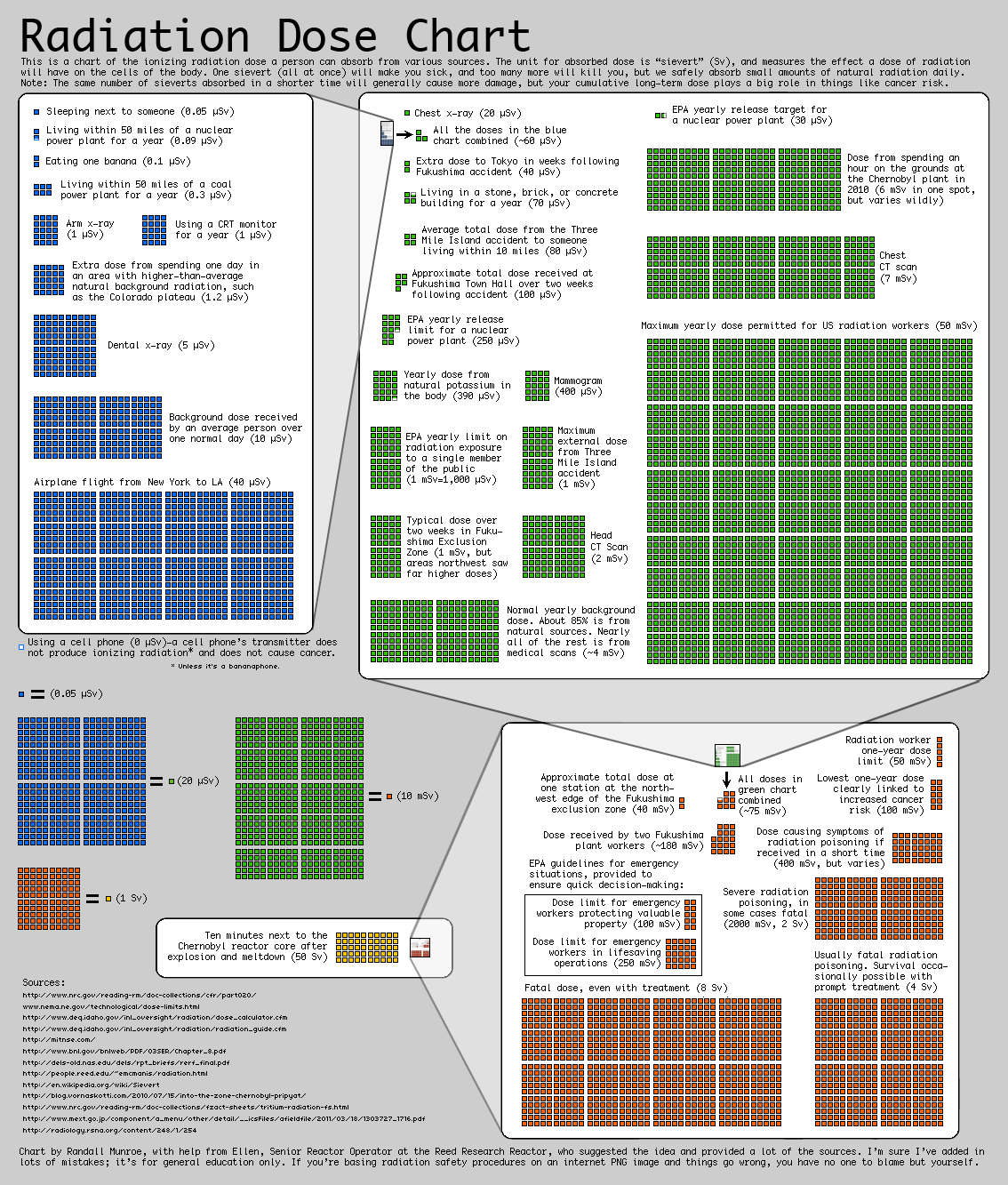
I have been curious about nuclear power and its potential problems for a long time. In the early days of the atom, it was touted as the new miracle energy that would put everyone on easy street. As with most things so new and wonderful, I have grown to have my doubts, not only about the wonderful promises of life changing improvements, but the doom of life changing disasters.
If a little is good, a lot has to be great, seems to be the cause of most of man kinds problems. Things that are used as directed tend to be fine in most cases, it is when we use too much of a good thing we get in trouble. That seems to be the main problem with nuclear energy.
Nuclear is scary and expensive. Because of that, governments and utilities try to cram too much in small spaces to compromise the fear and cost factors. Then if something goes wrong any is too much. Maybe people will never understand to read directions before use.
Since the situation in Fukushima started, I have spent more time than I should trying to put things in perspective. The nuclear problem is mainly due to trying to get too much out of the Fukushima power plant. At the time the plants were built, they produced huge amounts of energy for the time, with not a great deal of efficiency. The fuel when Fukushima was first built was fairly inexpensive for the time, the safety requirements were the main cost. The game plan to build bigger may have sounded great, but was not all that bright. Then to try to get the plants to produce as long as possible was not too bright either. This is not just a Japanese thing.
Too big is the main problem. While the technology of nuclear power in not difficult to understand in today's world, we still seem to be befuddled by it. More nuclear fuel takes longer to shut down than less. There are pretty simple calculation that you can make to see how much trouble you want to deal with in controlling nuclear power. In the old style reactors, the gross energy is three times the net energy produced. The emergency shut down energy is 7% of the gross and decreases rapidly to 1.5% of the gross over the next 24 hours. To safely shutdown a reactor you have to be able to deal with the 7% quickly and the 1.5% as it decreases for a long time. If you can't deal with it, then there will be a big loss of investment. You have trashed an expensive investment, loss a large portion of you electrical base load, scared the hell out of millions of people and have to pay damages to all the people that have had to change their daily lives to accommodate your screw up. To reduce the impact once the mega plant has been built, you have to use what the design and situation allows to control the damage.
The Japanese dealt with Fukushima as best they could under the conditions. Most people have great hind sight, so it is easy for folks sitting a home to point out all the things that could have been do better. Many say the best solution was to not get into that situation to begin with. I am not particularly better than most at arm chair quarterbacking, but there are a few things I think I have learned from Fukushima.
The first thing I notice is that the older the plant, the more you have to plan for things going wrong. Planning for each and every thing that happened is close to impossible. You can plan for the absolute worst case. That would be that the plant never shutdown and there was no water, no load, no nothing to stop things from going bad.
In a worst case, the worst thing is having to evacuate a sizable population. The area to be evacuated is dependent on the potential amount and spread of radiation. No matter how well the nuclear plant is designed, the potential fallout is has to be considered. Twenty to thirty kilometers is normal for a nuclear power plant of Fukushima's size. That area appears to be based on the size of the individual reactors not the total number of reactors. It takes energy to spread enough radiation and it is the individual reactor energy that would determine the average potential radiation spread. There reactors may spread more radiation, but the distance would be close to the same as the single largest reactor. In terms of human lives and livelihood, the most pressing safety concern, that evacuation area should be minimized.
Time and money can solve most any problem related to a nuclear power plant accident, except for the human element. Smaller individual reactors even with many more installed on a site, reduces the potential impact on lives.
Better understanding of the impact of radiation fallout can also reduce the evacuation area. I have noticed that I am not a part of as small a group as I was ten years ago. Advances in nuclear medicine have educated many more people to the truth of radiation. While it is still dangerous, the human body can tolerate a lot more than previously thought. We have even learned over the past 30 years that every day we are exposed to more naturally than we would have ever imagined. While many radioactive isotopes are no longer common in nature, they have similar isot0pes that are and we are continuously exposed to in varying amounts.
Most of my curiosity about radiation started years ago with the "discovery" of radon levels in homes. I used to test indoor air quality and I avoided jumping on the radon testing bandwagon. The health impact of low levels of radon were nothing compared to common molds. Water in homes where water is not supposed to be, is the primary cause of indoor air pollution followed by out gassing of volatile organic compounds. Knowing this, I have little problem living near a nuclear power plant but would be adamantly opposed to living near a chemical plant. I would have days or weeks to evacuate from a nuclear incident, but could be dead before the alarms sounded if I lived in Bopal, India, for example. Long term exposure to low levels of toxic chemical can have a much more devastating impact than low levels of radiation.
Safe use of nuclear energy demands knowing the potential for harmful levels of fallout in a worse case and understanding what levels are truly harmful. The first is known and can be reduced. The second is the bugger. Japan made a mistake by not establishing more realistic standards of harmful radiation levels. They had to revise maximum levels from their unrealistic standards to more realistic levels while a nuclear situation was in progress. That creates mistrust and that trust may never be regained.
The US Environmental Protection Agency is on the same poor path. They are imposing irresponsible maximum standards that are fractions of the standard guidelines of the US Nuclear Regulatory Commission which are themselves very conservative. For example, the Yucca Mountain National nuclear waste storage facility has EPA limits of 15 Millirem per year above background. 15 millirem per year is 1.7 microrem per hour equivalent to 17 nanosieverts per hour or 0.017 microsieverts per hour. One thousand times that, 1.7 microsieverts per hour, or 14.9 millisieverts per year is about one quarter the radiation exposure limit for people employed in nuclear medicine. With the EPA standard, people living in the area are exposed to more radiation if they have two smoke detectors in their homes (37 kiloBecquerel per detector). Think about that. 37,000 Becquerel per smoke detector. Of course, Becquerel is not directly convertible to Sieverts unless ingested, still it is an illuminating comparison.
Radiation is a part of our lives, isn't it time to start trying to better understand it?
Saturday, May 21, 2011
Japan's Radioactive Tea
A type of tea in Japan has been found to be contaminated with Cesium 137. The Japanese governments limit for radiation of the tea is 500 Becquerels per kilogram. Since tea is pretty important in Japanese culture, some citizens are wondering if the limit is really needed. The Japan Probe post on Radioactive Tea in Japan gives a good account of the situation. One of the main issues is tea is dried, steeped then drank, but the Japanese regulation is for un-dried tea like it is a vegetable to be eaten.
The unit Becquerel means one disintegration per second. In the USA we use the unit Curries were one Currie is equal to 37 million disintegrations per second. A disintegration is a pop or count on a Geiger counter. For the average tea drinker this is pretty scary and most have know clue it the tea is really bad for them since they have know clue what a Becquerel means health wise.
The Nuclear Regulatory Commission in the United States came up with the Banana Dose to help people understand radiation. The Banana Dose (BD) is considered to be 520 picocurries. Using a handy dandy converter a BD is 19 Becquerels. So 500 Bequerels is a bunch of bananas. Since most people don't eat tea fresh, it is dried first which decreases its weight which would increase the radiation per weight. But only a small amount of dried tea leaves are used at a time and not all the radiation may be dissolved in the tea after steeping. Interesting puzzle.
After drying, tea weighs about 15% of what it did straight off the tree. So a kilogram of dried tea that tested at 500 becquerel per kilogram fresh, would test roughly 3333 becquerel per kilogram dried. The average strong tea bag contains roughly 3.3 grams per Wikipedia, so a mug of radioactive tea would contain about 11 Becquerels. What I am calling a mug is about 1/4 liter. So one liter of radioactive tea would be about 44 Becquerels worth of radiation, if all of the radiation in the tea leaves dissolved in the water. For infants, the Japanese limit per liter of water for radiation is 100 becquerels and adults 300. So at first blush, it does not look like the 500 Becquerel limit for fresh tea leaves is all that reasonable. One thousand Becquerels per kilogram of fresh tea would bring the per liter of consumed tea to 88 Becquerels, which should be safe even for infants if it were water, milk, juices or any other liquid.
I just used rough numbers, but it looks like the tea should be pretty safe. Since the 100 Becquerel limit is very conservative to begin with, I am pretty sure it is safe at 1000 Becquerels per kilogram of fresh tea leaves. I would think the Japanese government would test the tea as it is used before setting a weird limit on a product unless there is a common food use for fresh tea leaves. It would also be nice if they used the banana dose equivalent more when describing the safety of food stuffs.
It would also be interesting to know if vegetables were tested after rinsing. Most radioactive isotopes wash into the soil. Some are taken in by growing plants, but the majority remains in the soil. Cesium is absorb in the human body similarly to potassium. According some of the sources I have read, most of the cesium ingested passes through the body in about 100 days. Since it is chemically similar to potassium and sodium, that makes sense, but more could be retained.
While Fukushima is a dangerous mess, there is plenty to be learned from the misfortune of the Japanese people. Hopefully, a better understanding of ionizing radiation will be one of the lessons learned.
The unit Becquerel means one disintegration per second. In the USA we use the unit Curries were one Currie is equal to 37 million disintegrations per second. A disintegration is a pop or count on a Geiger counter. For the average tea drinker this is pretty scary and most have know clue it the tea is really bad for them since they have know clue what a Becquerel means health wise.
The Nuclear Regulatory Commission in the United States came up with the Banana Dose to help people understand radiation. The Banana Dose (BD) is considered to be 520 picocurries. Using a handy dandy converter a BD is 19 Becquerels. So 500 Bequerels is a bunch of bananas. Since most people don't eat tea fresh, it is dried first which decreases its weight which would increase the radiation per weight. But only a small amount of dried tea leaves are used at a time and not all the radiation may be dissolved in the tea after steeping. Interesting puzzle.
After drying, tea weighs about 15% of what it did straight off the tree. So a kilogram of dried tea that tested at 500 becquerel per kilogram fresh, would test roughly 3333 becquerel per kilogram dried. The average strong tea bag contains roughly 3.3 grams per Wikipedia, so a mug of radioactive tea would contain about 11 Becquerels. What I am calling a mug is about 1/4 liter. So one liter of radioactive tea would be about 44 Becquerels worth of radiation, if all of the radiation in the tea leaves dissolved in the water. For infants, the Japanese limit per liter of water for radiation is 100 becquerels and adults 300. So at first blush, it does not look like the 500 Becquerel limit for fresh tea leaves is all that reasonable. One thousand Becquerels per kilogram of fresh tea would bring the per liter of consumed tea to 88 Becquerels, which should be safe even for infants if it were water, milk, juices or any other liquid.
I just used rough numbers, but it looks like the tea should be pretty safe. Since the 100 Becquerel limit is very conservative to begin with, I am pretty sure it is safe at 1000 Becquerels per kilogram of fresh tea leaves. I would think the Japanese government would test the tea as it is used before setting a weird limit on a product unless there is a common food use for fresh tea leaves. It would also be nice if they used the banana dose equivalent more when describing the safety of food stuffs.
It would also be interesting to know if vegetables were tested after rinsing. Most radioactive isotopes wash into the soil. Some are taken in by growing plants, but the majority remains in the soil. Cesium is absorb in the human body similarly to potassium. According some of the sources I have read, most of the cesium ingested passes through the body in about 100 days. Since it is chemically similar to potassium and sodium, that makes sense, but more could be retained.
While Fukushima is a dangerous mess, there is plenty to be learned from the misfortune of the Japanese people. Hopefully, a better understanding of ionizing radiation will be one of the lessons learned.
Sunday, May 15, 2011
Fukushima Reactor Meltdown- More Thoughts
Japan Probe, an interesting website I found during the earthquake/tsunami/nuclear disaster, reported recently that the Fukushima event was a confirmed meltdown. That is not particularly surprising, Chernobyl and Three Mile Island (TMI) were also meltdowns. The Fukushima situation ranks in the middle of Chernobyl and TMI as far as meltdowns go.
In the Japan Probe post, I saw my first artist's depiction of the core for reactor 1 at Fukushima Daiichi. Wikipedia has a similar depiction for TMI and a real picture of Chernobyl.
Chernobyl, most people will tell you, was an extremely poor design. There was not much thought put into containment.

As you can see from the Wikipedia picture above, the design lived up to expectations and did a poor job of containment. Unfortunately, for the Russians, the Chernobyl accident improved the World's understanding of the risks of nuclear power. It did too good of a job at that really. Only people that can compare the design realities get the real picture.
One thing that Chernobyl should have taught people is that the China Syndrome movie was just that, a movie meant to be exciting and suspenseful. The China Syndrome is a ludicrous description of more than a worse case. A nuclear meltdown will not burn its way to China. It can cause a very nasty situation.
TMI was a frightening situation with little nasty radiation fallout. The totally different design of the TMI reactor shows that responsible design makes a huge difference in end results.

The artist depiction above illustrates that a fifty percent meltdown was contained in the pressure vessel as it was designed to do.

The photo of the artists depiction of reactor 1 at Fukushima is not as detailed as the TMI one, it will take some time to determine more exactly what happened, but it is the best we have for now. The report Japan probe links to indicates that the plant operators think the melted fuel may have burn a or several small holes in the bottom of the reactor pressure vessel which allowed radioactive water to leak into the reactor dry well, then the containment building and then underground to the turbine building. This seems a little unlikely to me, but possible I guess.
My theory was that attempts to cool the reactor with limited water caused leakage at the piping connections to the reactor near the penetration of the high pressure steam pipe penetration of the containment building. That would give the radioactive water an easier path to the turbine building.
During the attempt to cool the reactor, the operators pumped huge amounts of water which could over flow the dry well, which could fill the containment building, but that does not appear to be the case. How the water leaked out of the dry well is a mystery to me, but the operators are there and I am not. I still have my doubts, but that does not mean anything.

This drawing of the Fukushima reactor containment design looks to me like leakage from the containment structures to the turbine room would be a little difficult. Leaking into the dry well though would not be. The same thermal expansion and contraction probable with the sporadic and inadequate water available could somewhat easily cause leakage at the control rod penetration of the reactor pressure vessel. The two penetrations that the control rods move through complicate the leakage path, but it is possible.
The interesting part of the design to me is that even with the lower control rod mounting, it would be extremely difficult for molten fuel to burn through the pressure vessel containment. The main pressure vessel is made of layers of steel which greatly reduces the chance of thermal stress fracturing and burn through. I am not sure, but the second penetration is probably layered steel as well.
In any case, the amount of water they were pumping in had to go somewhere. Whether I am right or not does not matter, what does matter is the that the old design basically did what it was designed to do, contain the fuel.
The situation with the spent fuel pools, especially at reactor 4, interests me. All of the pools should have been safe for at least 6 days without cooling or make-up water. SFP 4 had the highest decay heat load, so it is logical that it would have become a problem first. The SFP 4 situation may have exposed a design or operational flaw. Generally, make-up water flow, nearly twice the evaporation rate, would be available. The volume and depth of the pool should allow more than enough time to re-establish make-up water flow. This may have been over looked as a priority, operationally or due to the overall situation, which exposes a design issue. In turn, that may have exposed a near empty design flaw.
The pools are designed for safety when full without cooling and when empty. When full, make-up water is all that is required and there is nearly a week to find it. With the pool completely empty, the storage racks have enough ventilation for passive cooling. The problem is that when nearly empty, the ventilation is blocked by water at the bottom of the racks, which can cause over heating of the rod assemblies. This issue is sure to be investigated as a priority concern.
In the Japan Probe post, I saw my first artist's depiction of the core for reactor 1 at Fukushima Daiichi. Wikipedia has a similar depiction for TMI and a real picture of Chernobyl.
Chernobyl, most people will tell you, was an extremely poor design. There was not much thought put into containment.

As you can see from the Wikipedia picture above, the design lived up to expectations and did a poor job of containment. Unfortunately, for the Russians, the Chernobyl accident improved the World's understanding of the risks of nuclear power. It did too good of a job at that really. Only people that can compare the design realities get the real picture.
One thing that Chernobyl should have taught people is that the China Syndrome movie was just that, a movie meant to be exciting and suspenseful. The China Syndrome is a ludicrous description of more than a worse case. A nuclear meltdown will not burn its way to China. It can cause a very nasty situation.
TMI was a frightening situation with little nasty radiation fallout. The totally different design of the TMI reactor shows that responsible design makes a huge difference in end results.

The artist depiction above illustrates that a fifty percent meltdown was contained in the pressure vessel as it was designed to do.

The photo of the artists depiction of reactor 1 at Fukushima is not as detailed as the TMI one, it will take some time to determine more exactly what happened, but it is the best we have for now. The report Japan probe links to indicates that the plant operators think the melted fuel may have burn a or several small holes in the bottom of the reactor pressure vessel which allowed radioactive water to leak into the reactor dry well, then the containment building and then underground to the turbine building. This seems a little unlikely to me, but possible I guess.
My theory was that attempts to cool the reactor with limited water caused leakage at the piping connections to the reactor near the penetration of the high pressure steam pipe penetration of the containment building. That would give the radioactive water an easier path to the turbine building.
During the attempt to cool the reactor, the operators pumped huge amounts of water which could over flow the dry well, which could fill the containment building, but that does not appear to be the case. How the water leaked out of the dry well is a mystery to me, but the operators are there and I am not. I still have my doubts, but that does not mean anything.

This drawing of the Fukushima reactor containment design looks to me like leakage from the containment structures to the turbine room would be a little difficult. Leaking into the dry well though would not be. The same thermal expansion and contraction probable with the sporadic and inadequate water available could somewhat easily cause leakage at the control rod penetration of the reactor pressure vessel. The two penetrations that the control rods move through complicate the leakage path, but it is possible.
The interesting part of the design to me is that even with the lower control rod mounting, it would be extremely difficult for molten fuel to burn through the pressure vessel containment. The main pressure vessel is made of layers of steel which greatly reduces the chance of thermal stress fracturing and burn through. I am not sure, but the second penetration is probably layered steel as well.
In any case, the amount of water they were pumping in had to go somewhere. Whether I am right or not does not matter, what does matter is the that the old design basically did what it was designed to do, contain the fuel.
The situation with the spent fuel pools, especially at reactor 4, interests me. All of the pools should have been safe for at least 6 days without cooling or make-up water. SFP 4 had the highest decay heat load, so it is logical that it would have become a problem first. The SFP 4 situation may have exposed a design or operational flaw. Generally, make-up water flow, nearly twice the evaporation rate, would be available. The volume and depth of the pool should allow more than enough time to re-establish make-up water flow. This may have been over looked as a priority, operationally or due to the overall situation, which exposes a design issue. In turn, that may have exposed a near empty design flaw.
The pools are designed for safety when full without cooling and when empty. When full, make-up water is all that is required and there is nearly a week to find it. With the pool completely empty, the storage racks have enough ventilation for passive cooling. The problem is that when nearly empty, the ventilation is blocked by water at the bottom of the racks, which can cause over heating of the rod assemblies. This issue is sure to be investigated as a priority concern.
Tuesday, April 19, 2011
Nuclear Power Thoughts with Fukushima in Mind
I am pro nuclear power, with a few caveats. The Fukushima situation has strengthened most of my opinions about nuclear and anti-nuclear activists.
Activists for the most part are driven by their agenda and have little use for facts or fact checking. There are exceptions of course, but not that many really. They will quote any source that gives them ammunition for their crusade no matter how outdated or wrong it may be. The activists have been out in full force with Fukushima, but this time it seems their zeal, despite evidence, has bit them in the ass.
George Monboit, a left wing type blogger picked up on the lack of facts thing. Why Does It Matter, he is focused on the facts for a change after being duped for quite some time. Why he has suddenly started to use logic and reason is a bit of a puzzle. The non-sense has been out there for a long time, all he had to do was question the logic, i.e. build a bullshit detector. His revelation may be past due, but it has come.
I had mentioned a few passionate activists spreading lies without having a clue they were just pawns of other bullshitters. The Penn and Teller Di-hydrogen Monoxide video is a way of life for many of the activists. Some though are the bullshit originators. As the Japanese radiation situation unfolded, one activist posted a radiation map. The data is supposedly real time updated daily by SPEEDI, whoever they are. The original posting of the map mentioned that the data for Fukushima and a neighboring prefecture were not posted and insinuated that a possible Japanese Government cover-up was involved. Well, the real time data from SPEEDI stopped 17 days ago and the little anti-government note is missing. No, I do not believe government censorship was involved, more like the situation was getting better which went against his agenda. By the way, data for Fukushima prefecture and the neighboring prefecture were available from very early on at the MEXT website. It is in PDF form so the concerned activist would have actually had to look.
There will be more quotes available for activist use soon as the legal process for Fukushima begins. Expert witnesses can be found to testify for or against anything. So the misinformation hasn't even started. It will be interesting to find if the Japanese legal system is bullshit tolerant, for there will be plenty of bullshit to spread. All of this will confuse the real issues which I had hoped would finally be addressed. My main one is the degree of safety of light water reactor designs.
The basic light water reactor design is very safe though not terribly efficient. Using regular water as a coolant and moderator makes these reactors self regulating. Maximum chain reactions requires the water moderator. Should the water over heat, air bubbles slow the reaction. If all the water disappears the reaction nearly stops. It really is a very safe design. The problem with Fukushima and Three Mile Island is the size of the reactors. While they still have the inherent safety of the design, the mass of fuel and the residual temperature of that mass is enough to cause fuel damage, i.e. melting, in a loss of coolant event.
Because of the fuel damage, imaginations run wild. The China Syndrome comes to mind and people forget that it is a fantasy, a movie, not the real world. Once people start with the theoretical, it is Katey bar the door, anything goes. The designs, even the old General Electric Mark I without recommended modifications, will never produce a China Syndrome event. Much of the radiation released in Japan is due to attempts to save the population from something that cannot happen, a China Syndrome.
While imaginative use of the theoretical can convince people that doom is on its way, the real physics behind the design shows there is very little probability of a total meltdown burning through the reactor pressure vessel much less the concrete containment building. Unfortunately, this design feature has never been fully tested, so the theoretical can be brought into play by activists.
Smaller light water reactors eliminate even the theoretical possibility of a catastrophic meltdown. A few hours after the control rods are placed to stop the reaction, the energy of the reactor mass drops to about 1.5% of its maximum operating energy. The Fukushima reactors where rated for about 750 megawatts with roughly a 33% efficiency. The maximum power of the reactors allowing for efficiency is 2250 megawatts, 1.5% of that is 33.75 megawatts or 33,750 Kilowatts. That is enough energy to cause melting of the fuel rod cladding and some melting of the fuel oxide which has a higher melting point. That is enough energy to melt some of the way through the massive bottom of the reactor pressure vessel, but not enough to penetrate en mass. A smaller light water reactor designed for say 200 megawatts at the same efficiency would have a maximum energy of about 600 megawatts and a few hours after shut down, a residual energy of 9 megawatts. This amount of energy could cause some melting of the fuel cladding, but is unlikely to cause melting of the fuel oxide, so there is little chance of a major fuel damage scenario. That means the accident would be just that, a accident that is fairly easily corrected and the reactor could quite possibly be placed back into service. There is a huge potential cost difference between the design scales.
An even smarter design is 50 Megawatts, then with 150 megawatts maximum energy reduced to 1.5% you have 2.25 megawatts residual energy. That is 2,250 kilowatts which is not enough to reliably provide power to the average US household (Correction: that should be neighborhood not household, an average household is about 20 kilowatts). It is unlikely that there would be any damage at all to the reactor core with a loss of coolant accident.
These smaller designs also do something very interesting, by eliminating the theoretical dooms day scenario, they can actually be evaluated by insurance actuaries so that they can be insured by the utility instead of the government. They can even be used in destructive testing to "prove" what would happen in a realistic worst case accident. Eliminating the bizarre fantasies of the theoretical with realism is a good thing.
A less than realistic destructive test, one where say the reactor is run full bore without coolant, would cause some meltdown, which would damage the pressure vessel and core controls to the point that the reactor is unusable, but even that would not produce a very impressive accident. Then you could assume that Homer Simpson's less intelligent cousin was in charge and tried to cool the reactor with just enough water to produce maximum steam, therefore maximum radioactive fallout, kinda like at Fukushima, which would produce nearly a Three Mile Island event. In other words, small modular light water reactors are damn near idiot proof! (Added: Here is another view of small modular reactors from safety and security standpoints.)
Small modular reactors in the range of 50 to 150 megawatts each, used for a nuclear power parks, can produce equivalent power output at a more reasonable cost with much greater safety. That makes way too much sense though, I mean realistic regulations might even become part of life if we lose the theoretical.
Since facts are not much use in the activist world, we can always go with man powered treadle devices to recharge our electric cars in a few days. Then, there is no real need to think, is there?
Activists for the most part are driven by their agenda and have little use for facts or fact checking. There are exceptions of course, but not that many really. They will quote any source that gives them ammunition for their crusade no matter how outdated or wrong it may be. The activists have been out in full force with Fukushima, but this time it seems their zeal, despite evidence, has bit them in the ass.
George Monboit, a left wing type blogger picked up on the lack of facts thing. Why Does It Matter, he is focused on the facts for a change after being duped for quite some time. Why he has suddenly started to use logic and reason is a bit of a puzzle. The non-sense has been out there for a long time, all he had to do was question the logic, i.e. build a bullshit detector. His revelation may be past due, but it has come.
I had mentioned a few passionate activists spreading lies without having a clue they were just pawns of other bullshitters. The Penn and Teller Di-hydrogen Monoxide video is a way of life for many of the activists. Some though are the bullshit originators. As the Japanese radiation situation unfolded, one activist posted a radiation map. The data is supposedly real time updated daily by SPEEDI, whoever they are. The original posting of the map mentioned that the data for Fukushima and a neighboring prefecture were not posted and insinuated that a possible Japanese Government cover-up was involved. Well, the real time data from SPEEDI stopped 17 days ago and the little anti-government note is missing. No, I do not believe government censorship was involved, more like the situation was getting better which went against his agenda. By the way, data for Fukushima prefecture and the neighboring prefecture were available from very early on at the MEXT website. It is in PDF form so the concerned activist would have actually had to look.
There will be more quotes available for activist use soon as the legal process for Fukushima begins. Expert witnesses can be found to testify for or against anything. So the misinformation hasn't even started. It will be interesting to find if the Japanese legal system is bullshit tolerant, for there will be plenty of bullshit to spread. All of this will confuse the real issues which I had hoped would finally be addressed. My main one is the degree of safety of light water reactor designs.
The basic light water reactor design is very safe though not terribly efficient. Using regular water as a coolant and moderator makes these reactors self regulating. Maximum chain reactions requires the water moderator. Should the water over heat, air bubbles slow the reaction. If all the water disappears the reaction nearly stops. It really is a very safe design. The problem with Fukushima and Three Mile Island is the size of the reactors. While they still have the inherent safety of the design, the mass of fuel and the residual temperature of that mass is enough to cause fuel damage, i.e. melting, in a loss of coolant event.
Because of the fuel damage, imaginations run wild. The China Syndrome comes to mind and people forget that it is a fantasy, a movie, not the real world. Once people start with the theoretical, it is Katey bar the door, anything goes. The designs, even the old General Electric Mark I without recommended modifications, will never produce a China Syndrome event. Much of the radiation released in Japan is due to attempts to save the population from something that cannot happen, a China Syndrome.
While imaginative use of the theoretical can convince people that doom is on its way, the real physics behind the design shows there is very little probability of a total meltdown burning through the reactor pressure vessel much less the concrete containment building. Unfortunately, this design feature has never been fully tested, so the theoretical can be brought into play by activists.
Smaller light water reactors eliminate even the theoretical possibility of a catastrophic meltdown. A few hours after the control rods are placed to stop the reaction, the energy of the reactor mass drops to about 1.5% of its maximum operating energy. The Fukushima reactors where rated for about 750 megawatts with roughly a 33% efficiency. The maximum power of the reactors allowing for efficiency is 2250 megawatts, 1.5% of that is 33.75 megawatts or 33,750 Kilowatts. That is enough energy to cause melting of the fuel rod cladding and some melting of the fuel oxide which has a higher melting point. That is enough energy to melt some of the way through the massive bottom of the reactor pressure vessel, but not enough to penetrate en mass. A smaller light water reactor designed for say 200 megawatts at the same efficiency would have a maximum energy of about 600 megawatts and a few hours after shut down, a residual energy of 9 megawatts. This amount of energy could cause some melting of the fuel cladding, but is unlikely to cause melting of the fuel oxide, so there is little chance of a major fuel damage scenario. That means the accident would be just that, a accident that is fairly easily corrected and the reactor could quite possibly be placed back into service. There is a huge potential cost difference between the design scales.
An even smarter design is 50 Megawatts, then with 150 megawatts maximum energy reduced to 1.5% you have 2.25 megawatts residual energy. That is 2,250 kilowatts which is not enough to reliably provide power to the average US household (Correction: that should be neighborhood not household, an average household is about 20 kilowatts). It is unlikely that there would be any damage at all to the reactor core with a loss of coolant accident.
These smaller designs also do something very interesting, by eliminating the theoretical dooms day scenario, they can actually be evaluated by insurance actuaries so that they can be insured by the utility instead of the government. They can even be used in destructive testing to "prove" what would happen in a realistic worst case accident. Eliminating the bizarre fantasies of the theoretical with realism is a good thing.
A less than realistic destructive test, one where say the reactor is run full bore without coolant, would cause some meltdown, which would damage the pressure vessel and core controls to the point that the reactor is unusable, but even that would not produce a very impressive accident. Then you could assume that Homer Simpson's less intelligent cousin was in charge and tried to cool the reactor with just enough water to produce maximum steam, therefore maximum radioactive fallout, kinda like at Fukushima, which would produce nearly a Three Mile Island event. In other words, small modular light water reactors are damn near idiot proof! (Added: Here is another view of small modular reactors from safety and security standpoints.)
Small modular reactors in the range of 50 to 150 megawatts each, used for a nuclear power parks, can produce equivalent power output at a more reasonable cost with much greater safety. That makes way too much sense though, I mean realistic regulations might even become part of life if we lose the theoretical.
Since facts are not much use in the activist world, we can always go with man powered treadle devices to recharge our electric cars in a few days. Then, there is no real need to think, is there?
Monday, April 18, 2011
Future Farming in Fukushima Prefecture
The radioactive fall out in Fukushima is a concern for many, but the farmers and residents of the prefecture are the ones with the real concerns. There is great concern by many that purchase food stuff grown in the prefecture, that the meats and produce be safe.
One area that the prefecture can be compared to is Bikini Atoll, the site of hydrogen bomb tests following World War II. This is a very interesting comparison in that it involves both real and legal assessment of the risks. Legally, the once and future residents want the cleanest possible conditions which have much lower background radiation standards than many places in the world. A battle between the US Environmental Protection Agency (EPA) and the Nuclear Regulatory Commission (NRC)is at the heart of the issue.
To many, including the NRC, the EPA regulatory limits are impractically restrictive. From the Bikini Atoll website, "To give one an ideas of how strict this 15-millirem standard is, the EPA stated that the standard means that a person living eleven miles from the Yucca Mountain site, the distance to which the standard applies, will absorb less radiation annually than a person receives from two round-trip transcontinental flights in the United States. The EPA also stated that background radiation exposes the average American to 360-millrem of radiation annually, while three chest x-rays total about 18-millirem." The Yucca Mountain case was used by the Bikinians to press for tighter clean-up standards.
It is understandable that people are worried and afraid of radiation. The standards are so poorly defined that few, even experts in the field, are in agreement to what is reasonable. 100 millirem, equivalent to 1,000 microsieverts per year is considered a reasonable background dosage even though many places in the world have higher natural background radiation doses. To my knowledge, there are no studies showing that 1,000 millirems a year background have any indication of increase health risk. The 100 millirem standard appears to already be very conservative which is equivalent to approximately 0.1 microsieverts per hour.
1,000 millirem per year (~1.0 microsieverts per hour)is greater than the effective annual average combination dose (background and other exposure)of 3000 microsieverts per year (~0.34 microsieverts per hour), but much less than areas with high natural background radiation and no evident radiation health risk. "In Guarapari, Brazil, a city of 80 000 inhabitants built on the seaside, peak measurements made by EFN on the thorium-rich beach were as high as 40 microSv/hour (about 200 times higher than the average natural background radiation in other areas of the world)." Based on other regions with higher background radiation, it would seem that 1 to 10 microsieverts per hour is not an unreasonable estimate of safe background exposure.
Ultimately, that decision should be up to the residents of area impacted by the Fukushima NPP accident to make. Another question farmers in the area would have is the uptake of radioactive isotopes by crops. Cesium 137 is the primary fall out isotope. By the same study of Bikini Atoll, potassium fertilizers inhibit plant uptake of cesium 137. Proper fertilization to build potassium levels along with normal tilling and erosion, should enable most effected farmland to be productive without any significant increase in normal radiation level.
Realistically, the radiation damage is much less than most in the press have indicated. Legally, is a different matter. Many residents may opt for much tighter standards and the larger compensation they are likely to win through the courts.
The situations, both in Japan and Bikini Atoll, illustrate the need for much clearer definition of radiation exposure standards. With the inconstant and overly conservative current limits, the nuclear industry may not be viable. Moving to more realistic standards is sure to be opposed by anti-nuclear groups responsible for the much tighter standards that are in place now. It will be interesting to see if logic or passion wins.
One area that the prefecture can be compared to is Bikini Atoll, the site of hydrogen bomb tests following World War II. This is a very interesting comparison in that it involves both real and legal assessment of the risks. Legally, the once and future residents want the cleanest possible conditions which have much lower background radiation standards than many places in the world. A battle between the US Environmental Protection Agency (EPA) and the Nuclear Regulatory Commission (NRC)is at the heart of the issue.
To many, including the NRC, the EPA regulatory limits are impractically restrictive. From the Bikini Atoll website, "To give one an ideas of how strict this 15-millirem standard is, the EPA stated that the standard means that a person living eleven miles from the Yucca Mountain site, the distance to which the standard applies, will absorb less radiation annually than a person receives from two round-trip transcontinental flights in the United States. The EPA also stated that background radiation exposes the average American to 360-millrem of radiation annually, while three chest x-rays total about 18-millirem." The Yucca Mountain case was used by the Bikinians to press for tighter clean-up standards.
It is understandable that people are worried and afraid of radiation. The standards are so poorly defined that few, even experts in the field, are in agreement to what is reasonable. 100 millirem, equivalent to 1,000 microsieverts per year is considered a reasonable background dosage even though many places in the world have higher natural background radiation doses. To my knowledge, there are no studies showing that 1,000 millirems a year background have any indication of increase health risk. The 100 millirem standard appears to already be very conservative which is equivalent to approximately 0.1 microsieverts per hour.
1,000 millirem per year (~1.0 microsieverts per hour)is greater than the effective annual average combination dose (background and other exposure)of 3000 microsieverts per year (~0.34 microsieverts per hour), but much less than areas with high natural background radiation and no evident radiation health risk. "In Guarapari, Brazil, a city of 80 000 inhabitants built on the seaside, peak measurements made by EFN on the thorium-rich beach were as high as 40 microSv/hour (about 200 times higher than the average natural background radiation in other areas of the world)." Based on other regions with higher background radiation, it would seem that 1 to 10 microsieverts per hour is not an unreasonable estimate of safe background exposure.
Ultimately, that decision should be up to the residents of area impacted by the Fukushima NPP accident to make. Another question farmers in the area would have is the uptake of radioactive isotopes by crops. Cesium 137 is the primary fall out isotope. By the same study of Bikini Atoll, potassium fertilizers inhibit plant uptake of cesium 137. Proper fertilization to build potassium levels along with normal tilling and erosion, should enable most effected farmland to be productive without any significant increase in normal radiation level.
Realistically, the radiation damage is much less than most in the press have indicated. Legally, is a different matter. Many residents may opt for much tighter standards and the larger compensation they are likely to win through the courts.
The situations, both in Japan and Bikini Atoll, illustrate the need for much clearer definition of radiation exposure standards. With the inconstant and overly conservative current limits, the nuclear industry may not be viable. Moving to more realistic standards is sure to be opposed by anti-nuclear groups responsible for the much tighter standards that are in place now. It will be interesting to see if logic or passion wins.
Subscribe to:
Posts (Atom)