Figuring out why is the fun in life. Things should make sense, except for women, of course, but the universe expanding just don't make much sense.
What appears to be happening is the speed of light is decreasing as dark matter in the universe increases. So what does that mean?
In the Stefan-Boltzman equation there are two constants,5.67e-8 and ~0.926, emissivity. But is that emissivity for a black body space or both? I am thinking both. Since the emissivity of water is ~0.995 and the constant in the S-B equation is 0.926, my first guess would be that the emissivity of the most perfect black body that could exist in nature is approximately that of water. That means that the emissivity of space could be 0.069. Why would that not be zero? Dark matter.
Hum? If the emissivity of space is not perfectly zero, what happens to light passing through space? It interacts with space creating dark energy. Every one knows that there are tiny traces of hydrogen floating around in space. When light interacts with hydrogen, maybe one photon in billions and billions impacts the hydrogen molecule perfectly dead center, the photon, which is also has a mass of 1/billions and billions, creates a different form of energy and that transition is subject to entropy. No energy flow ever gets a free ride because of entropy, not even light.
How would increasing dark energy collapsing into dark matter change our perception of light? My guess is that the speed of light would appear to change. Perhaps the speed of light does change. I'll look into that in the future.
But since no energy ever gets a free ride, the equation makes perfectly good sense to me. What is the temperature of space again? Perhaps it may be worthy of a little closer inspection?
Update: One commenter thinks I am whacked. That is true. But if the expansion of the universe appears to be accelerating, that is kinda thought provoking. Since there a few real constants, why should light be or our perception of light be constant?
Monday, October 10, 2011

Explaining why Einstien, Angstrom, Plank, Stefan-Boltzman, Poisson and Arrhenus were Right and Trenberth is Wrong is a Lot Harder Than it Should be.
If I were a scientist, I would think Trenberth would have to prove he was right. Must b e that new science. The formula conserves energy and explains the work done by the energy. Does Trenberth? The formula agrees with classic physics, does Trenberth?
What is missing?
Relativistic Heat Conduction is just as valid as the theory of global warming. The theory of relativity is just a valid as the Theory of Global Warming. Why assume the Theory of global warming is MORE valid?
That equation is not mine. Only the value of the variables in on moment of time are mine. So why not prove my values are wrong? Try it.
BTW, the abledo assumed to determine the initial value of the no GHG Earth includes cloud albedo. So the 242 would be at the top of the atmosphere, not the surface. Think about it.
http://ourhydrogeneconomy.blogspot.com/2011/10/now-to-truly-prove-i-am-whack-job.html
Since this appears to be more complicated than I thought, http://www.thescienceforum.com/pseudoscience/25027-coming-ice-age.html#post287200
So we will see if it is relativistic physic or pseudo science, which is what relativity was at first considered.
Update: From some scatter comments. "I could be wrong." Well know doubt about that! Where is the question. The approximations for temperature and flux can be +/- 5%, the dF/dT could be further off, I check at 250K and it is off by 3%, but pretty linear. Those don't appear to be enough for 100Wm-2.
"Units for emissivity?" For "Effective" emissivity, it is unit-less. It is a ratio to adjust for the surface and atmosphere. With an average surface emissivity of ~0.965 and atmosphere of 0.85 it could be between 0.825 the "benchmark" or as high as 0.88, from what I see. The benchmark uses the estimated climate sensitivity 3.3 Wm-2/K dividing by the 4Wm-2 = 3.3/4 or 0.825. It is a unitless ratio. We have conductive flux becoming retained heat as it transitions to radiant, convective flux moving contained heat from the surface then becoming retained heat as it transitions to radiant, and radiative flux cooling or heating dependent on the value of the effective emissivity. From 0.825 to approximately 0.71, it increases the heat retained, from ~0.71 to 0.61 it produces cooling. All three fluxes are interrelated. Only at the surface, for one system state, are the numbers assigned to each valid, or at least appear to be valid. The solution only describes that one state, small changes should be valid to approximate the next state. Without knowing the shape of the curves for the conductivity, connectivity and Effective emissivity, I don't what they units they should have.
The rough shape of the combined variables should be like the temperature profile of the atmosphere. Initially warming, decreasing to cooling near the tropopause, then warming in the stratosphere.
"Why triangles for the up welling and down welling?" Simplicity. In three dimensions it would be a solid Bucky ball inside a hollow Bucky ball inside a larger hollow Bucky ball. So the triangles are similar to Buckymids, pyramid like shapes.
What is missing?
Relativistic Heat Conduction is just as valid as the theory of global warming. The theory of relativity is just a valid as the Theory of Global Warming. Why assume the Theory of global warming is MORE valid?
That equation is not mine. Only the value of the variables in on moment of time are mine. So why not prove my values are wrong? Try it.
BTW, the abledo assumed to determine the initial value of the no GHG Earth includes cloud albedo. So the 242 would be at the top of the atmosphere, not the surface. Think about it.
http://ourhydrogeneconomy.blogspot.com/2011/10/now-to-truly-prove-i-am-whack-job.html
Since this appears to be more complicated than I thought, http://www.thescienceforum.com/pseudoscience/25027-coming-ice-age.html#post287200
So we will see if it is relativistic physic or pseudo science, which is what relativity was at first considered.
Update: From some scatter comments. "I could be wrong." Well know doubt about that! Where is the question. The approximations for temperature and flux can be +/- 5%, the dF/dT could be further off, I check at 250K and it is off by 3%, but pretty linear. Those don't appear to be enough for 100Wm-2.
"Units for emissivity?" For "Effective" emissivity, it is unit-less. It is a ratio to adjust for the surface and atmosphere. With an average surface emissivity of ~0.965 and atmosphere of 0.85 it could be between 0.825 the "benchmark" or as high as 0.88, from what I see. The benchmark uses the estimated climate sensitivity 3.3 Wm-2/K dividing by the 4Wm-2 = 3.3/4 or 0.825. It is a unitless ratio. We have conductive flux becoming retained heat as it transitions to radiant, convective flux moving contained heat from the surface then becoming retained heat as it transitions to radiant, and radiative flux cooling or heating dependent on the value of the effective emissivity. From 0.825 to approximately 0.71, it increases the heat retained, from ~0.71 to 0.61 it produces cooling. All three fluxes are interrelated. Only at the surface, for one system state, are the numbers assigned to each valid, or at least appear to be valid. The solution only describes that one state, small changes should be valid to approximate the next state. Without knowing the shape of the curves for the conductivity, connectivity and Effective emissivity, I don't what they units they should have.
The rough shape of the combined variables should be like the temperature profile of the atmosphere. Initially warming, decreasing to cooling near the tropopause, then warming in the stratosphere.
"Why triangles for the up welling and down welling?" Simplicity. In three dimensions it would be a solid Bucky ball inside a hollow Bucky ball inside a larger hollow Bucky ball. So the triangles are similar to Buckymids, pyramid like shapes.
Sunday, October 9, 2011
Now, to Truly Prove I am a Whack Job
Note: I am updating this as questions are answered.
Dark Energy and the Speed of Light
The fact that emissivity, conductivity and convectivity, maybe a new term, all are impedance of thermal flux, the relationship I have been trying to prove, is a unified theory of thermal flux. I am sorry I may have pissed so many people off, but societal drop outs making a merger living as a fishing guide, doesn't get paid much attention in the scientific community. I perturbed the system to estimate DWLR and I perturbed the system to get heard.
No Comments? So some thermal flux are more special than others?
Is there a perfect media for Thermal Flux?
Would OLR not generate waste heat?, Conductive flow does, why not convective and radiant?
Do any of you guys remember a guy named Angstrom? http://rabett.blogspot.com/2011/01/required-reading.html
Would it not just be simplified relativistic heat conduction?
http://en.wikipedia.org/wiki/Relativistic_heat_conduction
Explaining this simple solution is the most difficult part of the problem, If energy is conserved the work performed has to be conserved. The opposing pyramids represent the continuous energies, up, combined kinetic is converted to potential as Conductive and latent are converted to radiant. DWLR is radiant waste heat of the contentious battle against gravity.
Think about it, with no GHG The Poisson solution is the Dry adiabatic lapse rate. With water for latent only, the solution is the moist adiabatic lapse rate. With GHG, the solution is the GHG effect. The differences are purely due to the efficiency of energy conversion.
Dark Energy and the Speed of Light
The fact that emissivity, conductivity and convectivity, maybe a new term, all are impedance of thermal flux, the relationship I have been trying to prove, is a unified theory of thermal flux. I am sorry I may have pissed so many people off, but societal drop outs making a merger living as a fishing guide, doesn't get paid much attention in the scientific community. I perturbed the system to estimate DWLR and I perturbed the system to get heard.
No Comments? So some thermal flux are more special than others?
Is there a perfect media for Thermal Flux?
Would OLR not generate waste heat?, Conductive flow does, why not convective and radiant?
Do any of you guys remember a guy named Angstrom? http://rabett.blogspot.com/2011/01/required-reading.html
Would it not just be simplified relativistic heat conduction?
http://en.wikipedia.org/wiki/Relativistic_heat_conduction
Explaining this simple solution is the most difficult part of the problem, If energy is conserved the work performed has to be conserved. The opposing pyramids represent the continuous energies, up, combined kinetic is converted to potential as Conductive and latent are converted to radiant. DWLR is radiant waste heat of the contentious battle against gravity.
Think about it, with no GHG The Poisson solution is the Dry adiabatic lapse rate. With water for latent only, the solution is the moist adiabatic lapse rate. With GHG, the solution is the GHG effect. The differences are purely due to the efficiency of energy conversion.
IPCC Down Welling Radiation Violates the Law!
Update: Explaining why Einstein, Angstrom, Plank, Poisson, Stefan-Boltzman and Arrhenus were right and Trenberth wrong is a lot harder than it should be.
Update: In Thermodynamics 101 you are taught the three real laws of thermo, KISS, FRAME of REFERENCE and ASSUME You need to wrap your minds around the simple stuff before you can understand the, a little more complicated. Why I have to explain the basics of thermodynamics is beyond me.
The Greenhouse triangles show simple how choice of frame of reference results in different temperatures relative to the surface temperature.
Update: The tropopause without the radiative effect of greenhouse gases.
The law of conservation of energy that is :) Down Welling Long Wave Radiation cannot be greater than the combined sources of the radiation. Based on their own estimates, the Earth without Greenhouse gases in the atmosphere would emitted only 240 Wm-2 of energy. That value, the initial energy, is the peak sustained value that could be converted into down welling radiation.
Down welling radiation is created by the resistance of heat flux through the atmosphere, i.e. is waste heat, the result of inefficient heat transfer.
Maybe that is a big enough shocker to get people to visualize the problem from the proper frame of reference and then begin to honestly appreciate the most elegant mathematical relationship in nature.
Update: In Thermodynamics 101 you are taught the three real laws of thermo, KISS, FRAME of REFERENCE and ASSUME You need to wrap your minds around the simple stuff before you can understand the, a little more complicated. Why I have to explain the basics of thermodynamics is beyond me.
The Greenhouse triangles show simple how choice of frame of reference results in different temperatures relative to the surface temperature.
Update: The tropopause without the radiative effect of greenhouse gases.
The law of conservation of energy that is :) Down Welling Long Wave Radiation cannot be greater than the combined sources of the radiation. Based on their own estimates, the Earth without Greenhouse gases in the atmosphere would emitted only 240 Wm-2 of energy. That value, the initial energy, is the peak sustained value that could be converted into down welling radiation.
Down welling radiation is created by the resistance of heat flux through the atmosphere, i.e. is waste heat, the result of inefficient heat transfer.
Maybe that is a big enough shocker to get people to visualize the problem from the proper frame of reference and then begin to honestly appreciate the most elegant mathematical relationship in nature.
Saturday, October 8, 2011
Visualization
I was going to draw a picture. I don't know how to do that very well on the computer.
So, how about you take a piece of paper out of your printer, rummage through your junk drawer, find a pencil and a ruler.
On the bottom of the paper draw two dots 3.9 inches apart, centered would be nice.
At the top draw two dots 2.4 inches apart, centered if you can.
Near the bottom third of the paper draw two dots about 2.2 inches apart, these should be centered, Then draw lines on the right side to connect the dots. Now the left side to connect the dots.
You have now connected the dots on upwelling flux.
You may begin to understand the equation,... now.
So, how about you take a piece of paper out of your printer, rummage through your junk drawer, find a pencil and a ruler.
On the bottom of the paper draw two dots 3.9 inches apart, centered would be nice.
At the top draw two dots 2.4 inches apart, centered if you can.
Near the bottom third of the paper draw two dots about 2.2 inches apart, these should be centered, Then draw lines on the right side to connect the dots. Now the left side to connect the dots.
You have now connected the dots on upwelling flux.
You may begin to understand the equation,... now.
Just For Fun
I don't like taking life or myself too seriously. Solving that equation was fun, but no one cares. I will let everything sit for a while the do a few rewrites.
I do have a semi final form of the equation,
dF/dT=(1.32*a*Fc+4.39*b*Fl+3.3*c*Fra+1.56*d*Frs)/T where Fc is conductive flux, Fl is latent flux Fra is Radiative flux in the GHG spectrum and Frs is the radiative flux in the window to space. T, is in K and the Fs are in Wm-2.
The variables a through d are undetermined equations for the relationships between fluxes. a for example would be change in conductivity, b the change is convectivity, b change in GHG emissivity and d the change in atmospheric window emissivity. If you divide the R value by 4 you have the initial values of each impedance. i.e. 0.33 is the impedance to Fc, multiplied by 4 = 1.32, which I am calling resistance. I need to double check the Frs and Fra relationships because that may be a little more non-linear, so use with caution. So far it has worked like a dream, but I type like crap and proof worse.
As I mentioned in an earlier post, the conductive flux resistance is equal to the potential energy divided by the flux, similar to Ohms law, were V=IR. R,the conductive resistance of the atmosphere is equal to the potential 288-216 divided by thermal current or flux 24, 288-216/24=3. the coefficient for a in aFc =1/R=0.33 and I have not named that value. For bFl, Rl=(288-216)/79=0.91 b=1/Rl=1.097. For the radiative values, Rr=(288-216)/87=1.21 e=1/1.21=0.825. Why did I chose 87 when the NASA drawing shows 79? Because it appears to have a small error. 79 plus the portion of the radiation through the atmospheric window is the correct value, 87-79=8.
If you want to solve for the atmospheric effect,
dF/dT=(1.32*a*Fc+4.39*b*Fl+3.3*c*Fra+1.56*d*Frs)/T - GHE = (1.32*a*Fc+4.39*b*Fl)/To
This is a bit of a shock to some, but you can assume no radiative greenhouse effect, but the Earth still has an atmosphere even without greenhouse gases. If you assume to=255, then you will come close to the classic 155Wm-2 and 33K. without water, you can drop the Fl term. I haven't solve it, but since the atmospheric sensitivity is 2.08 to all forcing and roughly 1.31 at t=288, the no GHG sensitivity is roughly 1.16 at 255K. It would involve a few recursive calculations to hone in the correct temperature.
The 3.3Wm-2/T is very accurate for the change in forcing for the Fra term, A doubling of CO2 will cause about 0.79 K increase in temperature, with some feed back for ~1.2 but completely closing the GHG window only produces, 2.01 degrees of warming. There seems to be a very close limit to saturation.
So anyone wants to play around with what if's have a ball. Remember the R values are variable and I have not determined their equations. Anyway, the equation works like magic, but I need an interpreter to explain why it works.
The R values are for F/T = 390/288 Since they are non-linear to a point, the values are only good for a small range, +/- 50Wm-2 approximately.
The equation indicates the the atmospheric sensitivity, dF/dT, to all forcings is 2.08 and that the maximum sensitivity to CO2 is when 3.3 increases to 4.4, a little tricky since that is what varies, which change Fra.
Well, I will take some time off and try to find some work.
I do have a semi final form of the equation,
dF/dT=(1.32*a*Fc+4.39*b*Fl+3.3*c*Fra+1.56*d*Frs)/T where Fc is conductive flux, Fl is latent flux Fra is Radiative flux in the GHG spectrum and Frs is the radiative flux in the window to space. T, is in K and the Fs are in Wm-2.
The variables a through d are undetermined equations for the relationships between fluxes. a for example would be change in conductivity, b the change is convectivity, b change in GHG emissivity and d the change in atmospheric window emissivity. If you divide the R value by 4 you have the initial values of each impedance. i.e. 0.33 is the impedance to Fc, multiplied by 4 = 1.32, which I am calling resistance. I need to double check the Frs and Fra relationships because that may be a little more non-linear, so use with caution. So far it has worked like a dream, but I type like crap and proof worse.
As I mentioned in an earlier post, the conductive flux resistance is equal to the potential energy divided by the flux, similar to Ohms law, were V=IR. R,the conductive resistance of the atmosphere is equal to the potential 288-216 divided by thermal current or flux 24, 288-216/24=3. the coefficient for a in aFc =1/R=0.33 and I have not named that value. For bFl, Rl=(288-216)/79=0.91 b=1/Rl=1.097. For the radiative values, Rr=(288-216)/87=1.21 e=1/1.21=0.825. Why did I chose 87 when the NASA drawing shows 79? Because it appears to have a small error. 79 plus the portion of the radiation through the atmospheric window is the correct value, 87-79=8.
If you want to solve for the atmospheric effect,
dF/dT=(1.32*a*Fc+4.39*b*Fl+3.3*c*Fra+1.56*d*Frs)/T - GHE = (1.32*a*Fc+4.39*b*Fl)/To
This is a bit of a shock to some, but you can assume no radiative greenhouse effect, but the Earth still has an atmosphere even without greenhouse gases. If you assume to=255, then you will come close to the classic 155Wm-2 and 33K. without water, you can drop the Fl term. I haven't solve it, but since the atmospheric sensitivity is 2.08 to all forcing and roughly 1.31 at t=288, the no GHG sensitivity is roughly 1.16 at 255K. It would involve a few recursive calculations to hone in the correct temperature.
The 3.3Wm-2/T is very accurate for the change in forcing for the Fra term, A doubling of CO2 will cause about 0.79 K increase in temperature, with some feed back for ~1.2 but completely closing the GHG window only produces, 2.01 degrees of warming. There seems to be a very close limit to saturation.
So anyone wants to play around with what if's have a ball. Remember the R values are variable and I have not determined their equations. Anyway, the equation works like magic, but I need an interpreter to explain why it works.
The R values are for F/T = 390/288 Since they are non-linear to a point, the values are only good for a small range, +/- 50Wm-2 approximately.
The equation indicates the the atmospheric sensitivity, dF/dT, to all forcings is 2.08 and that the maximum sensitivity to CO2 is when 3.3 increases to 4.4, a little tricky since that is what varies, which change Fra.
Well, I will take some time off and try to find some work.
How Ohms Law Relates to Atmospheric Physics
Ohms Law Applied to the Atmosphere
Update: I changed the title, to be a bit less of a redneck fisherman playing theoretical physicist.
Update 2: For some reason I have had a few comments mentioning that my blog is about Hydrogen. I do despise paying $5 a gallon at the dock, Hydrogen is not political, it is efficient, though a bear to transport, so you need a big honking boat pulling truck to haul the gas. If it matters, I don't think there is a big hydrogen to be in the pocket of :)
The flow of heat is a flux. As heat flows through any media, energy is lost to that media unless the heat coefficient of that media is perfect, or the coefficient of heat flux is equal to one. Heat has three basic methods of flux, conductive, convective (which we will latent) and radiative. Each of these three means of heat flux have varying coefficients related to their media and the temperature difference between the point of origin of the flux and the end point the heat sink. A change in flux relative to temperature takes the form dF/dT, where F is in units of W/m-2 and T is in unit Kelvin. For radiative heat flow, Stefan-Boltzmann has proven the F=a*b*(T)^4, Where a, is assumed to be a constant of emissivity and b =5.67*e-08.
Solving that formula for a one degree change from a temperature of 250K yields, a*567e-8*(251)^4/250 -a*5.67e-8*(T)^4 = a*0.2573 Since the value a, varies, we can include in its value the remainder .0073 to simplify the solution to the change in flux from 250K to 251K is equal to alpha*0.25 or alpha/4, so if flux increases by 4 temperature increase by 1, dF/dT=alpha*4*F/T, alpha is the coefficient of heat flow through a medium, similar to impedance in an electrical circuit.
For purely radiative flow, alpha is approximately equal to 0.926, with the inclusion of the remainder used to simplify, Alpha = 0.9333 or 0.93, a unit-less value, resulting in units for dF/dT of W/Km-2. alpha is considered the emissivity of the medium of heat flux source. In a medium that interacts with the flux, the term alpha times the emissivity of the media is equal to e, the effective emissivity. For this example, assume this is true, the actual value can be easily estimate using the NASA Energy Budget, below which I have modified to include an estimate greenhouse flux.

Update: This is the revised modification of the NASA Energy Budget Drawing, showing a better visualization of the atmospheric effect. The former did have an error.
For a combined flux flow, The sum of the flows is equal to 4(aFc+bFl+eFr)/T, for conductive, latent(convective) and radiative flux. where the source of the heat fluxes is a common temperature T.
For the coefficient a=alpha*heat flow coefficient of conduction in the media, b=alpha*heat flow coefficient of convection and e=alpha*media emissivity.
So this simple equation describes the combined flow of fluxes in a media with the different effects of the media on the individual flux.
Both aFc and bFl are limited by their media. aFc, decreases with distance as a function of the change in its media known commonly as resistance. aFl decreases with distance as a function of temperature. eFr decreases with distances as a function of the media's emissivity.
At the surface, three equal fluxes will result in warming of the media proportional to flux and heat flow coefficient. If 100Wm-2 of conductive flux leaves the surface it will decrease to zero at an altitude relative to the decrease in pressure with height. The conductive flux from a source with an initial T will decrease to zero at some temperature (T-4aFc/T), i.e., the conductive flux will transition to radiative flux, and be lost to space. As this flux transistions, energy is added to the system, which becomes either latent or radiant heat which in turn transition back to conductive, for conversation of energy, Latent heat absorbed at the surface rises with reduced local pressure, gaining and losing sensible heat and radiant heat until condensation, where that energy, known as the heat of evaporation is lost to the atmosphere as conductive and radiant heat. The latent heat can be regained with vaporization or lose more heat with the freezing known as the heat of fusion. Radiative flux resisted by the emissivity of the increases as the emissivity reduces and the radiant energy release of the conductive and convected increases. The combined fluxes at the surface equals the radiative flux at the top of the atmosphere.where the emissivity of space approaches unity. All of these interactions between the energy fluxes warm the atmosphere near the surface and cool it at the top.
Conductive flux warms the surface because of its resistance to flow, convective flux cools the surface by transporting absorbed energy from the surface to an altitude, Radiant flux warms the surface due to the initial high resistance and cools the atmosphere as emissivity decreases with respect to out and increases with respect to in or down. Work is being preformed on the system at varying locations at varying rates. The heat as a result of this warm, generates the atmospheric effect which is a heat source at a distance with a different coefficient of heat flux.
For conductive flux, the resistance to flow increases with altitude until all of the flux has transitioned into radiative flux, this point, which I will call the effective temperature and pressure of conduction, is located fairly low in the atmosphere. Latent heat is absorbed at the surface and transported via convection until the reduction in temperature precipitates all of the moisture. This point I will call, the effective temperature and pressure of convective heat. For radiant heat, the flux uniformly increases to a value equal to the total of all surface fluxes less the energy retained in the atmosphere as latent and sensible heats, potential energies. Once radiant heat reaches its maximum value, i.e. both conductive and convective have transitioned in to radiant flux, i will call this the effective temperature and pressure of radiant flux, approximately located the tropopause. So we have an atmosphere with three effective temperatures, conductive, convective and radiant at three different temperatures and pressures. The pressures correspond to altitudes.
The effective conductive temperature is equal to the dry adiabatic lapse rate and its effective temperature is the potential temperature of air at that altitude.
The effective temperature of latent is equal to the moist adiabatic lapse rate and located above the effective conductive temperature and pressure.
The effective temperature of radiant flux is at an altitude above the latent effective temperature and pressure. All of the three effective temperatures interact as each has a temperature and pressure different than the others. The net impact of the interaction of fluxes at equilibrium is that the total heat zthe atmosphere gained is equal to the potential temperature of conductive effective temperature and pressure, as can be determined by Poisson's equation.
Stage 2 Estimating the greenhouse down welling Flux
The simplest estimate is to determine the atmospheric impact on the individual flux values, by dividing the values by their respective coefficients, Fc=24/0.33=72.7, Fl=79/1.09=72 and the Fr component absorbed by the atmosphere 72-21=51/.825=61.8, the sum, 72.7+72+61.8=206.5. This estimate does not include the radiation absorbed in the atmosphere by the radiant energy through the atmospheric window.
The 21Wm-2 through the atmospheric window, while it does not transfer significant energy to the atmosphere, still experiences scattering and some attenuation due to the atmosphere, The estimated TOA emissivity of the atmosphere is ~0.61, so the surface equivalent source for the 21Wm-2 would be 21/0.61=34.4Wm-2.
When combined, 206.6+34.4=240Wm-2, the value of the radiation at the TOA. The radiative flux through the atmospheric window does not get a completely free pass. Water and ice in the atmosphere interact with portions of this radiation, so the true value of the down welling radiation would be between the 206 and 240 values. The radiation in the atmospheric window does interact with the atmosphere. Since the radiation window down is more opaque than up, only 39% is felt at the surface, 21*.39=8.8, so 206.5+8.8=215 Wm-2 is a more accurate estimate of the atmosphere effect in W/m-2.
If you consider the value provide by K&T, 321Wm-2, if it were applied at the top of the atmosphere, 321*.61 would equal 192.6, had K&T not miscalculated the amount of radiation absorb by the atmosphere, which is 51 per NASA and ~26per K&T, the value would be 192.6+25=217.6Wm-2.
If the logic is followable, one can see that the formula accurately predicts energy interactions in the atmosphere, even with approximated values for a, b and e, based on the NASA flux values. But is there any reason that the 216 range for DWLR should be used instead of 321 per K&T or the 155 common used in literature? Yes, because the atmospheric effect is based on a physical property, the adiabatic lapse rate. The work done by the competing upwelling and down welling fluxes it to maintain the potential energy of the atmosphere, it lapse rate. The conductive heat flux from the surface energizes the molecules in the atmosphere causing then to rise from the surface to a point where the force of gravity stops their accent. If the atmosphere collapsed the heat generate would equal the atmospheric effective temperature.
Ohms Law and Atmospheric Thermal Balance.
As I mentioned in the beginning, the conductive flux resistance is equal to the potential energy divided by the flux, similar to Ohms law, were V=IR. R,the conductive resistance of the atmosphere is equal to the potential 288-216 divided by thermal current or flux 24, 288-216/24=3. the coefficient for a in aFc =1/R=0.33 and I have not named that value. For bFl, Rl=(288-216)/79=0.91 b=1/Rl=1.097. For the radiative values, Rr=(288-216)/87=1.21 e=1/1.21=0.825. Why did I chose 87 when the NASA drawing shows 79? Because it appears to have a small error. 79 plus the portion of the radiation through the atmospheric window is the correct value, 87-79=8. Now of course this is all still numerology, or is it?
Greenhouse Down Welling Radiation and its Relationship to Potential Temperature.
The value of the DWLR is 216, which I can calculate an effective temperature for using the S-B equation of 248 degrees not using the 0.926 indicated in the S-B equation, that is include in the coefficients. If I calculate the potential temperature of this value using the dry adiabatic lapse rate to determine the approximate pressure, 273-248= degrees or -25 degrees at~ 600 mb the answer is 287.2, very close to the surface temperature of 288K Still Numerology?
The values for the coefficients a, b and e are estimated for the NASA drawing using the modified Flux field equation. They are close, but not exact and they are also variable as each is dependent on the others. Hopefully this little exercise shows that there is some value in the equation and that 216 is a very reasonable estimate for DWLR with physical meaning pertinent to understanding out atmosphere.
Update: http://en.wikipedia.org/wiki/Relativistic_heat_conduction
So why is a simple equation that works not used? I'll never know. Perhaps it is just better science to over complicate things. That's why there are so many engineers that are skeptical.
Please Note that this is consuming too much of my time, donation would be greatly appreciate in the tip jar. An a proof reader to clean up my poor attempt desperately needed.
Update: I changed the title, to be a bit less of a redneck fisherman playing theoretical physicist.
Update 2: For some reason I have had a few comments mentioning that my blog is about Hydrogen. I do despise paying $5 a gallon at the dock, Hydrogen is not political, it is efficient, though a bear to transport, so you need a big honking boat pulling truck to haul the gas. If it matters, I don't think there is a big hydrogen to be in the pocket of :)
The flow of heat is a flux. As heat flows through any media, energy is lost to that media unless the heat coefficient of that media is perfect, or the coefficient of heat flux is equal to one. Heat has three basic methods of flux, conductive, convective (which we will latent) and radiative. Each of these three means of heat flux have varying coefficients related to their media and the temperature difference between the point of origin of the flux and the end point the heat sink. A change in flux relative to temperature takes the form dF/dT, where F is in units of W/m-2 and T is in unit Kelvin. For radiative heat flow, Stefan-Boltzmann has proven the F=a*b*(T)^4, Where a, is assumed to be a constant of emissivity and b =5.67*e-08.
Solving that formula for a one degree change from a temperature of 250K yields, a*567e-8*(251)^4/250 -a*5.67e-8*(T)^4 = a*0.2573 Since the value a, varies, we can include in its value the remainder .0073 to simplify the solution to the change in flux from 250K to 251K is equal to alpha*0.25 or alpha/4, so if flux increases by 4 temperature increase by 1, dF/dT=alpha*4*F/T, alpha is the coefficient of heat flow through a medium, similar to impedance in an electrical circuit.
For purely radiative flow, alpha is approximately equal to 0.926, with the inclusion of the remainder used to simplify, Alpha = 0.9333 or 0.93, a unit-less value, resulting in units for dF/dT of W/Km-2. alpha is considered the emissivity of the medium of heat flux source. In a medium that interacts with the flux, the term alpha times the emissivity of the media is equal to e, the effective emissivity. For this example, assume this is true, the actual value can be easily estimate using the NASA Energy Budget, below which I have modified to include an estimate greenhouse flux.
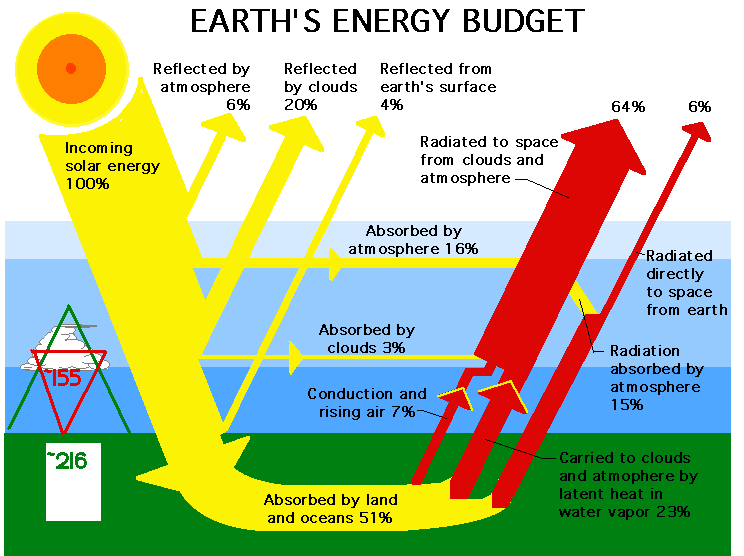
Update: This is the revised modification of the NASA Energy Budget Drawing, showing a better visualization of the atmospheric effect. The former did have an error.
For a combined flux flow, The sum of the flows is equal to 4(aFc+bFl+eFr)/T, for conductive, latent(convective) and radiative flux. where the source of the heat fluxes is a common temperature T.
For the coefficient a=alpha*heat flow coefficient of conduction in the media, b=alpha*heat flow coefficient of convection and e=alpha*media emissivity.
So this simple equation describes the combined flow of fluxes in a media with the different effects of the media on the individual flux.
Both aFc and bFl are limited by their media. aFc, decreases with distance as a function of the change in its media known commonly as resistance. aFl decreases with distance as a function of temperature. eFr decreases with distances as a function of the media's emissivity.
At the surface, three equal fluxes will result in warming of the media proportional to flux and heat flow coefficient. If 100Wm-2 of conductive flux leaves the surface it will decrease to zero at an altitude relative to the decrease in pressure with height. The conductive flux from a source with an initial T will decrease to zero at some temperature (T-4aFc/T), i.e., the conductive flux will transition to radiative flux, and be lost to space. As this flux transistions, energy is added to the system, which becomes either latent or radiant heat which in turn transition back to conductive, for conversation of energy, Latent heat absorbed at the surface rises with reduced local pressure, gaining and losing sensible heat and radiant heat until condensation, where that energy, known as the heat of evaporation is lost to the atmosphere as conductive and radiant heat. The latent heat can be regained with vaporization or lose more heat with the freezing known as the heat of fusion. Radiative flux resisted by the emissivity of the increases as the emissivity reduces and the radiant energy release of the conductive and convected increases. The combined fluxes at the surface equals the radiative flux at the top of the atmosphere.where the emissivity of space approaches unity. All of these interactions between the energy fluxes warm the atmosphere near the surface and cool it at the top.
Conductive flux warms the surface because of its resistance to flow, convective flux cools the surface by transporting absorbed energy from the surface to an altitude, Radiant flux warms the surface due to the initial high resistance and cools the atmosphere as emissivity decreases with respect to out and increases with respect to in or down. Work is being preformed on the system at varying locations at varying rates. The heat as a result of this warm, generates the atmospheric effect which is a heat source at a distance with a different coefficient of heat flux.
For conductive flux, the resistance to flow increases with altitude until all of the flux has transitioned into radiative flux, this point, which I will call the effective temperature and pressure of conduction, is located fairly low in the atmosphere. Latent heat is absorbed at the surface and transported via convection until the reduction in temperature precipitates all of the moisture. This point I will call, the effective temperature and pressure of convective heat. For radiant heat, the flux uniformly increases to a value equal to the total of all surface fluxes less the energy retained in the atmosphere as latent and sensible heats, potential energies. Once radiant heat reaches its maximum value, i.e. both conductive and convective have transitioned in to radiant flux, i will call this the effective temperature and pressure of radiant flux, approximately located the tropopause. So we have an atmosphere with three effective temperatures, conductive, convective and radiant at three different temperatures and pressures. The pressures correspond to altitudes.
The effective conductive temperature is equal to the dry adiabatic lapse rate and its effective temperature is the potential temperature of air at that altitude.
The effective temperature of latent is equal to the moist adiabatic lapse rate and located above the effective conductive temperature and pressure.
The effective temperature of radiant flux is at an altitude above the latent effective temperature and pressure. All of the three effective temperatures interact as each has a temperature and pressure different than the others. The net impact of the interaction of fluxes at equilibrium is that the total heat zthe atmosphere gained is equal to the potential temperature of conductive effective temperature and pressure, as can be determined by Poisson's equation.
Stage 2 Estimating the greenhouse down welling Flux
The simplest estimate is to determine the atmospheric impact on the individual flux values, by dividing the values by their respective coefficients, Fc=24/0.33=72.7, Fl=79/1.09=72 and the Fr component absorbed by the atmosphere 72-21=51/.825=61.8, the sum, 72.7+72+61.8=206.5. This estimate does not include the radiation absorbed in the atmosphere by the radiant energy through the atmospheric window.
The 21Wm-2 through the atmospheric window, while it does not transfer significant energy to the atmosphere, still experiences scattering and some attenuation due to the atmosphere, The estimated TOA emissivity of the atmosphere is ~0.61, so the surface equivalent source for the 21Wm-2 would be 21/0.61=34.4Wm-2.
When combined, 206.6+34.4=240Wm-2, the value of the radiation at the TOA. The radiative flux through the atmospheric window does not get a completely free pass. Water and ice in the atmosphere interact with portions of this radiation, so the true value of the down welling radiation would be between the 206 and 240 values. The radiation in the atmospheric window does interact with the atmosphere. Since the radiation window down is more opaque than up, only 39% is felt at the surface, 21*.39=8.8, so 206.5+8.8=215 Wm-2 is a more accurate estimate of the atmosphere effect in W/m-2.
If you consider the value provide by K&T, 321Wm-2, if it were applied at the top of the atmosphere, 321*.61 would equal 192.6, had K&T not miscalculated the amount of radiation absorb by the atmosphere, which is 51 per NASA and ~26per K&T, the value would be 192.6+25=217.6Wm-2.
If the logic is followable, one can see that the formula accurately predicts energy interactions in the atmosphere, even with approximated values for a, b and e, based on the NASA flux values. But is there any reason that the 216 range for DWLR should be used instead of 321 per K&T or the 155 common used in literature? Yes, because the atmospheric effect is based on a physical property, the adiabatic lapse rate. The work done by the competing upwelling and down welling fluxes it to maintain the potential energy of the atmosphere, it lapse rate. The conductive heat flux from the surface energizes the molecules in the atmosphere causing then to rise from the surface to a point where the force of gravity stops their accent. If the atmosphere collapsed the heat generate would equal the atmospheric effective temperature.
Ohms Law and Atmospheric Thermal Balance.
As I mentioned in the beginning, the conductive flux resistance is equal to the potential energy divided by the flux, similar to Ohms law, were V=IR. R,the conductive resistance of the atmosphere is equal to the potential 288-216 divided by thermal current or flux 24, 288-216/24=3. the coefficient for a in aFc =1/R=0.33 and I have not named that value. For bFl, Rl=(288-216)/79=0.91 b=1/Rl=1.097. For the radiative values, Rr=(288-216)/87=1.21 e=1/1.21=0.825. Why did I chose 87 when the NASA drawing shows 79? Because it appears to have a small error. 79 plus the portion of the radiation through the atmospheric window is the correct value, 87-79=8. Now of course this is all still numerology, or is it?
Greenhouse Down Welling Radiation and its Relationship to Potential Temperature.
The value of the DWLR is 216, which I can calculate an effective temperature for using the S-B equation of 248 degrees not using the 0.926 indicated in the S-B equation, that is include in the coefficients. If I calculate the potential temperature of this value using the dry adiabatic lapse rate to determine the approximate pressure, 273-248= degrees or -25 degrees at~ 600 mb the answer is 287.2, very close to the surface temperature of 288K Still Numerology?
The values for the coefficients a, b and e are estimated for the NASA drawing using the modified Flux field equation. They are close, but not exact and they are also variable as each is dependent on the others. Hopefully this little exercise shows that there is some value in the equation and that 216 is a very reasonable estimate for DWLR with physical meaning pertinent to understanding out atmosphere.
Update: http://en.wikipedia.org/wiki/Relativistic_heat_conduction
So why is a simple equation that works not used? I'll never know. Perhaps it is just better science to over complicate things. That's why there are so many engineers that are skeptical.
Please Note that this is consuming too much of my time, donation would be greatly appreciate in the tip jar. An a proof reader to clean up my poor attempt desperately needed.
Subscribe to:
Posts (Atom)