First, I do have a life of sorts. My trip today was postponed, but I have been shopping, went to the laundry, hung out at the dock with buddies, went to a meeting and done a few other things today. I am fascinated with the goings on in Japan, so I have been digging up stuff instead of watching the tube.
The radiation map thing and its thinly veiled allegation that there is a Japanese government cover up going on, has been on my mind. I found plenty of data on radiation readings including fallout for Iodine (I 131) and Cesium (Cs 137). The readings are of course in new units which means more calculations to see what they mean.
These two radioactive Isotopes have half lives, I 131 is 8 days and Cs 137 is 30.17 years, per wikipedia. Cs 137 is the nastier of the two. This link has the fallout readings for most of Japan, but is not complete for two prefectures because of limited access following the Earthquake.
Ibaraki has the highest fallout with 85,000 I 131 and 12,000 Cs 137 recorded as MBq/KM2. A MBq is MegaBecquerel and KM2 is kilometers squared. The IAEA report is in meters squared, so one KM2 is equal to 1,000,000 M2. That makes the conversion easy since MBq/KM2 is equal to Bq/M2. But, the IAEA report is in MBq/M2, so we have to divide the 12,000 by a million which is 0.012 MBq/M2.
So for the nasty Cs 137, the fallout is 0.012 Bq/M2. There is also I 131 which would be 0.08 MBq/M2 for at total of about 0.1 MBq for simplicity. Now what does that mean? A Bq is one pop or nucleus decay per second. That really does not mean a lot until it is converted to Severts, damaging absorbed radiation. Since I was not there when the IAEA guys did the test, I will ratio the high reading in the report 160 microseverts and 0.9 MBq/M2 to get about 17 microseverts/hr per meter squared.
Now if that wasn't complicated enough, I 131 has a half life of 8 days, so every 8 days the pops drop by half. 80,000 today, 40,000 in 8 days, 20,000 in 16 days and 10,000 in 24 days. So in a couple months, only Cs 137 is really a concern. Then the fallout radiation drops to 1.7 microseverts per hour. That would be 14,900 microseverts per year. Unless you happen to be a Brazilian airline pilot, that is high (see the chart and radiation readings on this link for Ibaraki.)
That was simple enough, but wait! There is more! From Wikipedia, "Health officials have predicted that over the next 70 years there will be a 2% increase in cancer rates in much of the population which was exposed to the 5–12 EBq (depending on source) of radioactive contamination released from the reactor." (Re: Chernobyl). So what the hell is an EBq? That is an exabecquerel which is 10e18 Becquerel or 1,000,000 MBq! So if there is a 2% increase in cancer rates for 12,000,000 MBq, what is the increase for 0.1 MBq/M2? Don't know. It don't work like a linear relationship. That is why we underpay the scientist types and have to trust our governments. I doubt that anyone on CNN, FOX or the BBC has a clue either! I wouldn't drink any milk or eat any leafy green veggies from that area until next year. Once the rain washes the Cs 137 into the soil, things will be different. Stay tuned!
Tuesday, March 22, 2011

More Main Stream Media Fun
Luckily, lawyers can find work as weather experts.
They are thinking about changing the name to Club Meltdown. Oh, let's not forget Sky News.
So How is the World Press Doing?
I have beat on trustworthiness and clearly communicated information needed for people in any disaster to make informed decisions. Several Japanese media outlets have expressed some aggravation at the way the foreign press has fanned the flames of fear with sensationalized and inaccurate reporting.
From the Japan Times:
" According to another "fact," authorities have been warning those in a position to leave Tokyo to flee the city immediately, because another severe quake or an eruption at Mount Fuji could spark a meltdown at the "Shibuya Eggman nuclear reactor" — which in reality is a live house, or concert hall, in Tokyo."
And from the Japan Probe"
"Hikaru added: ‘There is a lot of anger in Japan against the French. We are not particularly close to that country and their officials have been coming out very publicly and accusing the Japanese of mishandling the power-plant disaster.
‘How dare the French attack us when they are always the first to collapse and run away at the first sign of any trouble?’"
And recently on all the major US main stream media outlets there has been the report of radiation levels 1600 times normal 12 miles away from Fukushima. The International Atomic Energy Agency report did indeed state that measured level of combination beta/gamma radiation was measured at level of 2 to 161 microseverts per hour compared to a background radiation of 0.1 microseverts per hour. That is a high dose rate. It is cause for concern. It is not a cause for panic.
For emergency workers at the plant, 100,000 microseverts (100 milliseverts) is the maximum dosage recommended before they are removed from the site for precautionary treatment with stable iodine for example. Younger people who would be more susceptible to radiation exposure should closely monitor reliable official announcements to find if they should evacuate the area and where would be best to relocate. If that level is sustained, those evacuation notices will be announced. At the maximum tested radiation rate, residents would have nearly 13 days to determine where and if they need to relocate before they were exposed to one half the limit of plant emergency workers. That has not been reported in the press, nor has that the readings will be monitored to see if they are sustained or a short term spike that may not require any action.
The press has made note of past situations where the electrical utility company TEPCO, has been reprimanded for failures to perform various tests of equipment. The press has not to my knowledge made attempts to determine the degree of the issues nor any corrective action taken on the dated irregularities.
The US announcement that US citizens should be evacuate from a 50 mile radius of the incident has also been sensationalized. Evacuation of non-essential personnel from an emergency area is common practice. Staged evacuation greatly simplifies the overall evacuation should it be required.
The Japanese people are industrious and intelligent. They have a reliable government worthy of trust in this situation to do the right thing. Under the extremely difficult conditions they are doing an admirable job which should have much more focus in the foreign press.
Just my thoughts.
From the Japan Times:
" According to another "fact," authorities have been warning those in a position to leave Tokyo to flee the city immediately, because another severe quake or an eruption at Mount Fuji could spark a meltdown at the "Shibuya Eggman nuclear reactor" — which in reality is a live house, or concert hall, in Tokyo."
And from the Japan Probe"
"Hikaru added: ‘There is a lot of anger in Japan against the French. We are not particularly close to that country and their officials have been coming out very publicly and accusing the Japanese of mishandling the power-plant disaster.
‘How dare the French attack us when they are always the first to collapse and run away at the first sign of any trouble?’"
And recently on all the major US main stream media outlets there has been the report of radiation levels 1600 times normal 12 miles away from Fukushima. The International Atomic Energy Agency report did indeed state that measured level of combination beta/gamma radiation was measured at level of 2 to 161 microseverts per hour compared to a background radiation of 0.1 microseverts per hour. That is a high dose rate. It is cause for concern. It is not a cause for panic.
For emergency workers at the plant, 100,000 microseverts (100 milliseverts) is the maximum dosage recommended before they are removed from the site for precautionary treatment with stable iodine for example. Younger people who would be more susceptible to radiation exposure should closely monitor reliable official announcements to find if they should evacuate the area and where would be best to relocate. If that level is sustained, those evacuation notices will be announced. At the maximum tested radiation rate, residents would have nearly 13 days to determine where and if they need to relocate before they were exposed to one half the limit of plant emergency workers. That has not been reported in the press, nor has that the readings will be monitored to see if they are sustained or a short term spike that may not require any action.
The press has made note of past situations where the electrical utility company TEPCO, has been reprimanded for failures to perform various tests of equipment. The press has not to my knowledge made attempts to determine the degree of the issues nor any corrective action taken on the dated irregularities.
The US announcement that US citizens should be evacuate from a 50 mile radius of the incident has also been sensationalized. Evacuation of non-essential personnel from an emergency area is common practice. Staged evacuation greatly simplifies the overall evacuation should it be required.
The Japanese people are industrious and intelligent. They have a reliable government worthy of trust in this situation to do the right thing. Under the extremely difficult conditions they are doing an admirable job which should have much more focus in the foreign press.
Just my thoughts.
Monday, March 21, 2011
More on Radiation Dosage
I just borrowed a neat radiation dosage chart that has just about everything you ever wanted to know about radiation on it. One problem, to read the chart I have to write some nonsense to get the chart below the advertising junk that no one cares about. So I am going to insert some line breaks to get that crap out of the way.
I will also stick a silly picture in to fill the gap. The Blues Brothers imitators, they were good by the way.
This is a link for the current radiation doses in areas of Japan. The readings are in nGy/h or nanograys per hour. One microrad (10e-6) equals 10 nanograys. So 0.1 rads equals on gray. The conversion to Severt depends on the type of radiation, but 1 Severt is approximately equal to 100 rems. Or if you like, 1 nanogray per hour is approximately equal to 0.001 microseverts per hour. Hmm? I wonder if the map make is anti-nuke?

Original link for this image xkcd.com
Xkcd.com is a very neat site you should visit. It has some great cartoons. They recently posted this chart of radiation doses that has been found at several blogs I have visited. Please visit their site often so the don't think I am some kind of graphics stealer, which I am in this case, but I am trying very hard to not tick them off too much. This is though about the coolest radiation chart I have ever seen!
I will also stick a silly picture in to fill the gap. The Blues Brothers imitators, they were good by the way.

This is a link for the current radiation doses in areas of Japan. The readings are in nGy/h or nanograys per hour. One microrad (10e-6) equals 10 nanograys. So 0.1 rads equals on gray. The conversion to Severt depends on the type of radiation, but 1 Severt is approximately equal to 100 rems. Or if you like, 1 nanogray per hour is approximately equal to 0.001 microseverts per hour. Hmm? I wonder if the map make is anti-nuke?
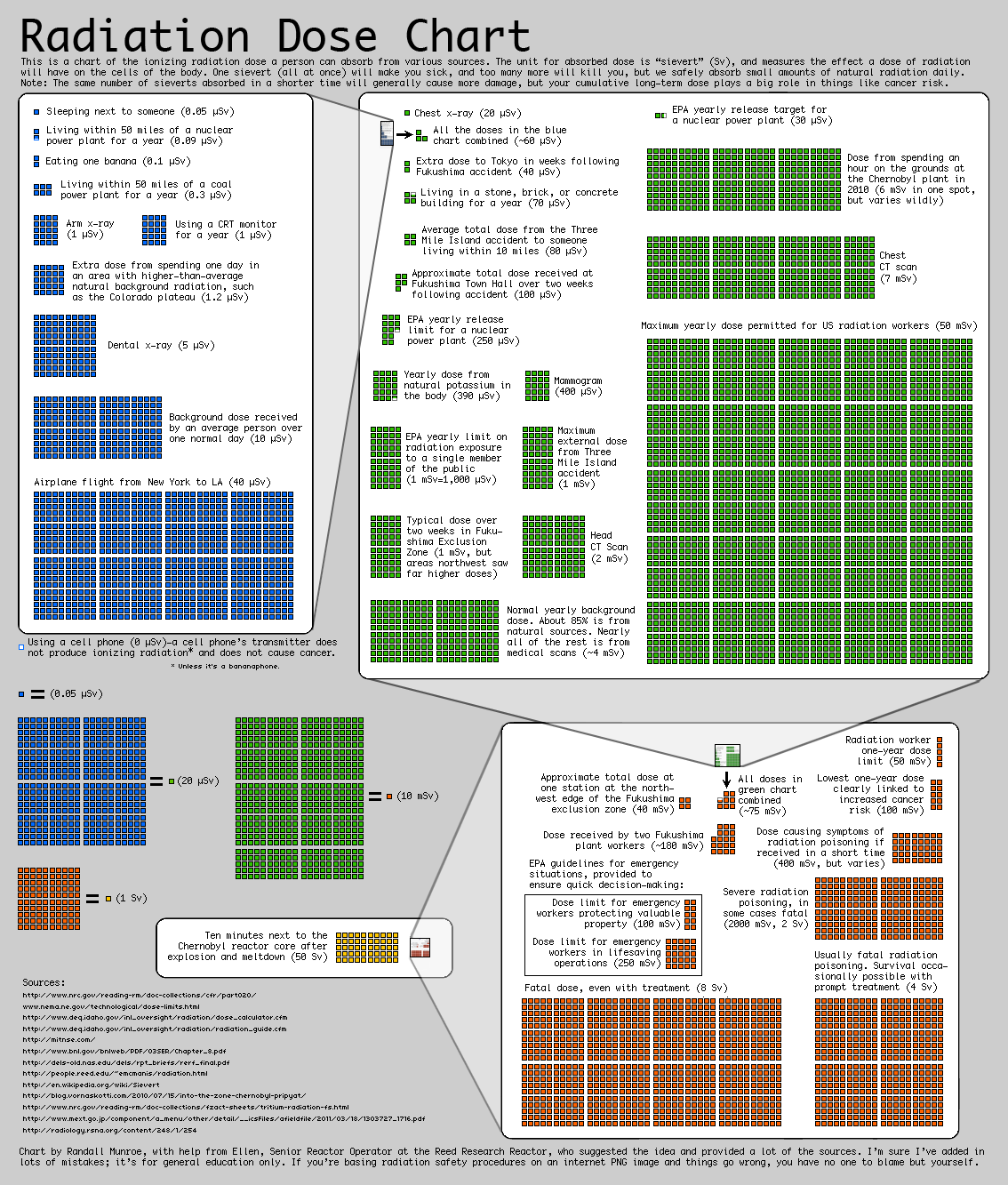
Original link for this image xkcd.com
Xkcd.com is a very neat site you should visit. It has some great cartoons. They recently posted this chart of radiation doses that has been found at several blogs I have visited. Please visit their site often so the don't think I am some kind of graphics stealer, which I am in this case, but I am trying very hard to not tick them off too much. This is though about the coolest radiation chart I have ever seen!
A Renewed Interest in Pool-Type Reactors?
One man's trash is another man's treasure. Pool-type reactors are used in training and in rare cases, hot water production. Spent Fuel Storage Pools (SFSP) are not pool-type reactors because the storage racks and boric acid added to the water are used to prevent reaction. The Chinese are looking to use SFSP's as a solution to their nuclear waste storage issues.
Light water reactors create neutron poisons, isotopes that capture neutrons limiting the chain reaction in the reactor. This one of the safety factors of LWR technology and one of the problems with LWR technology, it generates more waste that has to be reprocessed or stored. Nuclear non-proliferation places limits on reprocessing in the United States that helps increase the waste storage problem. Most nuclear wast is not really waste it is wasted energy because of political issues.
Spent fuel still generate decay heat and can still sustain a less efficient chain reaction. The Chinese idea is to use the energy in the spent fuel as it decays for producing heating hot water for use in district heating and desalination plants. Spent fuel ponds can also be used for hydrogen production.
The boric acid added to the SFSP increases the production of hydrogen from near zero for pure water to usable quantities as the percentage of boric acid increases. Different impurities can be added to the water to increase hydrogen production.
Eventually, spent fuel will either be reprocessed into new fuel or added to Generation IV reactors for more complete burn up. Until then, spent fuel trash may be a treasure.
Light water reactors create neutron poisons, isotopes that capture neutrons limiting the chain reaction in the reactor. This one of the safety factors of LWR technology and one of the problems with LWR technology, it generates more waste that has to be reprocessed or stored. Nuclear non-proliferation places limits on reprocessing in the United States that helps increase the waste storage problem. Most nuclear wast is not really waste it is wasted energy because of political issues.
Spent fuel still generate decay heat and can still sustain a less efficient chain reaction. The Chinese idea is to use the energy in the spent fuel as it decays for producing heating hot water for use in district heating and desalination plants. Spent fuel ponds can also be used for hydrogen production.
The boric acid added to the SFSP increases the production of hydrogen from near zero for pure water to usable quantities as the percentage of boric acid increases. Different impurities can be added to the water to increase hydrogen production.
Eventually, spent fuel will either be reprocessed into new fuel or added to Generation IV reactors for more complete burn up. Until then, spent fuel trash may be a treasure.
Sunday, March 20, 2011
Concerns for US Nuclear Power Post Fukushima
The Fukushima events have reveled a number legitimate questions about the safety of nuclear power in the United States. A thorough review of the safety here at home is warranted and has commenced. While I am a no body, here are my major concerns.
1. Pressure relief venting. The design of the GE Mark I initially allowed for venting into the exterior containment buildings. A recommended modification to reroute relief pressure in excess of the suppression pool capacity was proposed by GE which appears to not have been implemented in the Fukushima case, which caused the explosions damaging several buildings and also appears to have caused damage to one of the reactor main containment suppression pool structure.
2. Spent Fuel Storage Pool design may have cause greater than expected release of radiation. One of the primary reasons appears to be the design of the SFSP weir gate allowing more water leakage than expected or make up water loss for greater than expected duration. Make up water is a critical consideration that appears to have been compromised.
3. The design of the racks used in the SFSP and the spent fuel loading configuration needs to be verified. While considered an unlikely possibility, oxidation of the spent fuel rod cladding can occur and possibly spread if adequate dry pool passive ventilation is not available. Tests for the exact conditions at Fukushima have never been analyzed, only worst cases of totally dry pool conditions. The situation provides a unique opportunity to study mid-range situations assumed to be less critical than worst cases situations.
4. Due to tsunami destruction, offsite response equipment was greatly delayed and onsite equipment damage greater than expected. Availability of offsite equipment was reduced by the massive destruction caused by the combination earthquake and tsunami. Assigning proper priority of available equipment to the degree of risk appears to have been in question. Emergency response planning needs to be reviewed.
Those are the major considerations. "Real" risk in terms of released radiation needs to be clarified. Decisions by the plant control operators appear to have been influenced by less likely risks to the public resulting in greater overall risk. Plant designs allow for human error, but impact of human error can be reduced through better training.
1. Pressure relief venting. The design of the GE Mark I initially allowed for venting into the exterior containment buildings. A recommended modification to reroute relief pressure in excess of the suppression pool capacity was proposed by GE which appears to not have been implemented in the Fukushima case, which caused the explosions damaging several buildings and also appears to have caused damage to one of the reactor main containment suppression pool structure.
2. Spent Fuel Storage Pool design may have cause greater than expected release of radiation. One of the primary reasons appears to be the design of the SFSP weir gate allowing more water leakage than expected or make up water loss for greater than expected duration. Make up water is a critical consideration that appears to have been compromised.
3. The design of the racks used in the SFSP and the spent fuel loading configuration needs to be verified. While considered an unlikely possibility, oxidation of the spent fuel rod cladding can occur and possibly spread if adequate dry pool passive ventilation is not available. Tests for the exact conditions at Fukushima have never been analyzed, only worst cases of totally dry pool conditions. The situation provides a unique opportunity to study mid-range situations assumed to be less critical than worst cases situations.
4. Due to tsunami destruction, offsite response equipment was greatly delayed and onsite equipment damage greater than expected. Availability of offsite equipment was reduced by the massive destruction caused by the combination earthquake and tsunami. Assigning proper priority of available equipment to the degree of risk appears to have been in question. Emergency response planning needs to be reviewed.
Those are the major considerations. "Real" risk in terms of released radiation needs to be clarified. Decisions by the plant control operators appear to have been influenced by less likely risks to the public resulting in greater overall risk. Plant designs allow for human error, but impact of human error can be reduced through better training.
Saturday, March 19, 2011
What Nuclear Power Designs Should be in Our Future?
With the Fukushima crisis a number of question arise of what kind and if nuclear energy should be in our future.
If, is a decision for the public. Nuclear agencies are tasked with safety standards that make the nuclear industry designs and procedures predict a huge variety of combinations of potential events and responses to those events. Public perception of the competence of these agencies to do that job is very important when making that decision. In our democracy, the opinion of all individuals is considered and open for the public to review.
A number of opinions on the safety of design aspects of nuclear plant design, spent fuel storage and other elements have been raised that the NRC has addressed which are now open to more rigorous review. I want to touch on a few of those before discussing my view on plant design.
First is partial melt down. Melt down is not a very good term in my opinion. Fuel damage is more accurate. The first and second levels of containment are fuel (pellets in this case) and the cladding that houses the fuel pellets. The cladding is made of a material call zircaloy. It is a zirconium metal alloy that has different material properties than the fuel pellets. Zircaloy has a melting point of ~1820 degrees C that is lower than the melting point of the fuel, oxides of uranium and in one case Plutonium in Mixed Oxide (MOX), which is ~2700 degrees C (http://www.ornl.gov/~webworks/cpr/v823/rpt/109264.pdf). Zircaloy can also burn at temperatures between (Correction)1000 900 C and 1200 C, depending on several factors. The fuel rod(s) are damaged at a temperature much lower than that of the fuel. Reactors are designed for worst case scenarios. This worst case is where the reaction was not stopped by the control rods and cooling was lost. A complete melt of the fuel is assumed in this case and the third level of containment, the reactor pressure vessel, and fourth level, the reactor containment building are designed based on this situation.
From the NTC Design requirements:
"Criterion 50--Containment design basis. The reactor containment structure, including access openings, penetrations, and the containment heat removal system shall be designed so that the containment structure and its internal compartments can accommodate, without exceeding the design leakage rate and with sufficient margin, the calculated pressure and temperature conditions resulting from any loss-of-coolant accident. This margin shall reflect consideration of (1) the effects of potential energy sources which have not been included in the determination of the peak conditions, such as energy in steam generators and as required by § 50.44 energy from metal-water and other chemical reactions that may result from degradation but not total failure of emergency core cooling functioning, (2) the limited experience and experimental data available for defining accident phenomena and containment responses, and (3) the conservatism of the calculational model and input parameters."
The bold section can be interpreted as not considering a total cooling loss which should be reviewed. I have a request for clarification from the designer, General Electric, for the design as modified in Fukushima. One design modification I would recommend relates to the proper handling of the steam produced by loss of cooling. The Fukushima Mark I design has a pressure suppression system that condensates relief steam in the suppression pool within the containment building. An external condensation pool recommended by the original designer should be considered in all installations. Improperly timed and diverted steam relief appears to have contributed to the current difficulties in Fukushima.
Second, the design of the Spent Fuel Storage Pools should allow for total loss of mechanical cooling including total loss of water in the pool. Questions of the possibility of renewed criticality and Zircaloy cladding fire potential in the SFSP has been raised. I have reviewed SFSP designs which appear to be adequate with reasonable increase in radioactive material release anticipated for the short term. If the pools are dry, that greatly complicates regaining control of the SFSP radiation levels. In a passive air cooling situation, the spent fuel will become hotter than the boiling point of water. Adding water will produce steam which will carry radiation out of the pool. Some believe that this may also contribute to cladding oxidation and hydrogen production. Recovery from a dry SFSP is not clearly addressed in the literature I have located so far. In a loss of cooling, make up water is designed to maintain radiation containment. The original design allows for boiling of the water in the pool with maximum decay heat. In general situations, the total decay heat of a normal SFSP spent fuel load would warm the water causing increased surface evaporation but not boiling. (As stated by a TEPCO representative.) The make up water should be provided by hard piped make up water systems. Should that system fail, water from tankers or other emergency back up sources can be provided. I have requested more information from the manufacturer better explain design considerations for this worst case scenario.
Added: I don't want the link police after me so here, http://www.osti.gov/bridge/purl.cover.jsp?purl=/6135335-5voofL/
Speaking of link police, I made a comment on another blog that the SFSP do not need cooling. They of course attacked me as an uniformed idiot. Well, SFSP's do not require mechanical cooling, evaporation provides all the cooling they need for safety (The water could boil, so that is a safety risk if you are around the pool). They do require make up water. A hot SFSP can go about 4 days with no cooling and no make up water. A hot pool is one with all fresh rods with less than 96 days of decay. The pool at Fukushima number unit 4 was hotter (deecay heat wise) than the rest but far from a "hot" pool
Small modular reactors like Nuscale modular designs, better address fuel damage which is both an important economic and public health consideration that needs to be considered in future nuclear power plants. The spent fuel storage issue, both SFSP and dry cask storage, is an important issue to be considered before nuclear power in the United States is expanded.
While I have determined that these issues are adequately addressed (contingent on expanded Dry Cask Storage), they are concerns worthy of much more intense scrutiny. I will try to provide more information on the important and complex issue of worst case nuclear power plant design and waste storage.
Small Modular Designs (SMR) include a variety reactor technologies. Light Water Reactor design is the basis for the Nuscale modulars which appears to be more likely available for near term deployment. In my opinion, their design is very similar to US Navy Designs which have a proven safety and reliability record. There are people that disagree and would prefer to wait for the increased safety of Generation IV designs. I totally agree that Generation IV designs, especially Molten Salt Reactors, are inherently safer, but the current generation of reactor designs offer adequate safety for responsible expansion of nuclear power. I will try to get an opposing view to expand the quality of the discussion.
If, is a decision for the public. Nuclear agencies are tasked with safety standards that make the nuclear industry designs and procedures predict a huge variety of combinations of potential events and responses to those events. Public perception of the competence of these agencies to do that job is very important when making that decision. In our democracy, the opinion of all individuals is considered and open for the public to review.
A number of opinions on the safety of design aspects of nuclear plant design, spent fuel storage and other elements have been raised that the NRC has addressed which are now open to more rigorous review. I want to touch on a few of those before discussing my view on plant design.
First is partial melt down. Melt down is not a very good term in my opinion. Fuel damage is more accurate. The first and second levels of containment are fuel (pellets in this case) and the cladding that houses the fuel pellets. The cladding is made of a material call zircaloy. It is a zirconium metal alloy that has different material properties than the fuel pellets. Zircaloy has a melting point of ~1820 degrees C that is lower than the melting point of the fuel, oxides of uranium and in one case Plutonium in Mixed Oxide (MOX), which is ~2700 degrees C (http://www.ornl.gov/~webworks/cpr/v823/rpt/109264.pdf). Zircaloy can also burn at temperatures between (Correction)
From the NTC Design requirements:
"Criterion 50--Containment design basis. The reactor containment structure, including access openings, penetrations, and the containment heat removal system shall be designed so that the containment structure and its internal compartments can accommodate, without exceeding the design leakage rate and with sufficient margin, the calculated pressure and temperature conditions resulting from any loss-of-coolant accident. This margin shall reflect consideration of (1) the effects of potential energy sources which have not been included in the determination of the peak conditions, such as energy in steam generators and as required by § 50.44 energy from metal-water and other chemical reactions that may result from degradation but not total failure of emergency core cooling functioning, (2) the limited experience and experimental data available for defining accident phenomena and containment responses, and (3) the conservatism of the calculational model and input parameters."
The bold section can be interpreted as not considering a total cooling loss which should be reviewed. I have a request for clarification from the designer, General Electric, for the design as modified in Fukushima. One design modification I would recommend relates to the proper handling of the steam produced by loss of cooling. The Fukushima Mark I design has a pressure suppression system that condensates relief steam in the suppression pool within the containment building. An external condensation pool recommended by the original designer should be considered in all installations. Improperly timed and diverted steam relief appears to have contributed to the current difficulties in Fukushima.
Second, the design of the Spent Fuel Storage Pools should allow for total loss of mechanical cooling including total loss of water in the pool. Questions of the possibility of renewed criticality and Zircaloy cladding fire potential in the SFSP has been raised. I have reviewed SFSP designs which appear to be adequate with reasonable increase in radioactive material release anticipated for the short term. If the pools are dry, that greatly complicates regaining control of the SFSP radiation levels. In a passive air cooling situation, the spent fuel will become hotter than the boiling point of water. Adding water will produce steam which will carry radiation out of the pool. Some believe that this may also contribute to cladding oxidation and hydrogen production. Recovery from a dry SFSP is not clearly addressed in the literature I have located so far. In a loss of cooling, make up water is designed to maintain radiation containment. The original design allows for boiling of the water in the pool with maximum decay heat. In general situations, the total decay heat of a normal SFSP spent fuel load would warm the water causing increased surface evaporation but not boiling. (As stated by a TEPCO representative.) The make up water should be provided by hard piped make up water systems. Should that system fail, water from tankers or other emergency back up sources can be provided. I have requested more information from the manufacturer better explain design considerations for this worst case scenario.
Added: I don't want the link police after me so here, http://www.osti.gov/bridge/purl.cover.jsp?purl=/6135335-5voofL/
Speaking of link police, I made a comment on another blog that the SFSP do not need cooling. They of course attacked me as an uniformed idiot. Well, SFSP's do not require mechanical cooling, evaporation provides all the cooling they need for safety (The water could boil, so that is a safety risk if you are around the pool). They do require make up water. A hot SFSP can go about 4 days with no cooling and no make up water. A hot pool is one with all fresh rods with less than 96 days of decay. The pool at Fukushima number unit 4 was hotter (deecay heat wise) than the rest but far from a "hot" pool
Small modular reactors like Nuscale modular designs, better address fuel damage which is both an important economic and public health consideration that needs to be considered in future nuclear power plants. The spent fuel storage issue, both SFSP and dry cask storage, is an important issue to be considered before nuclear power in the United States is expanded.
While I have determined that these issues are adequately addressed (contingent on expanded Dry Cask Storage), they are concerns worthy of much more intense scrutiny. I will try to provide more information on the important and complex issue of worst case nuclear power plant design and waste storage.
Small Modular Designs (SMR) include a variety reactor technologies. Light Water Reactor design is the basis for the Nuscale modulars which appears to be more likely available for near term deployment. In my opinion, their design is very similar to US Navy Designs which have a proven safety and reliability record. There are people that disagree and would prefer to wait for the increased safety of Generation IV designs. I totally agree that Generation IV designs, especially Molten Salt Reactors, are inherently safer, but the current generation of reactor designs offer adequate safety for responsible expansion of nuclear power. I will try to get an opposing view to expand the quality of the discussion.
Subscribe to:
Posts (Atom)